Sandro Botticelli
1445-1510
Sandro Botticelli, a renowned Italian painter of the Early Renaissance, is best known for his captivating mythological and religious works that epitomize the linear grace of late Italian Gothic and Early Renaissance painting.
Origins
Born in 1445 in Florence, Italy, Sandro Botticelli grew up in the Ognissanti neighborhood, where he lived and worked for most of his life. His father, Mariano di Vanni d'Amedeo Filipepi, was a tanner who later became a gold-beater. Botticelli's artistic training began under Fra Filippo Lippi, one of the leading Florentine painters and a favorite of the Medici family. This early training had a profound impact on Botticelli's style, which would come to be characterized by intimate compositions with beautiful, melancholic figures drawn with clear contours and subtle contrasts of light and shadow.
Life and turning points
Botticelli's career spanned several decades, during which he received patronage from prominent figures, including the Medici family. His early works, such as the 'Adoration of the Magi' (c. 1475-76), showcase his growing reputation as an artist. In 1481, Botticelli was summoned to Rome to fresco the walls of the Sistine Chapel, a project that further solidified his position as a leading artist of his time. Despite his success, Botticelli's style became more personal and, to some extent, mannered in his later works. He continued to work in Florence until his death in 1510.
Style and technique
Botticelli's paintings are renowned for their elegant and naturalistic depictions of the human form. His use of clear contours and subtle shading created a sense of depth and volume in his works. Botticelli's style, which blended elements of late Italian Gothic and Early Renaissance painting, was characterized by a sense of lyricism and poetry. His most famous works, such as 'The Birth of Venus' and 'Primavera', showcase his mastery of composition and his ability to convey complex emotions through his figures.
Stories and anecdotes
One of the most intriguing anecdotes about Botticelli concerns his fresco in the Palazzo Vecchio, which depicted the execution of the leaders of the Pazzi conspiracy. This work, unfortunately, was destroyed after the expulsion of the Medici family. Botticelli was also known for his sense of humor, as evidenced by the practical jokes he included in his works, such as the scribbles in the open book above Saint Augustine in his fresco of the saint.
Legacy
Botticelli's legacy as an artist was not fully appreciated until the late 19th century, when he was rediscovered by the Pre-Raphaelites. Today, his paintings are considered some of the greatest works of the Early Renaissance. Botticelli's influence can be seen in the work of many later artists, including Raphael and Michelangelo. His paintings continue to captivate art lovers with their beauty, elegance, and emotional depth.
Có thể bạn chưa biết
- Did you know that Botticelli's nickname, 'Botticelli,' meaning 'little barrel,' was derived from his brother's nickname, 'Botticello'?
- Did you know that Botticelli lived and worked in the same house in Florence for most of his life?
- Did you know that Botticelli's only signed and dated work is the 'Mystic Nativity' (1501), now in the National Gallery in London?
- Did you know that Botticelli's paintings often featured portraits of prominent figures, including members of the Medici family?
Thời kỳ Phục hưng sớm · Thượng Phục Hưng
Họa sĩ liên quan
Leonardo da Vinci · Tiziano Vecelli · Albrecht Dürer
Tranh của Sandro Botticelli
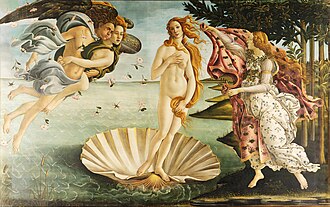 Sự ra đời của thần Vệ Nữ - Sandro Botticelli (c. 1485)
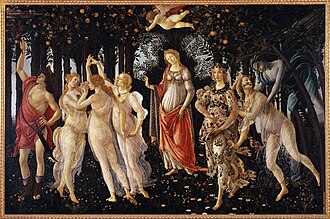 Primavera - Sandro Botticelli (1480s)
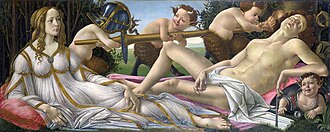 Venus and Mars - Sandro Botticelli (1485)
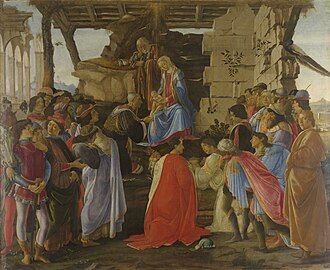 Adoration of the Magi - Sandro Botticelli (1470s)
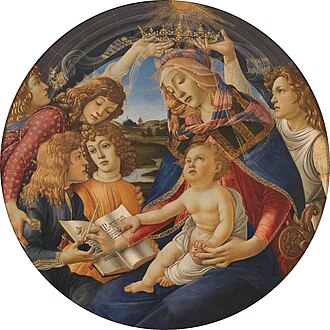 Madonna of the Magnificat - Sandro Botticelli (1481)
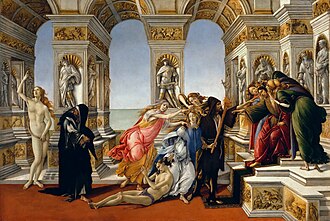 Calumny of Apelles - Sandro Botticelli (1490s)
.jpg) Pallas and the Centaur - Sandro Botticelli (1482)
Pallas and the Centaur - Sandro Botticelli (1482)%20-%20Google%20Art%20Project.jpg) Idealized Portrait of a Lady - Sandro Botticelli (1480)
Idealized Portrait of a Lady - Sandro Botticelli (1480)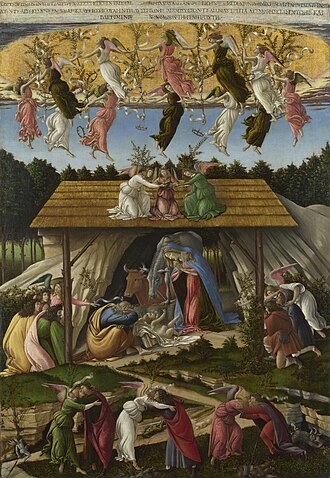 The Mystical Nativity - Sandro Botticelli (1500)
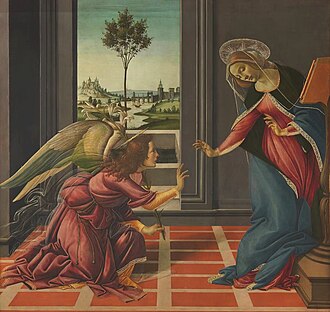 Cestello Annunciation - Sandro Botticelli
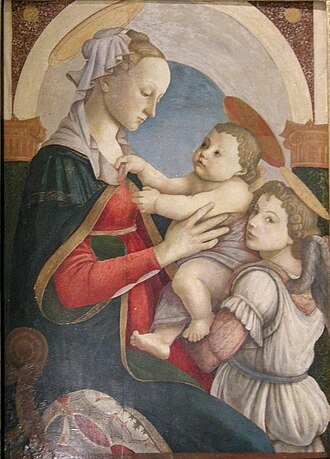 Madonna and Child with an Angel - Sandro Botticelli (1465)
.jpg) Portrait of a Man with a Medal of Cosimo the Elder - Sandro Botticelli (1474)
Portrait of a Man with a Medal of Cosimo the Elder - Sandro Botticelli (1474)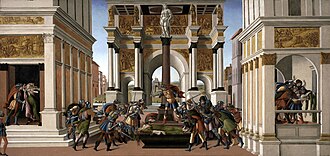 The Story of Lucretia - Sandro Botticelli (1500)
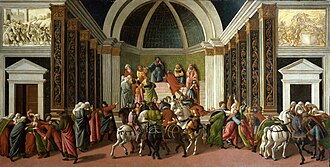 The Story of Virginia - Sandro Botticelli (1505)
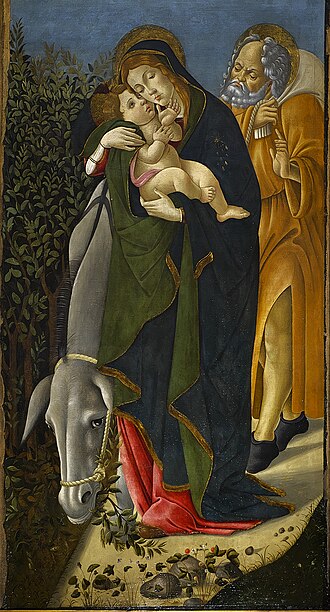 The Flight into Egypt - Sandro Botticelli (1510)