Nhà thờ Auvers
Vincent van Gogh · 1890
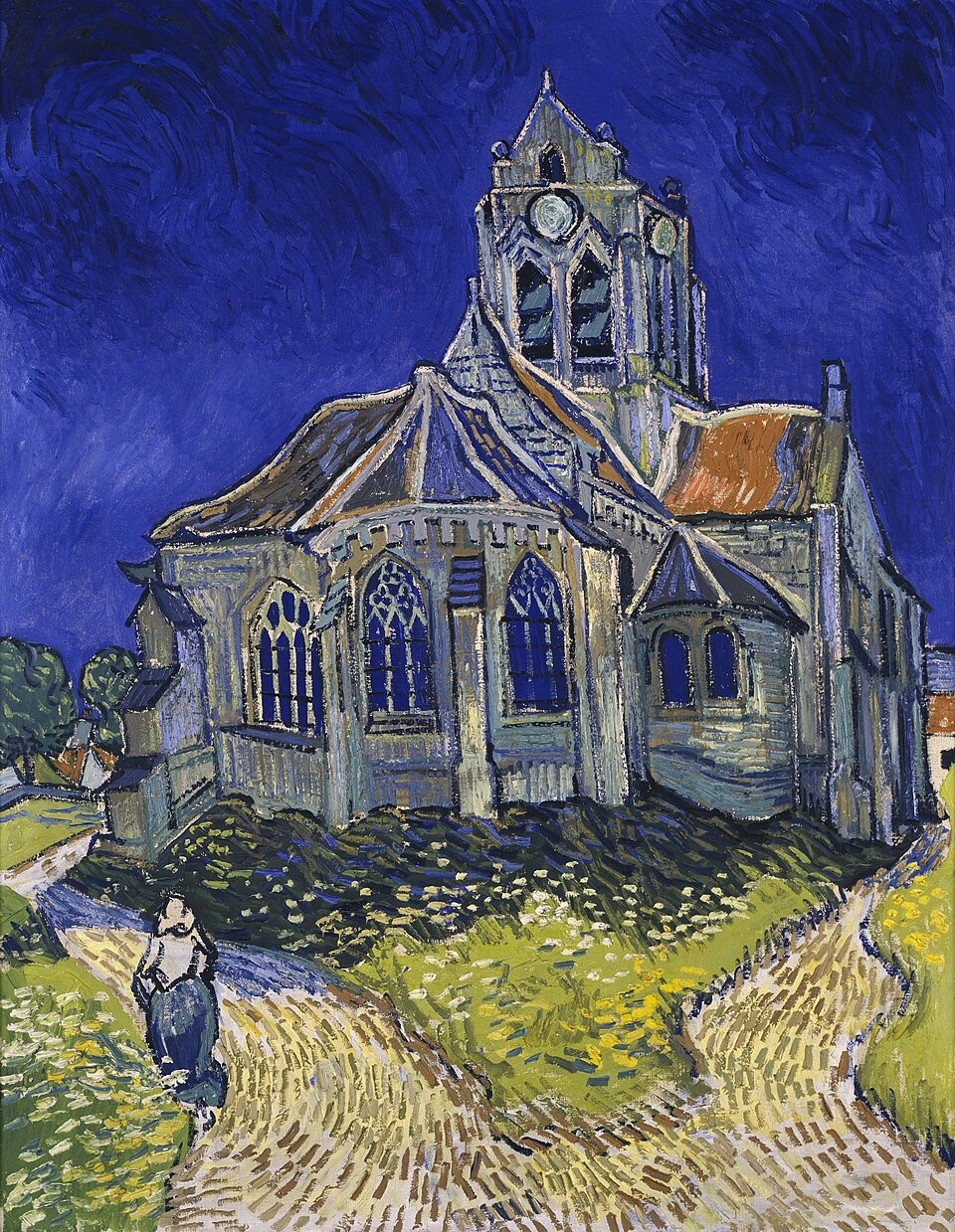
A poignant and powerful painting created in the final months of the artist's life, The Church at Auvers is a testament to Vincent van Gogh's innovative style and emotional depth.
The story behind the painting
In June 1890, Vincent van Gogh painted The Church at Auvers, a beautiful and evocative work that captures the essence of the village church in Auvers-sur-Oise, France. At the time, Van Gogh was living in Auvers-sur-Oise, where he had moved to be near his brother Theo and under the care of Dr. Paul Gachet. The painting is reminiscent of his earlier work in Nuenen, and he wrote to his sister Wilhelmina about the church's 'violet-hued' building against a 'simple deep blue' sky. This was one of the last paintings Van Gogh completed before his death on July 29, 1890.
What to look for
The Church at Auvers is a masterful example of Van Gogh's post-impressionist style. The church itself is depicted in shades of gray and blue, with a striking contrast between the building's cool tones and the vibrant blue of the sky. The foreground is brightly lit, with a woman walking along a path lined with flowers and grass. The brushwork is bold and expressive, with thick, textured strokes that give the painting a sense of energy and movement. Look for the way the light falls on the church, casting a sense of shadow and depth.
Meaning and intent
The Church at Auvers is often seen as a symbol of Van Gogh's nostalgia for the north and his feelings of melancholy and introspection. The church itself may represent a sense of tradition and community, while the diverging paths in the foreground may suggest a sense of choice or uncertainty. Van Gogh's use of color and light creates a sense of atmosphere and mood, drawing the viewer into the world of the painting. As he wrote to his sister, the painting was an attempt to capture the essence of the village and its church, and to convey a sense of beauty and emotion.
Legacy
The Church at Auvers is now part of the collection at the Musée d'Orsay in Paris, where it remains one of Van Gogh's most famous and beloved works. The painting has had a lasting impact on the development of modern art, influencing generations of artists and art lovers. Today, it is recognized as a masterpiece of post-impressionism, and a testament to Van Gogh's innovative style and emotional depth.
Có thể bạn chưa biết
- The Church at Auvers was painted in June 1890.
- The painting measures 94 × 74 cm.
- It is part of the collection at the Musée d'Orsay in Paris.
- The church depicted in the painting is the Église Notre-Dame-de-l'Assomption in Auvers-sur-Oise, France.
Wikipedia · Wikipedia - Vincent van Gogh · Wikidata
Về họa sĩ
Vincent van Gogh (1853-1890)
phụ nữ · tranh phong cảnh · hậu ấn tượng · Bảo tàng Orsay · bầu trời · hoa · nhà thờ Kitô giáo
Tranh khác của Vincent van Gogh
 Đêm đầy sao - Vincent van Gogh (1889)
.jpg) Hiên quán cà phê về đêm - Vincent van Gogh (1888)
Hiên quán cà phê về đêm - Vincent van Gogh (1888) Hoa hướng dương - Vincent van Gogh (1888)
 Hoa hạnh nhân - Vincent van Gogh (1890)
 Cánh đồng lúa mì có bầy quạ - Vincent van Gogh (1890)
 Phòng ngủ ở Arles - Vincent van Gogh (1888)
 Những người ăn khoai - Vincent van Gogh (1885)
 Hoa diên vĩ - Vincent van Gogh (1889)
Tranh của các họa sĩ liên quan
 Ta từ đâu đến? Ta là ai? Ta đi về đâu? - Paul Gauguin (1897-1898)
%201889.jpg) Đức Kitô màu vàng - Paul Gauguin (1889)
Đức Kitô màu vàng - Paul Gauguin (1889) Bữa trưa trên cỏ - Édouard Manet (1863)
 Olympia - Édouard Manet (1863)