Pieter Bruegel the Elder
1525-1569
Pieter Bruegel the Elder turned the villages, feasts, games and frozen winters of sixteenth-century Flanders into great paintings, a learned townsman whose peasants and landscapes became windows on a vanished world.
Origins
Bruegel's birth was never recorded. Because he entered the Antwerp painters' guild in 1551, usually done between twenty and twenty-five, he is thought to have been born between 1525 and 1530. Lodovico Guicciardini wrote that he was born in Breda; Karel van Mander named a village near Breda called Brueghel, a place no one has been able to identify. Nothing is known of his family. Van Mander pictured him as a peasant's son, but modern scholars see a townsman, highly educated and at ease among the humanists of his day, though he seems not to have mastered Latin. Between 1545 and 1550 he trained with the Antwerp painter Pieter Coecke van Aelst, who died in December 1550. By then Bruegel was already working in Mechelen, assisting Peeter Baltens on an altarpiece, now lost, by painting its wings in grisaille, a job perhaps found through Coecke's wife, Mayken Verhulst, whose family were all artists.
Life and turning points
In 1551 Bruegel became a free master of Antwerp's Guild of Saint Luke and soon set out for Italy. He visited Rome and, adventurously for the time, reached Reggio Calabria by 1552, drawing the city in flames after a Turkish raid. By 1553 he was back in Rome, where he befriended the miniaturist Giulio Clovio. He reached Antwerp by 1555, and until 1563 lived there, designing more than forty prints for Hieronymus Cock, the leading print publisher of northern Europe. His dated paintings begin in 1557, and by the end of the decade painting had become his main medium. In 1563 he married Mayken Coecke, his old master's daughter, in Brussels, where he spent the rest of his short life. Patrons included wealthy Flemish collectors and Cardinal Granvelle. He had two sons who became famous painters, Pieter Brueghel the Younger and Jan Brueghel the Elder, and a daughter. He died in Brussels on 9 September 1569 and was buried in the Kapellekerk.
Style and technique
Bruegel painted no portraits and pioneered the large painting of landscapes and peasant life. His earlier scenes, such as Netherlandish Proverbs and Children's Games, spread dozens of small figures across the picture from a high viewpoint, each person or group absorbed in its own activity. In the 1560s he moved toward a few large figures set before the landscape. He took the panoramic world landscape, with its imaginary mountains, lowlands and water seen from above, and made it more natural. In Landscape with the Fall of Icarus the largest figure is a ploughman who may not even notice the myth unfolding. The culmination is his series of the seasons, of which five paintings survive, including The Hunters in the Snow of 1565: a genre scene in the foreground and a vast view seen past or through trees. His vision is earthy and unsentimental, yet full of comic energy, and in works like The Blind Leading the Blind he depicted people with disabilities with striking accuracy.
Stories and anecdotes
From 1559 Bruegel dropped the h from his name and switched his signature from Gothic letters to Roman capitals, perhaps an attempt to Latinise it, while his relatives kept Brueghel or Breughel. Van Mander relates that his mother-in-law pushed for the move to Brussels to separate him from a servant girl with whom he had been involved. Van Mander also records that before he died Bruegel told his wife to burn certain drawings whose inscriptions were too sharp or sarcastic, either out of remorse or for fear she might come to harm, which has fed speculation that they were politically or religiously provocative in a tense age of Reformation and Inquisition. In Italy, unlike most visiting artists, he seems to have ignored ancient ruins and drawn only landscapes. And a famous group of mountain drawings long credited to his journey was shown in the 1980s not to be his at all.
Legacy
Bruegel was a formative influence on Dutch Golden Age painting and on painting in general, one of the first generation for whom religious subjects were no longer the natural matter of art. Some of his works, such as The Fight Between Carnival and Lent, are among the earliest images of social protest in art. His scenes of farming, hunts, meals, festivals, dances and games are unique records of a vanished folk culture, and his winter scenes of 1565 are even cited as evidence of the harsh winters of the Little Ice Age. His art lived on through his sons, both painters, and in the twentieth and twenty-first centuries works such as Landscape with the Fall of Icarus and The Hunters in the Snow have inspired writers and filmmakers alike. Many proverbs in his Netherlandish Proverbs are still spoken today in Flemish, Dutch, French and English, so his crowded little worlds still speak our language.
豆知識
- Bruegel's exact birth date is unknown; it is inferred from his entry into the Antwerp guild in 1551.
- He painted no portraits, unusual for a Netherlandish artist of his time.
- In 1559 he dropped the h from his name, while his family kept the spelling Brueghel.
- His winter landscapes are cited as evidence of the Little Ice Age.
関連する画家
Pieter Bruegel the Elderの作品
%20-%20Google%20Art%20Project.jpg) 雪中の狩人 - Pieter Bruegel the Elder (1565)
雪中の狩人 - Pieter Bruegel the Elder (1565)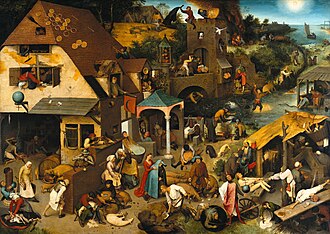 ネーデルラントの諺 - Pieter Bruegel the Elder (1551)
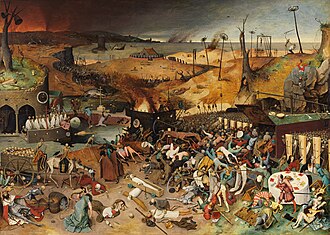 死の勝利 - Pieter Bruegel the Elder (1560s)
%20-%20Blind%20leading%20the%20blind%20Google%20Art%20Project.jpeg) 盲人の寓話 - Pieter Bruegel the Elder (1568)
盲人の寓話 - Pieter Bruegel the Elder (1568)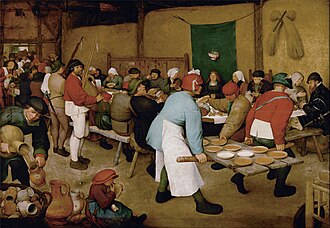 農民の婚宴 - Pieter Bruegel the Elder (1560s)
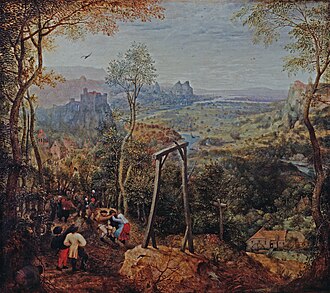 絞首台の上のかささぎ - Pieter Bruegel the Elder (1568)
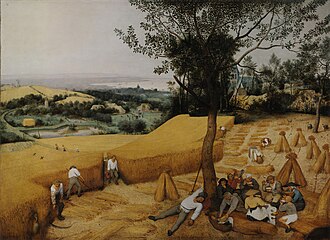 穀物の収穫 - Pieter Bruegel the Elder (1565)
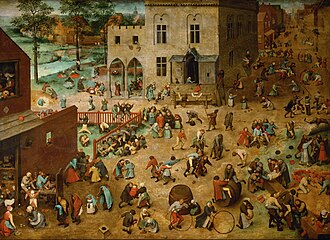 子供の遊戯 - Pieter Bruegel the Elder (1560)
%20-%20Christ%20and%20the%20woman%20taken%20in%20adultery.jpg) キリストと姦通の女 - Pieter Bruegel the Elder (1565)
キリストと姦通の女 - Pieter Bruegel the Elder (1565)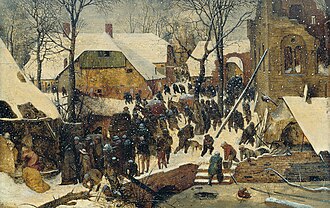 雪中の東方三博士の礼拝 - Pieter Bruegel the Elder (1563)