種まく人の譬え
Pieter Bruegel the Elder · 1557
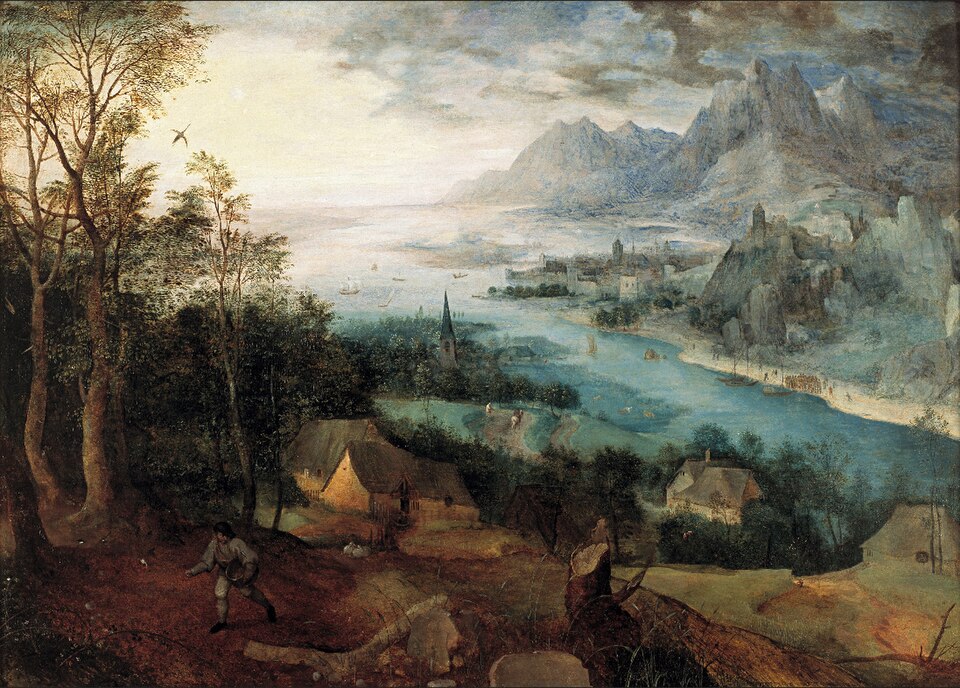
A wide river valley, a Flemish village, Alpine peaks, and in a corner a man scattering seed. In one of his earliest signed paintings, Bruegel hid a gospel parable inside a whole world.
The story behind the painting
In 1553 Pieter Bruegel the Elder left Antwerp to study in Italy. On his way back he crossed the Alps and filled sheets with sketches of the mountains, and those drawings shaped the peaks rising in the upper right of this picture. Painted in 1557, Parable of the Sower is among Bruegel's earliest signed paintings and among his first large-scale landscapes. It measures about 74 by 103 cm and now hangs in the Timken Museum of Art in San Diego, California, far from the Flemish countryside it describes.
What to look for
Start in the lower left foreground, where the sower himself walks, spreading seed. Then follow the river, which runs from the lower right to the upper left, lined by a church and a Flemish village. On the right bank, near a small group of boats, find a tiny crowd: there Jesus is preaching the very parable the painting is named after. John Wilson, executive director of the Timken Museum, points to small things that catch the eye, like the tower of a church, the thatched hut, birds and horses, all set against those distant Alpine heights.
Meaning and intent
The parable appears in the gospels of Matthew, Mark and Luke: a sower's seeds are partly eaten by birds, partly wasted on stony soil or choked by thorns, and partly successful in fertile ground. Wilson says Bruegel totally humanises the spiritual subject, placing the sacred inside everyday life. Larry Silver of the University of Pennsylvania adds a lovely reading: Bruegel chose Jesus's first parable as the subject of his own first landscape painting, a work that planted the seed of his lifelong affinity with landscape.
Legacy
Wilson sees in this early picture the detail, religiosity and human element that run through Bruegel's later paintings. The habit of tucking the main story into a corner of a vast, living landscape would become one of his signatures. That makes this canvas a beginning: the seed of a way of seeing that grew into some of the best loved landscapes of Northern Renaissance art. Today it is one of the treasures of the Timken Museum, where visitors can trace the path from sower to preacher in a single look.
豆知識
- Painted in 1557, among Bruegel's earliest signed paintings.
- The Alpine peaks come from sketches made on his return from Italy.
- Jesus preaches the parable on the right bank of the river.
- Now in the Timken Museum of Art, San Diego.
画家について
Pieter Bruegel the Elder (1525-1569)
同じ画家の作品: Pieter Bruegel the Elder
 雪中の狩人 - Pieter Bruegel the Elder (1565)
 ネーデルラントの諺 - Pieter Bruegel the Elder (1551)
 死の勝利 - Pieter Bruegel the Elder (1560s)
 盲人の寓話 - Pieter Bruegel the Elder (1568)
 農民の婚宴 - Pieter Bruegel the Elder (1560s)
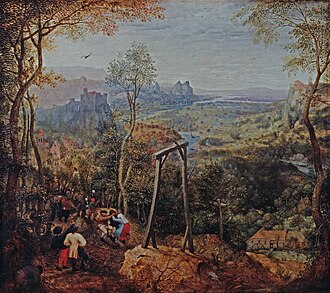 絞首台の上のかささぎ - Pieter Bruegel the Elder (1568)
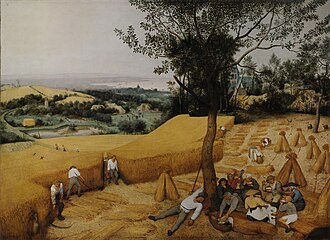 穀物の収穫 - Pieter Bruegel the Elder (1565)
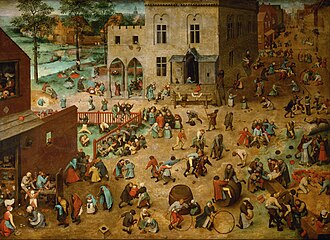 子供の遊戯 - Pieter Bruegel the Elder (1560)
関連する画家の作品
 大使たち - Hans Holbein the Younger (1533)
 墓の中のキリストの屍 - Hans Holbein the Younger (1520s)
 快楽の園 - Hieronymus Bosch
 愚者の船 - Hieronymus Bosch (1500s)
 アルノルフィーニ夫妻像 - Jan van Eyck (1434)
 ヘントの祭壇画 - Jan van Eyck (1432)