ヒエロニムス・ボス
1450-1516
Hieronymus Bosch filled oak panels with dreams and nightmares: giant fruit, hybrid creatures and a hell lit by distant fires. He left no letters and no diaries, only paintings that still seem to flicker and change before our eyes.
Origins
Bosch was born Jheronimus van Aken around 1450 in his grandfather's house in 's-Hertogenbosch, a flourishing town in the Duchy of Brabant. The family's roots lay in Nijmegen and Aachen, which gave the surname Van Aken; the name he signed, Bosch, comes from his town, locally called Den Bosch, the forest. His birth year is only an estimate, based on a drawing, perhaps a self-portrait, made shortly before his death that shows a man probably in his late sixties. Painting was the family trade. His grandfather Jan van Aken was a painter, four of Jan's five sons were painters too, and Bosch's father Anthonius advised the town's Brotherhood of Our Lady on art. Either his father or an uncle probably taught him, though none of their works survive. In 1463, when he was about thirteen, a fire destroyed 4,000 houses in the town, a disaster he presumably saw.
Life and turning points
Very little is known about Bosch's life. He left no letters or diaries, and nothing is known of his personality or his thoughts on his art. What survives are brief mentions in the town records and in the accounts of the Illustrious Brotherhood of Our Blessed Lady. He first appears in the municipal record on 5 April 1474, named with two brothers and a sister. Sometime between 1479 and 1481 he married Aleid Goyaerts van den Meervenne, a few years older than he was, and the couple moved to nearby Oirschot, where she had inherited a house and land from her wealthy family. In 1486 or 1487 he joined the Brotherhood of Our Lady, a devotional confraternity of some forty influential citizens with thousands of outer members across Europe. He became a popular painter who often received commissions from abroad. The Brotherhood held a memorial mass for him in the church of Saint John on 9 August 1516.
Style and technique
Bosch painted mostly in oil on oak panels with the usual pigments of his day: azurite for skies and distances, copper greens for foliage, lead-tin yellow, ochres and red lakes for figures. Yet his handling was unusual. Where the great Netherlandish painters built up smooth, transparent glazes to hide the brushwork, as if their pictures were nearly divine creations, Bosch sometimes painted in a sketchy way, with rough, raised surfaces. His subjects were fantastic illustrations of religious ideas. The Garden of Earthly Delights opens with Eden, where a youthful God presents Eve to Adam, spreads into a central panorama of nude figures, compound animals, oversized fruit and hybrid rocks, and ends in a frozen, night-dark hell lit by explosions. The scholar Dirk Bax argued that his images often translate verbal metaphors and puns from the Bible and folklore into pictures.
Stories and anecdotes
In 1560 the Spaniard Felipe de Guevara wrote that Bosch was regarded merely as the inventor of monsters and chimeras, and in the early seventeenth century Karel van Mander admired his wondrous and strange fantasies but found them often less pleasant than gruesome to look at. In the twentieth century some argued he was inspired by heretical sects or hermetic practices; more recent scholars see his art as reflecting the orthodox beliefs and moral sermons of his age, while others stress its irony. Unusually for the time he signed several paintings, though not every signature is genuine, and none are dated. Experts disagree on how much is truly his: mid-century historians gave him thirty to fifty paintings, a 1980 study gave him twenty-five paintings and fourteen drawings, and today about twenty-five paintings and eight drawings are accepted. In 2016 a small Temptation of St. Anthony in Kansas City was credited to his own hand.
Legacy
Bosch is one of the most notable painters of the Early Netherlandish school. In his lifetime his work was collected in the Netherlands, Austria and Spain and widely copied, above all his macabre visions of hell. In the late sixteenth century Philip II of Spain acquired many of his paintings, which is why the Prado in Madrid now holds The Garden of Earthly Delights, The Haywain Triptych and the Adoration of the Magi. His fantastical style shaped northern art throughout the sixteenth century, and Pieter Bruegel the Elder became his best-known follower. Of at least sixteen triptychs, eight survive intact. Today he is seen as a deeply individual artist who offered profound insights into human desires and our deepest fears, and his panels still invite viewers to lean in close and lose themselves in their crowded, unsettling worlds.
豆知識
- His real name was Jheronimus van Aken; Bosch comes from his home town, 's-Hertogenbosch.
- Only about 25 paintings are confidently identified as his today.
- His signature appears on only seven of his surviving paintings.
- Tree-ring study of his oak panels has made the dating of most of his paintings more precise.
関連する画家
ロヒール・ファン・デル・ウェイデン · ヤン・ファン・エイク · ハンス・メムリンク · Pieter Bruegel the Elder
ヒエロニムス・ボスの作品
 快楽の園 - Hieronymus Bosch
 愚者の船 - Hieronymus Bosch (1500s)
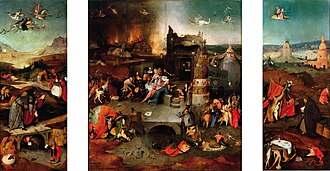 聖アントニウスの誘惑の三連祭壇画 - Hieronymus Bosch (1501)
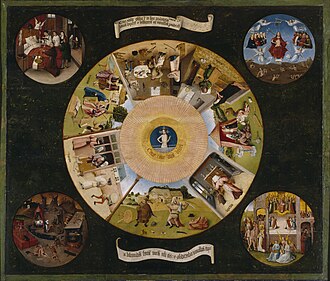 七つの大罪と四終 - Hieronymus Bosch (1500)
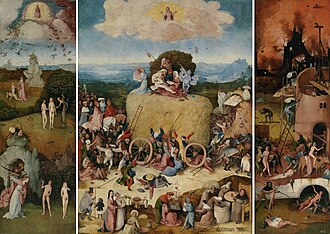 乾草車の三連祭壇画 - Hieronymus Bosch (1510s)
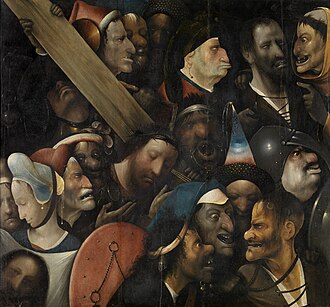 十字架を担うキリスト - Hieronymus Bosch (1510s)
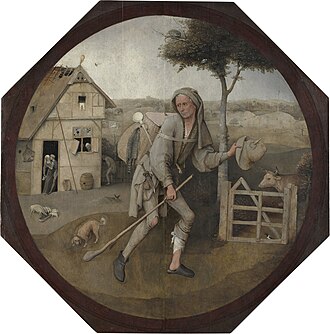 放浪者 - Hieronymus Bosch (1500)
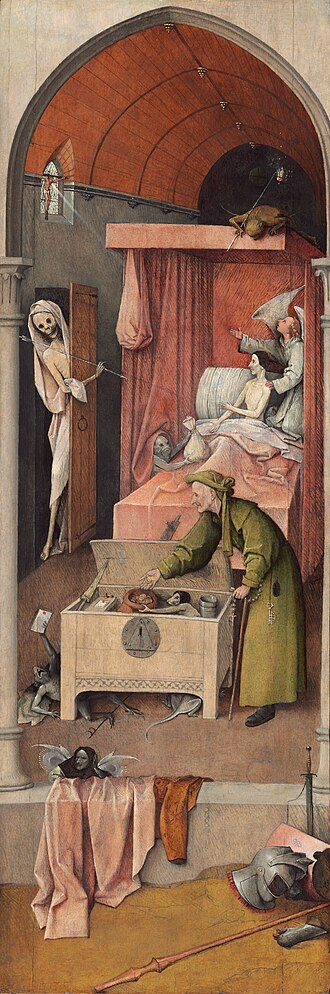 守銭奴の死 - Hieronymus Bosch (1500s)
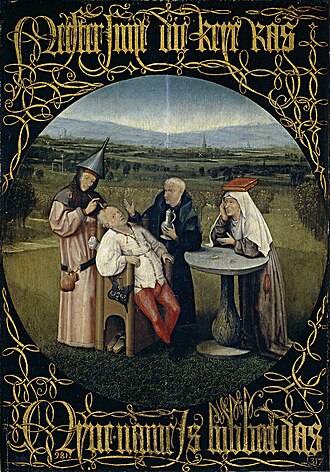 愚者の石の切除 - Hieronymus Bosch (1500s)
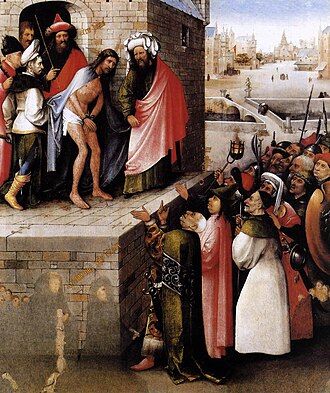 この人を見よ - Hieronymus Bosch (1490s)
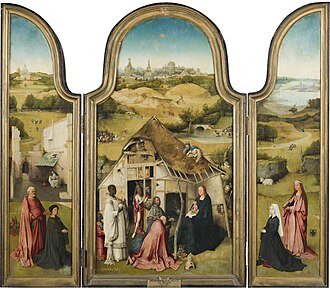 東方三博士の礼拝の三連祭壇画 - Hieronymus Bosch (1494)
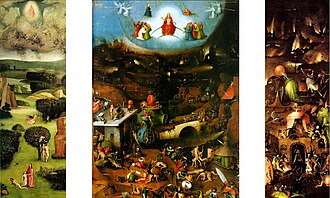 最後の審判の三連祭壇画 - Hieronymus Bosch (1500s)
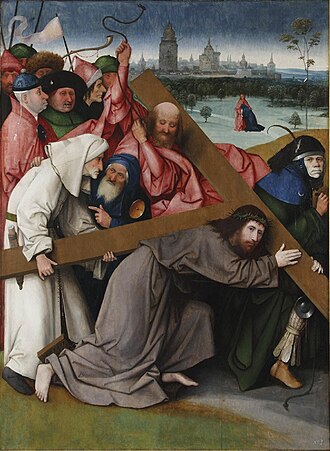 十字架を担うキリスト - Hieronymus Bosch (1500s)
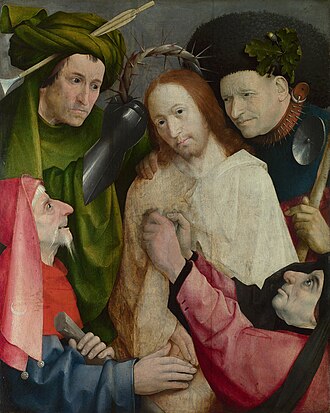 荊冠のキリスト - Hieronymus Bosch (1495)
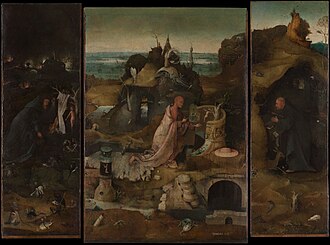 隠遁聖者の三連祭壇画 - Hieronymus Bosch (1493)
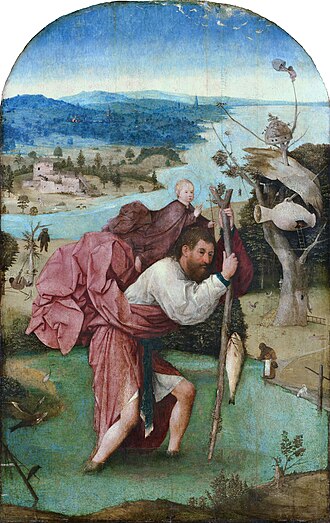 聖クリストフォロス - Hieronymus Bosch (1500)
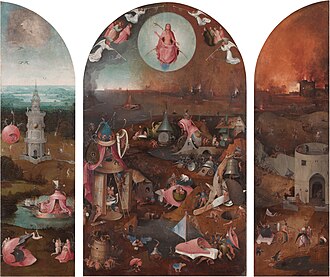 最後の審判の三連祭壇画 - Hieronymus Bosch (1500)
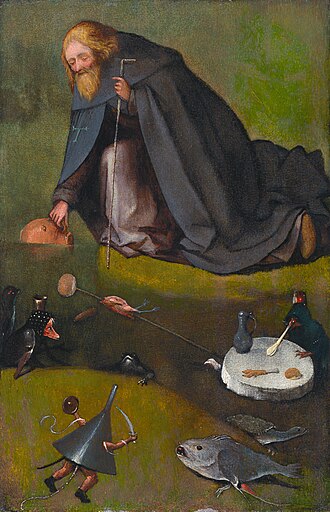 聖アントニウスの誘惑 - Hieronymus Bosch (1500s)
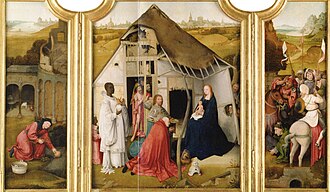 The Adoration of the Kings - Hieronymus Bosch (1514)
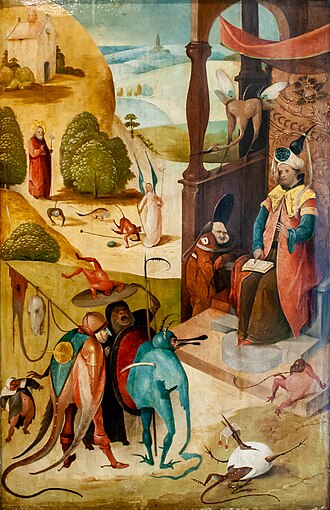 The holy Jacob and the magician Hermogenes - Hieronymus Bosch (1550)
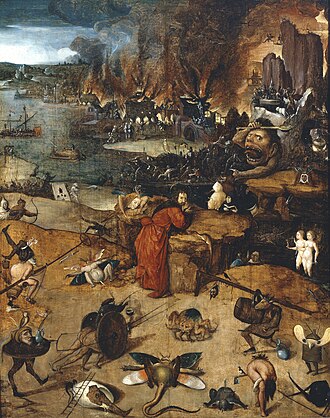 聖アントニウスの誘惑 - Hieronymus Bosch (1550s)
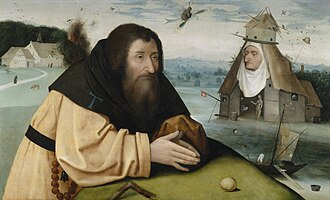 The Temptations of Saint Anthony - Hieronymus Bosch (1510s)
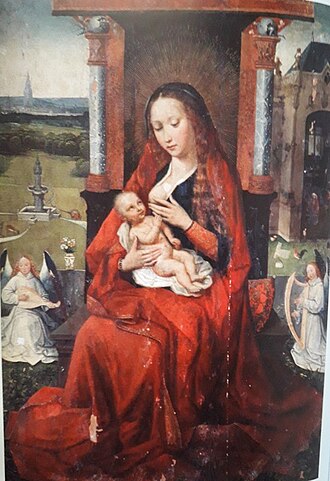 Vierge à l'Enfant - Hieronymus Bosch (1505)