人間嫌い
Pieter Bruegel the Elder · 1568
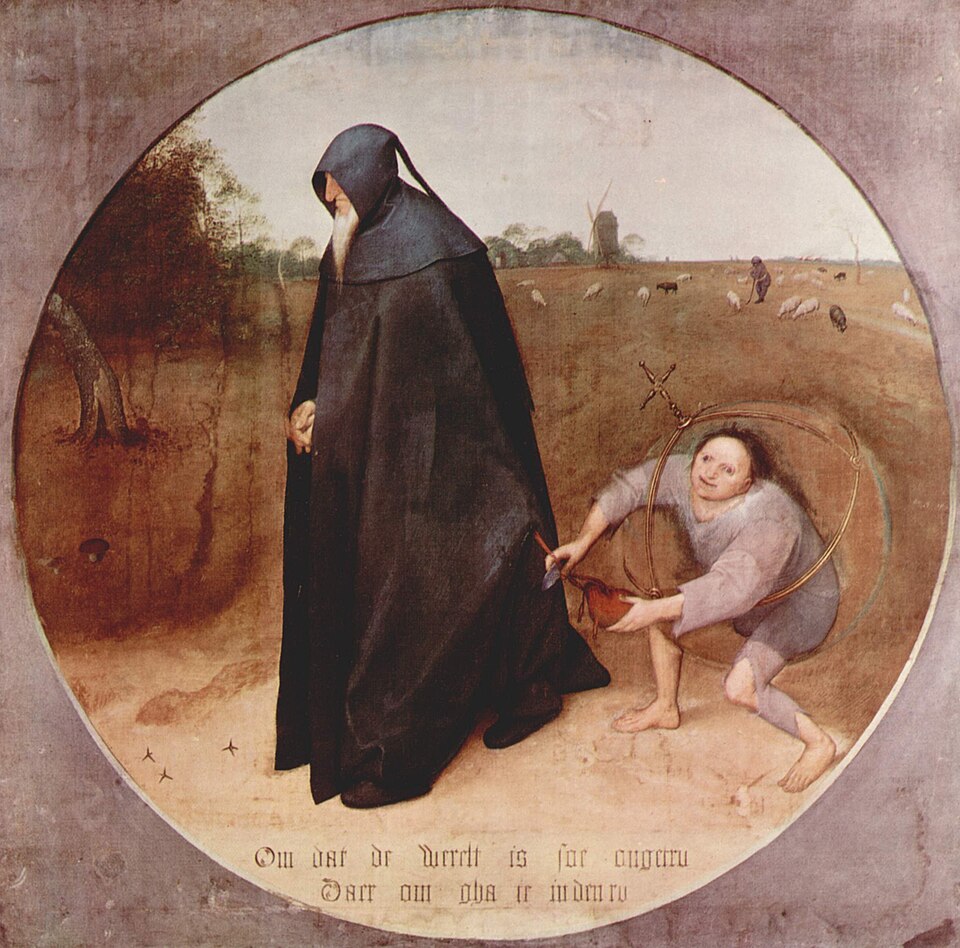
An old man in black walks away from the world, hands clasped, eyes lowered, while a ragged little thief inside a glass globe cuts his purse and spiked caltrops wait on his path. Bruegel painted this bitter round picture in 1568.
The story behind the painting
The Misanthrope is a tempera painting on canvas made by Pieter Bruegel the Elder in 1568, a small moral picture whose symbols invite more than one reading. The circular scene is set inside a square frame, and at the bottom runs a Flemish inscription: Because the world is perfidious, I am going into mourning. The picture is a moral image built around that line, with every figure answering the old man's complaint. It measures about 86 by 85 cm and is now in the National Museum of Capodimonte in Naples. The sources do not say who commissioned it or where it hung before reaching Naples.
What to look for
A white-bearded old man in a black hooded robe clasps his hands before him. Behind him, a smaller barefoot man uses a knife to cut the strings of his money pouch. The old man seems so lost in thought that he notices neither the theft nor the caltrops, the spiked metal traps scattered in his path. The thief is enclosed in a globe topped with a cross, a globus cruciger. In the background, far from this little drama, a shepherd watches over his sheep. Read the round picture slowly, from the inscription up to the figures and out to the landscape.
Meaning and intent
The figure in the globe may stand for vanity, though the religious symbolism of the globe opens other readings: the world itself is robbing the man who claims to leave it. The caltrops set in his path show that he cannot simply walk away from the world as he wishes. Bruegel contrasts him with the shepherd in the background, who is presented as more virtuous because he simply and honourably does his duty and takes responsibility for those in his care. Withdrawal, the picture seems to say, is not the same as goodness, and complaining about the world does not protect you from it.
Legacy
Bruegel's son Pieter Bruegel the Younger was known for making many copies of his father's works, and he painted his own Misanthrope, also tempera on canvas, with a slightly different composition. That version entered the permanent collection of the Bank of the Republic of Colombia in 1999, and since August 2023 it has been shown at the Museo Casa de Moneda in Bogotá. So the old man in black, still being robbed and still not noticing, can be met today on two continents: in Naples, in his father's original, and in Bogotá, in the son's variation.
豆知識
- Painted by Pieter Bruegel the Elder in 1568, tempera on canvas.
- A Flemish inscription explains the old man's flight from the world.
- Now in the National Museum of Capodimonte, Naples.
- A variant by Pieter Bruegel the Younger is in Bogotá.
画家について
Pieter Bruegel the Elder (1525-1569)
男性 · 風俗美術 · カポディモンテ美術館 · 宝珠
同じ画家の作品: Pieter Bruegel the Elder
 雪中の狩人 - Pieter Bruegel the Elder (1565)
 ネーデルラントの諺 - Pieter Bruegel the Elder (1551)
 死の勝利 - Pieter Bruegel the Elder (1560s)
 盲人の寓話 - Pieter Bruegel the Elder (1568)
 農民の婚宴 - Pieter Bruegel the Elder (1560s)
 絞首台の上のかささぎ - Pieter Bruegel the Elder (1568)
 穀物の収穫 - Pieter Bruegel the Elder (1565)
 子供の遊戯 - Pieter Bruegel the Elder (1560)
関連する画家の作品
 大使たち - Hans Holbein the Younger (1533)
 墓の中のキリストの屍 - Hans Holbein the Younger (1520s)
 快楽の園 - Hieronymus Bosch
 愚者の船 - Hieronymus Bosch (1500s)
 アルノルフィーニ夫妻像 - Jan van Eyck (1434)
 ヘントの祭壇画 - Jan van Eyck (1432)