ミケランジェロ・ブオナローティ
1475-1564
Michelangelo said he took in the knack of chisel and hammer with his nurse's milk. Sculptor, painter, architect and poet, he carved the Pietà and David before thirty and filled the Sistine Chapel with figures that still leave viewers in awe.
Origins
Michelangelo di Lodovico Buonarroti Simoni was born on 6 March 1475 in Caprese, a small town near Arezzo in Tuscany, where his father was the local administrator. For generations the family had been small-scale bankers in Florence, but the bank had failed. A few months after his birth they returned to Florence. During his mother's long illness and after her death in 1481, when he was six, he lived with a nanny and her husband, a stonecutter, in Settignano, where his father owned a marble quarry. There he gained his love for working marble. Vasari quotes him saying that along with the milk of his nurse he received the knack of handling chisel and hammer. At school he showed no interest in grammar and preferred copying paintings in churches.
Life and turning points
In 1488, at 13, he was apprenticed to Domenico Ghirlandaio, and a year later Lorenzo de' Medici asked for Ghirlandaio's two best pupils and received Michelangelo and Francesco Granacci. From 1490 to 1492 he attended the Medici's Platonic Academy. After Lorenzo's death in 1492 he moved between Florence, Venice and Bologna, and arrived in Rome in 1496 at 21. There he carved the Pietà, finished when he was 24. Back in Florence he completed David in 1504. In 1505 Pope Julius II called him to Rome to build his tomb, a project broken by constant interruptions. He went on to paint the Sistine Chapel ceiling and The Last Judgment, designed the Laurentian Library and, at 71, became architect of St. Peter's Basilica. He died on 18 February 1564.
Style and technique
Michelangelo's work was inspired by models from classical antiquity, and his contemporaries admired his terribilità, his ability to instil a sense of awe. He did not consider himself a painter, yet he created two of the most influential frescoes in Western art: the scenes from Genesis on the Sistine ceiling and The Last Judgment on its altar wall. He studied anatomy by dissecting corpses, first at the hospital of Santo Spirito in Florence, which he thanked with a carved wooden crucifix. In Florence he studied and copied Giotto and Masaccio. His design of the Laurentian Library pioneered Mannerist architecture, and later artists who tried to imitate the expressive physicality of his figures helped give rise to Mannerism, the movement between the High Renaissance and the Baroque.
Stories and anecdotes
When he was 17, another pupil, Pietro Torrigiano, struck him on the nose, causing the disfigurement visible in his portraits. In 1494, after heavy snowfalls, Piero de' Medici commissioned him to make a statue of snow. According to Condivi, a sleeping Cupid he carved was made to look buried so that it could be sold in Rome as an ancient work; Cardinal Raffaele Riario discovered the fraud but was so impressed that he invited the young sculptor to Rome. The Pietà is the only work he is known to have signed, with his name on the Virgin's sash. Leonardo and he were both commissioned to paint battle scenes in Florence's council chamber; neither was finished and both were lost. With Julius II, both men hot-tempered, he soon argued and in 1506 left Rome in secret.
Legacy
Michelangelo was the first Western artist whose biography was published in his lifetime. In Vasari's Lives of 1550 he was the only living artist given a biography, presented as the culmination of the revival of the arts and called divino. Ascanio Condivi's Life of 1553, prepared with his participation, corrected Vasari in places. He is one of the best-documented artists of the 16th century, thanks to his surviving letters, sketches and reminiscences. Along with his rival Leonardo da Vinci he is seen as the archetypal Renaissance man. David still stands in the Accademia in Florence, the Pietà in St Peter's Basilica, and the dome of St. Peter's rose to his design, with some changes, after his death.
豆知識
- He called Ghiberti's bronze Baptistery doors "The Gates of Paradise".
- His father persuaded Ghirlandaio to pay him as an artist at 14, which was rare for someone so young.
- A marble replica of David was placed in the Piazza della Signoria in 1910.
- The Buonarrotis claimed descent from Countess Matilde di Canossa, a claim unproven but one Michelangelo believed.
関連する画家
ティツィアーノ・ヴェチェッリオ · ラファエロ・サンティ · Leonardo da Vinci · アルブレヒト・デューラー · Sandro Botticelli · ヒエロニムス・ボス
ミケランジェロ・ブオナローティの作品
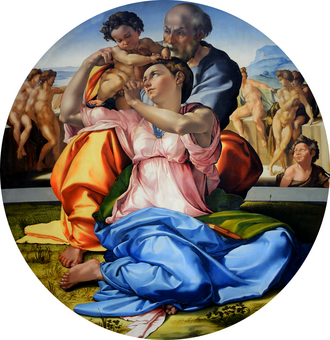 聖家族 - Michelangelo (1500s)
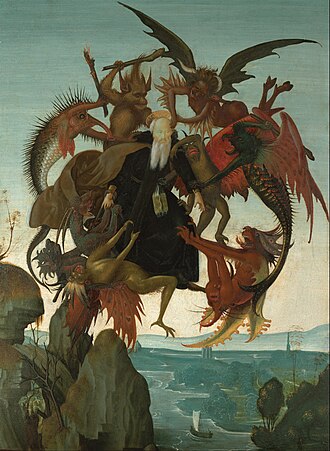 聖アンソニーの苦悩 - Michelangelo (1487)
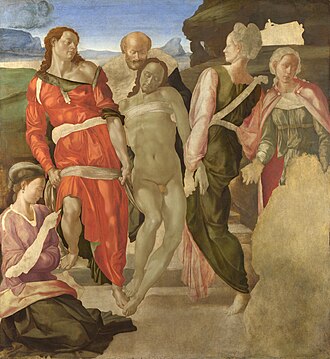 キリストの埋葬 - Michelangelo (1500s)
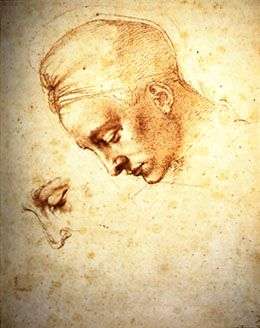 レダと白鳥 - Michelangelo (1530)
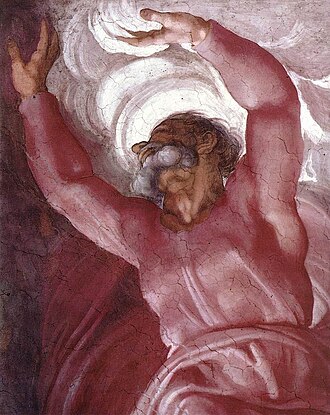 Separation of Light from Darkness - Michelangelo (1512)
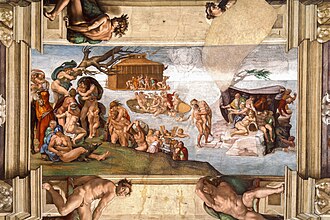 大洪水 - Michelangelo (1508)
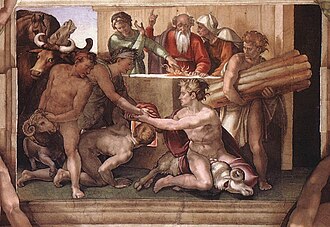 ノアの燔祭 - Michelangelo (1508)
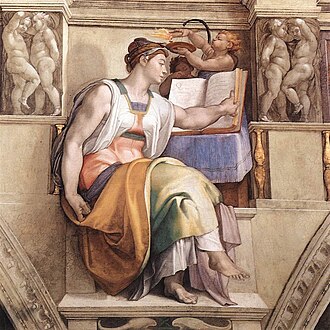 エリュトレイアの巫女 - Michelangelo (1508)
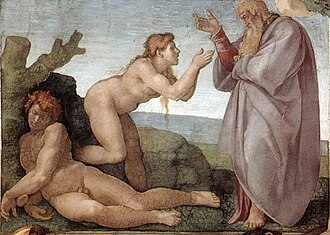 The Creation of Eve - Michelangelo (1511)
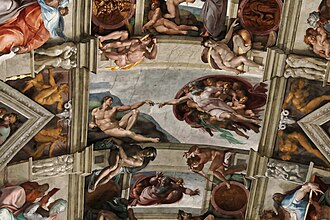 The Separation of the Earth and Waters - Michelangelo (1511)