The Creation of Eve
ミケランジェロ・ブオナローティ · 1511
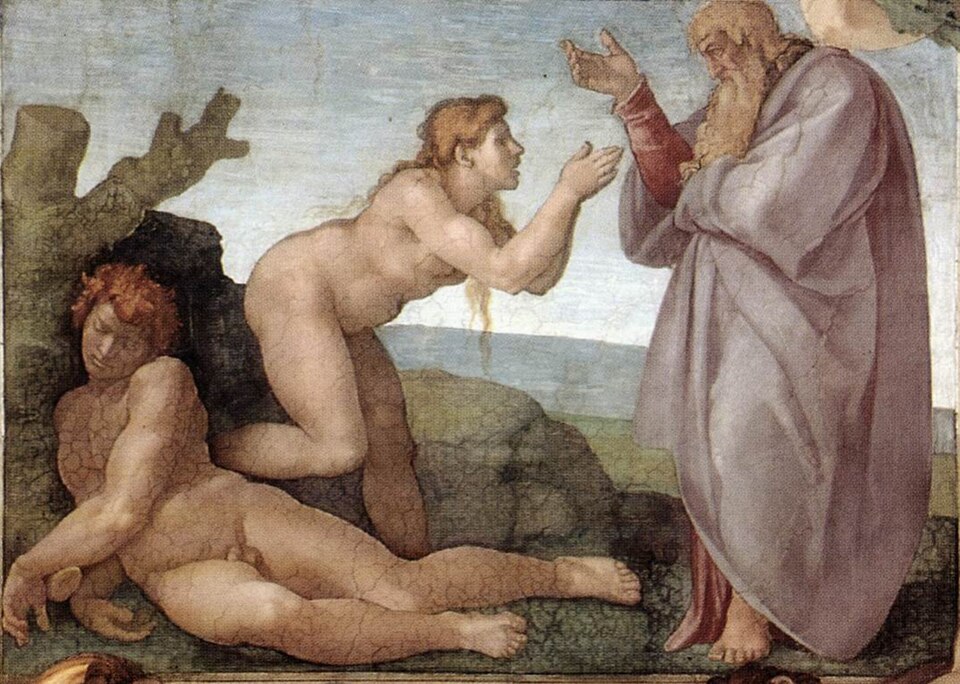
Adam sleeps against a dead tree, and Eve rises from beside him with her hands joined, bowing toward God. This quiet scene sits at the exact middle of the Sistine Chapel's biblical stories.
The story behind the painting
The Creation of Eve is a fresco by Michelangelo, about 170 by 260 cm, painted around 1511 on the Sistine Chapel ceiling commissioned by Pope Julius II. The vault was painted in two halves, because the scaffolding covered only half the chapel and had to be taken down and rebuilt. This was the first scene painted after the rebuilding, probably in autumn 1511. From here the number of working days per scene dropped sharply, from twelve or thirteen to only four, which helps explain how the second half was finished in barely a year, under the Pope's constant pressure. The ceiling was unveiled on 31 October 1512.
What to look for
Adam lies in the lower left corner on a diagonal, leaning on a dry tree. Eve rises almost at right angles to him, drawn up by an eloquent gesture of God, who stands in front of her wrapped in a large violet cloak. Here, unlike the other scenes, God is not in the sky. Eve emerges with her hands joined, and the heads of the three figures line up on one diagonal. The landscape is spare: a strip of sea, a pale blue sky, green grass, a slope of rocks. God's blond hair and beard are unusual, as he is grey elsewhere. Small changes were found around Adam's head, the tree's branches and Eve's hair and body.
Meaning and intent
Eve's central place can be read through the Christian habit of seeing Old Testament scenes as foreshadowing the New. Eve was often taken as a symbol of Mary, who in turn stood for the Church, so Eve drawn from Adam's side mirrored the Church born from the wound in the side of Christ. The chapel is dedicated to the Assumption of the Virgin. Condivi wrote that Eve seemed to thank God while he blessed her. Because Eve is shown before her own creation is complete, some have wondered if she might be Lilith instead.
Legacy
Vasari described the two figures vividly: Adam inert and held by sleep, Eve full of life and awake to the divine blessing. The figure of God recalls the monumental, heroic weight of Masaccio in the Brancacci Chapel and Giotto in the Peruzzi Chapel. The closest model is Jacopo della Quercia's relief on the Porta Magna of San Petronio in Bologna, which Michelangelo had studied and probably saw again in 1511, where the three figures take very similar poses. Scholars also note links with the mosaics of Saint Paul Outside the Walls and the Malermi Bible of 1491.
豆知識
- Fresco about 170 x 260 cm, around 1511.
- First scene painted after the scaffolding was moved.
- Placed at the exact middle of the ceiling's biblical stories.
- Close to a relief by Jacopo della Quercia in Bologna.
画家について
ミケランジェロ・ブオナローティ (1475-1564)
宗教美術 · 女性 · 男性 · 盛期ルネサンス · ヌード · バチカン美術館
同じ画家の作品: ミケランジェロ・ブオナローティ
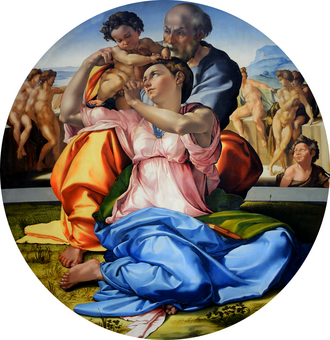 聖家族 - Michelangelo (1500s)
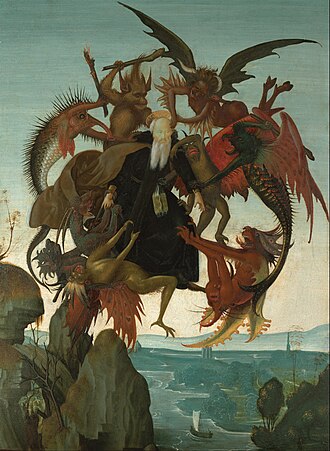 聖アンソニーの苦悩 - Michelangelo (1487)
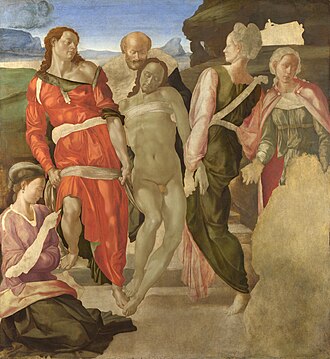 キリストの埋葬 - Michelangelo (1500s)
 レダと白鳥 - Michelangelo (1530)
 大洪水 - Michelangelo (1508)
 ノアの燔祭 - Michelangelo (1508)
 Separation of Light from Darkness - Michelangelo (1512)
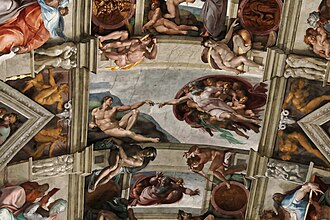 The Separation of the Earth and Waters - Michelangelo (1511)
関連する画家の作品
.jpg) ウルビーノのヴィーナス - Titian (1538)
ウルビーノのヴィーナス - Titian (1538) 聖母被昇天 - Titian (1510s)
 システィーナの聖母 - Raphael (1510s)
.jpg) ラ・フォルナリーナ - Raphael
ラ・フォルナリーナ - Raphael モナ・リザ - Leonardo da Vinci (1503-1519)
 白貂を抱く貴婦人 - Leonardo da Vinci (1490)
 自画像 - Albrecht Dürer (1500)
 東方三博士の礼拝 - Albrecht Dürer (1504)
 ヴィーナスの誕生 - Sandro Botticelli (c. 1485)
 プリマヴェーラ - Sandro Botticelli (1480s)
 快楽の園 - Hieronymus Bosch
 愚者の船 - Hieronymus Bosch (1500s)