Ancestors of Christ: David and Solomon
ミケランジェロ・ブオナローティ · 1511
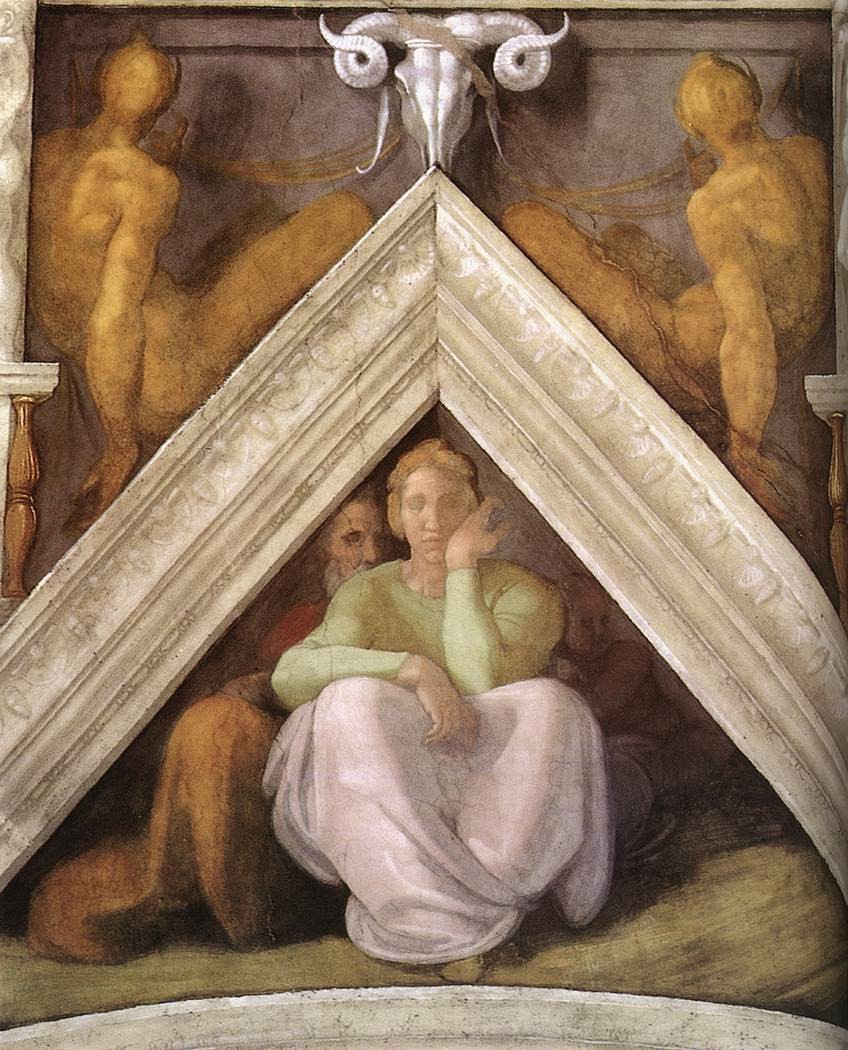
High on the Sistine ceiling, a woman sits utterly still on the ground, staring out with an enigmatic gaze, a hand turned against her face. Behind her in the dark, a man and a barely visible child. Michelangelo painted this family among the very last.
The story behind the painting
Michelangelo frescoed this vault segment around 1511 to 1512 as part of the Sistine Chapel ceiling commissioned by Pope Julius II. The vault segments, like the lunettes below them, hold the series of the Ancestors of Christ, named from the genealogy in the Gospel of Matthew. The ceiling was painted in two phases starting from the wall opposite the altar. The second phase began in October 1511 and ended a year later, just in time for the unveiling on the eve of All Saints' Day 1512, so this segment is one of the last he painted.
What to look for
These are concave triangular spaces, and Michelangelo filled them with family groups on dark backgrounds, sitting on the ground rather than on steps, to fit the shape. Here a mother fills the whole foreground, facing outward in absolute stillness. Her legs are bent and apart, feet crossed under a purple mantle, and a tight green dress at the bust reveals a muscular build typical of his women. One hand rests on her legs, the other touches her face with its back. Behind, a darker man is sketched more abstractly at left, and a child is barely visible at right.
Meaning and intent
The lunette below names David and Solomon, so this group should be the family of Jesse, the child probably being Jesse himself, with his father and mother. Yet scholars do not agree on the names of the groups. Michelangelo used no attributes, and may not have wanted a direct, certain identification at all, focusing instead on human types and attitudes. That is why the woman's gaze feels so open: she is less a named ancestor than a portrait of waiting, rest and inward thought, stretched across a curved triangle of plaster.
Legacy
Above the segment, two bronze nudes, monochrome figures imitating bronze, sit wedged into the triangular spaces against dark violet grounds, separated by a ram's skull hung with golden ribbons. They turn their backs and heads away, one arm dropped forward, the other holding the golden cords. Both come from the same cartoon reversed, nearly symmetrical, yet with small differences that break the pattern: the one on the right has a much sturdier arm. Together with the family below, they remain part of the ceiling in the Vatican Museums.
豆知識
- Fresco, about 1511-1512, Sistine Chapel ceiling.
- Part of the Ancestors of Christ series from Matthew's genealogy.
- One of the last vault segments painted before the unveiling in 1512.
- The group is thought to show Jesse's family; identifications are debated.
画家について
ミケランジェロ・ブオナローティ (1475-1564)
宗教美術 · 盛期ルネサンス · システィーナ礼拝堂 · ダビデ · ソロモン
同じ画家の作品: ミケランジェロ・ブオナローティ
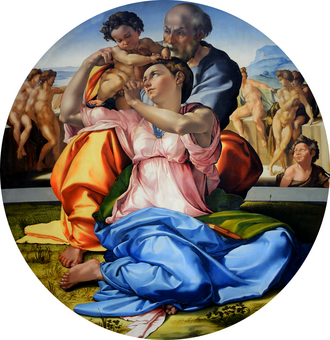 聖家族 - Michelangelo (1500s)
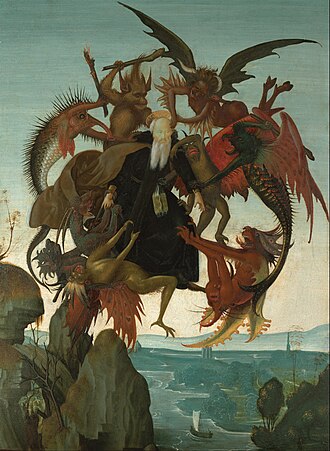 聖アンソニーの苦悩 - Michelangelo (1487)
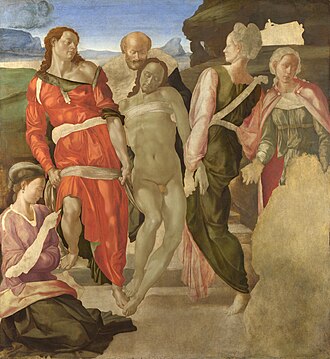 キリストの埋葬 - Michelangelo (1500s)
 マンチェスターの聖母 - Michelangelo (1494)
 レダと白鳥 - Michelangelo (1530)
 大洪水 - Michelangelo (1508)
 ノアの燔祭 - Michelangelo (1508)
 Separation of Light from Darkness - Michelangelo (1512)
関連する画家の作品
 システィーナの聖母 - Raphael (1510s)
.jpg) ラ・フォルナリーナ - Raphael
ラ・フォルナリーナ - Raphael.jpg) ウルビーノのヴィーナス - Titian (1538)
ウルビーノのヴィーナス - Titian (1538) 聖母被昇天 - Titian (1510s)
 モナ・リザ - Leonardo da Vinci (1503-1519)
 白貂を抱く貴婦人 - Leonardo da Vinci (1490)
 自画像 - Albrecht Dürer (1500)
 東方三博士の礼拝 - Albrecht Dürer (1504)
 ヴィーナスの誕生 - Sandro Botticelli (c. 1485)
 プリマヴェーラ - Sandro Botticelli (1480s)
 快楽の園 - Hieronymus Bosch
 愚者の船 - Hieronymus Bosch (1500s)