The Ancestors of Christ: Josias, Jeconiah and Shealtiel
ミケランジェロ・ブオナローティ · 1508
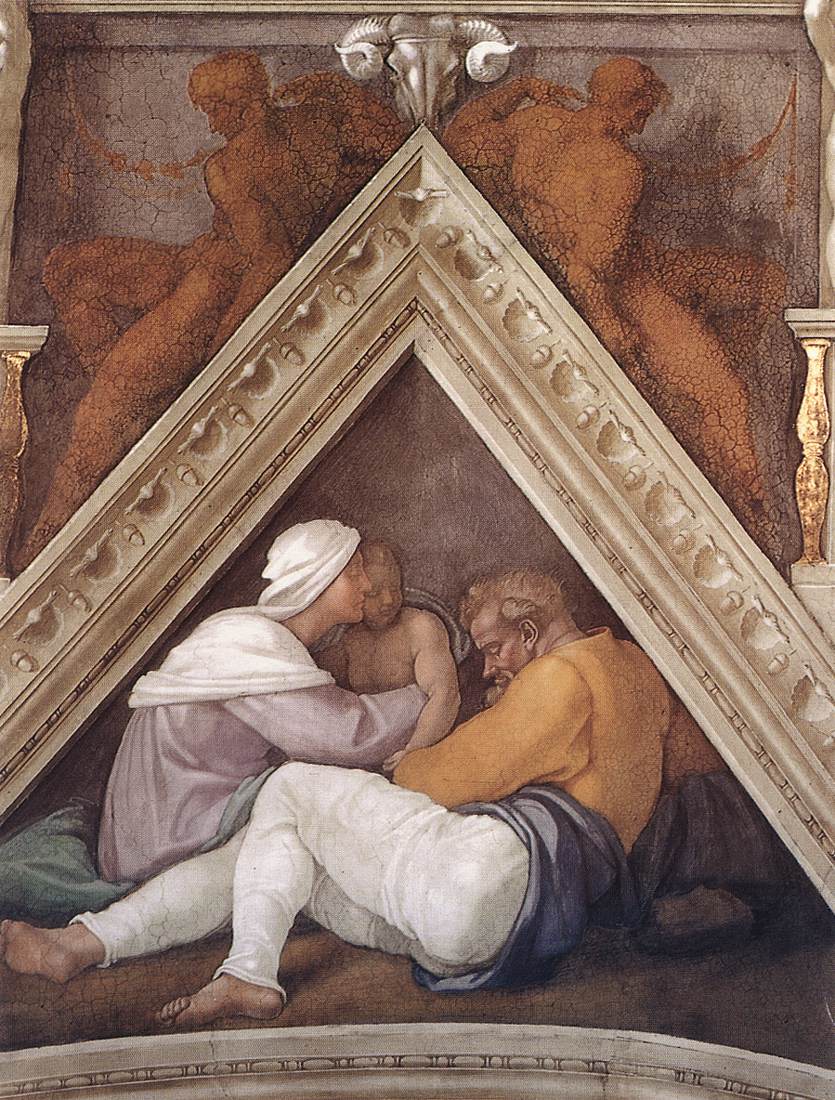
A family rests on bare ground like travellers on the road: a man in white stretches out, a mother draws her cloak around her child. Michelangelo painted these pilgrims on earth among the first scenes of the Sistine vault.
The story behind the painting
This triangular section of the vault, above the lunette of Josiah, Jeconiah and Shealtiel, was frescoed by Michelangelo around 1508 to 1510 as part of the Sistine Chapel ceiling commissioned by Pope Julius II; Wikidata gives 1508. Close to the scene of the Flood, it was among the first spandrels to be painted. The vault was painted in two phases starting from the wall opposite the altar, so the later episodes of the story were painted first. In summer 1511 the scaffolding was rebuilt in the other half, and the second phase ended a year later, in time for the unveiling on the eve of All Saints 1512. Wikidata gives about 245 by 340 cm.
What to look for
In the foreground a man stretches out his legs in white trousers, a striking contrast with the dark ground, his torso turned back, his head in profile. Behind him, in a complementary position, his wife sits in profile on a green cushion, her head wrapped in a white veil, wearing a violet dress. In the half-light she embraces a child, bringing her face tenderly close to her son's and trying to cover him with her mantle. Above, two bronze nudes lie symmetrically with their torsos turned, backs to the viewer, designed from the same cartoon reversed, with slight differences to avoid rigid symmetry.
Meaning and intent
The composition recalls scenes of the Flight into Egypt. According to the source, the attitude echoes Saint Paul, who called the ancestors of Christ pilgrims on earth, on the way to the promised land. The identity of the figures in the lunette below is not certain, but the family of Jeconiah, with his wife and his son Shealtiel, is generally identified in this spandrel. Michelangelo gave the ancestors no attributes; scholars still disagree on the names of many groups, and he may have been more interested in human types and attitudes than in precise identification. Here the subject becomes simply a family on a journey.
Legacy
The different lighting and finish of each figure create planes that move gradually away from the viewer and grow less defined, a method very close to sculpture. The source compares it to the unfinished effects in many of Michelangelo's works, such as the Pitti and Taddei Tondi. Only two days of fresco were needed to paint the spandrel, the design transferred from a cartoon by spolvero, dusting charcoal through pricked holes. Like the other spandrels, it stands on a dark ground, framed by violet triangles with a ram's skull and golden ribbons, a small, tender scene among the first that Michelangelo painted on the ceiling.
豆知識
- Frescoed around 1508 to 1510, among the first spandrels painted.
- Generally identified as Jeconiah with his wife and son Shealtiel.
- Painted in only two days, transferred by spolvero.
- The pose recalls the Flight into Egypt and Paul's pilgrims on earth.
画家について
ミケランジェロ・ブオナローティ (1475-1564)
同じ画家の作品: ミケランジェロ・ブオナローティ
 聖家族 - Michelangelo (1500s)
 聖アンソニーの苦悩 - Michelangelo (1487)
 キリストの埋葬 - Michelangelo (1500s)
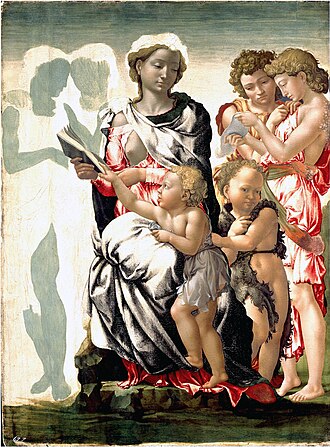 マンチェスターの聖母 - Michelangelo (1494)
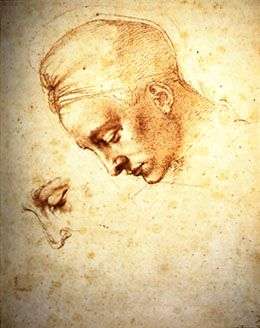 レダと白鳥 - Michelangelo (1530)
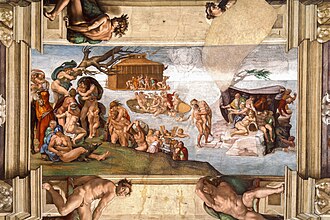 大洪水 - Michelangelo (1508)
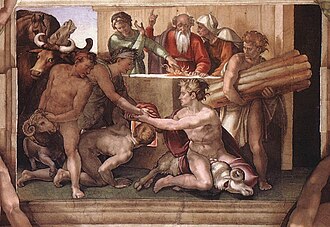 ノアの燔祭 - Michelangelo (1508)
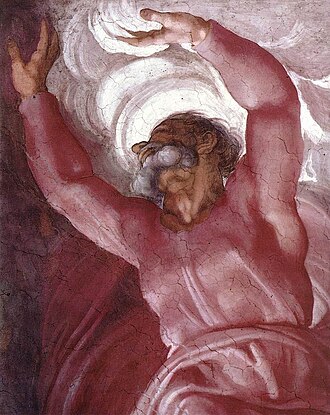 Separation of Light from Darkness - Michelangelo (1512)
関連する画家の作品
 システィーナの聖母 - Raphael (1510s)
.jpg) ラ・フォルナリーナ - Raphael
ラ・フォルナリーナ - Raphael.jpg) ウルビーノのヴィーナス - Titian (1538)
ウルビーノのヴィーナス - Titian (1538) 聖母被昇天 - Titian (1510s)
 モナ・リザ - Leonardo da Vinci (1503-1519)
 白貂を抱く貴婦人 - Leonardo da Vinci (1490)
 自画像 - Albrecht Dürer (1500)
 東方三博士の礼拝 - Albrecht Dürer (1504)
 ヴィーナスの誕生 - Sandro Botticelli (c. 1485)
 プリマヴェーラ - Sandro Botticelli (1480s)
 快楽の園 - Hieronymus Bosch
 愚者の船 - Hieronymus Bosch (1500s)