レダと白鳥
ミケランジェロ・ブオナローティ · 1530
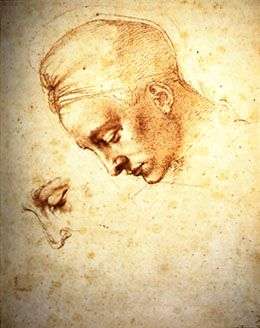
Michelangelo promised a duke a painting on the Sistine scaffolding, delivered it eighteen years later, and then refused to hand it over. Today the original is lost.
The story behind the painting
In 1512 Alfonso I d'Este, Duke of Ferrara, visited the Sistine Chapel while Michelangelo was finishing the ceiling. He climbed the scaffolding, talked admiringly with the artist, and was promised a painting. Years passed. In 1529 Michelangelo came to Ferrara to inspect its walls as governor general of fortifications for the Florentine Republic, and the duke reminded him of his promise. According to Condivi and Vasari, he made the work after returning to Florence in August 1530, after the city's fall, perhaps while in hiding. It was finished by mid-October 1530.
What to look for
We can no longer look at the original, a tempera painting on canvas of the Greek myth of Leda and the Swan. The sources describe a square work showing Jupiter, in the form of a swan, making love to a reclining Leda, based on a composition from ancient Roman gems and seals, together with an egg and the twins Castor and Pollux as children. Our sense of it comes from copies: the best known, once attributed to Rosso Fiorentino, is in the National Gallery in London, and there are others in Dresden, Berlin and the Correr Museum in Venice.
Meaning and intent
The painting's story is one of pride and controversy. When the duke called it a "little thing" in Michelangelo's hearing, the artist refused to deliver it. It passed instead to Antonio Mini, who took it to France in 1531 and in 1532 left it to Francis I, who sent it to Fontainebleau. Its frank sensuality may have led to its loss: according to reports, Queen Anne of Austria ordered it destroyed in the seventeenth century for its perceived "lasciviousness", and an inventory of 1691 records this.
Legacy
Even lost, the composition survived through copies and prints. The Casa Buonarroti in Florence holds a copy and a preparatory study for Leda's head held to be by Michelangelo himself. Among the prints, the one by Nicolas Béatrizet, which also shows Castor and Pollux, is thought to be the most faithful. So a picture that no one alive has seen continues to shape how we imagine Michelangelo as a painter of myth, carried forward by the hands of others.
豆知識
- Promised to Alfonso I d'Este in 1512; completed by mid-October 1530.
- Taken to France by Antonio Mini in 1531; left to Francis I in 1532.
- Reportedly destroyed on the orders of Anne of Austria; recorded in a 1691 inventory.
- Best-known copy: National Gallery, London.
画家について
ミケランジェロ・ブオナローティ (1475-1564)
同じ画家の作品: ミケランジェロ・ブオナローティ
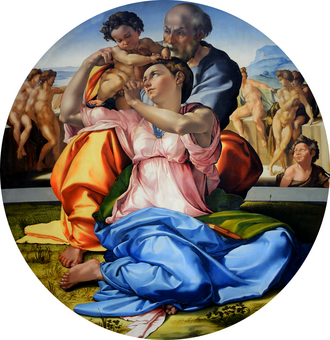 聖家族 - Michelangelo (1500s)
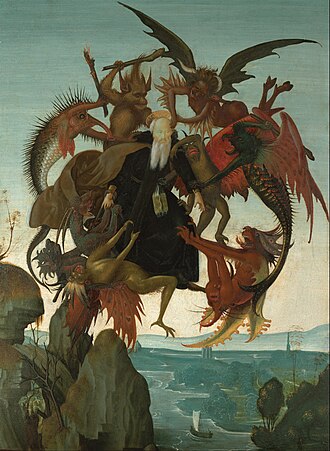 聖アンソニーの苦悩 - Michelangelo (1487)
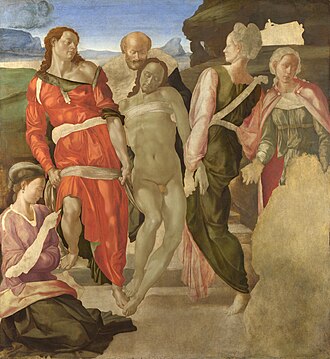 キリストの埋葬 - Michelangelo (1500s)
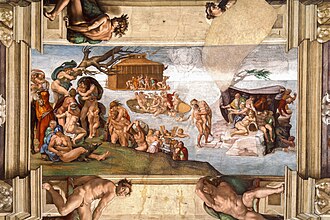 大洪水 - Michelangelo (1508)
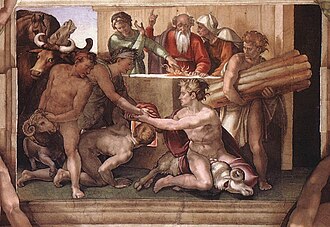 ノアの燔祭 - Michelangelo (1508)
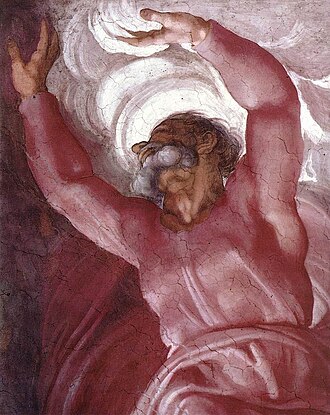 Separation of Light from Darkness - Michelangelo (1512)
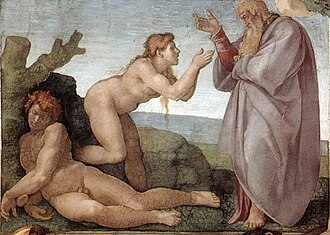 The Creation of Eve - Michelangelo (1511)
 The Separation of the Earth and Waters - Michelangelo (1511)
関連する画家の作品
.jpg) ウルビーノのヴィーナス - Titian (1538)
ウルビーノのヴィーナス - Titian (1538) 聖母被昇天 - Titian (1510s)
 システィーナの聖母 - Raphael (1510s)
.jpg) ラ・フォルナリーナ - Raphael
ラ・フォルナリーナ - Raphael モナ・リザ - Leonardo da Vinci (1503-1519)
 白貂を抱く貴婦人 - Leonardo da Vinci (1490)
 自画像 - Albrecht Dürer (1500)
 東方三博士の礼拝 - Albrecht Dürer (1504)
 ヴィーナスの誕生 - Sandro Botticelli (c. 1485)
 プリマヴェーラ - Sandro Botticelli (1480s)
 快楽の園 - Hieronymus Bosch
 愚者の船 - Hieronymus Bosch (1500s)