Uzziah, Jotham and Ahaz
ミケランジェロ・ブオナローティ · 1508
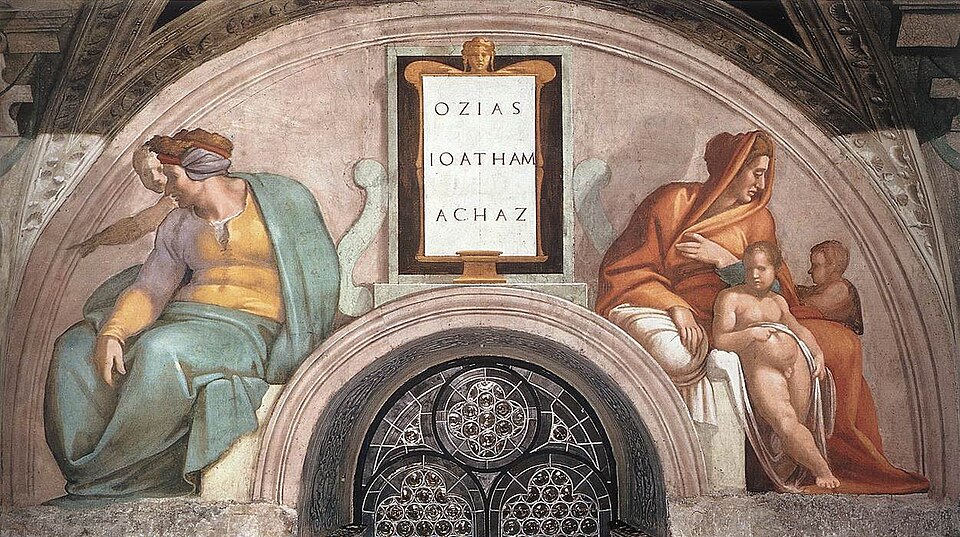
A father in a green mantle gazes where a boy points; across from him, a veiled mother in blazing orange holds two children close. In this Sistine lunette Michelangelo turned names from a genealogy into living families.
The story behind the painting
Uzziah, Jotham and Ahaz is a lunette fresco painted by Michelangelo around 1508 to 1511 on the walls of the Sistine Chapel, as part of the ceiling decoration commissioned by Pope Julius II. Wikidata gives 1508 and a size of about 215 by 430 cm. The lunettes above the windows hold Michelangelo's series of the Ancestors of Christ, painted like the rest of the ceiling in two phases, starting from the far wall opposite the altar, so the latest generations in the story were painted first. By summer 1511 the first half of the chapel had to be finished, and the scaffolding was taken down and rebuilt in the other half. The second phase began in October 1511 and ended a year later, just in time for the unveiling on the eve of All Saints' Day 1512. This lunette was probably the eighth Michelangelo painted.
What to look for
The lunette is split into two groups on either side of a tablet bearing the names in Roman capitals: OZIAS, IOATHAM, ACHAZ. The main figures are set in studied symmetry, faces turned outward, chests facing front. The man on the left, usually identified as Jotham with his son Ahaz, wears a large green mantle over a yellow tunic, with violet shadows on the shoulder matching the cap tied with violet ribbons. He sits relaxed, an arm on his knees, lips parted, staring at a point the boy behind him shows with his finger. On the right a woman closes an intensely orange mantle that dominates the colour of the whole scene, flanked by two children.
Meaning and intent
The lunettes follow the genealogy of Christ from the Gospel of Matthew. The three kings named here sit in the fourth lunette of the right wall counting from the altar, and one of the three, though no one knows which, is shown in the family group in the vaulted triangle above. Rather than painting royal portraits, Michelangelo gives us ordinary waiting, a father's distracted gaze, a mother's gravity. Her veiled head and solemn bearing recall ancient statues, and the child in front, strongly sculptural, recalls the funerary spirits of Roman sarcophagi; a very similar pose appears among the nudes in the background of his Doni Tondo of about 1506 to 1508.
Legacy
The figures were painted extremely quickly and without hesitation, with liquid, transparent strokes, except for the one behind the woman, later turned into a shadow. The second child, in shade, is sketched so briefly that it has been called a drawing made with the brush. The lunettes were among the most blackened parts of the chapel's decoration, and their restoration in 1986 gave astonishing results, revealing these bright colours again. Today the orange mantle that once lay under grime is again the visual heart of the scene.
豆知識
- Lunette fresco, about 1508 to 1511.
- Probably the eighth lunette Michelangelo painted.
- Names on the tablet: OZIAS, IOATHAM, ACHAZ.
- Restored with striking results in 1986.
画家について
ミケランジェロ・ブオナローティ (1475-1564)
同じ画家の作品: ミケランジェロ・ブオナローティ
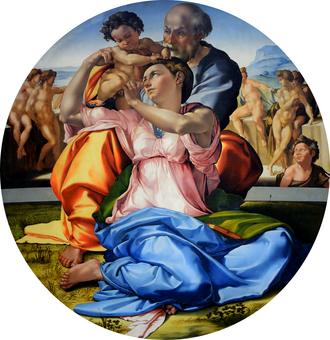 聖家族 - Michelangelo (1500s)
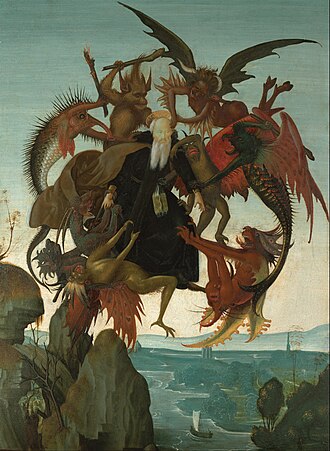 聖アンソニーの苦悩 - Michelangelo (1487)
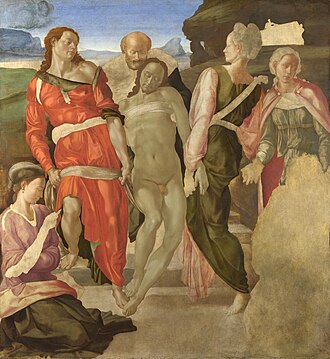 キリストの埋葬 - Michelangelo (1500s)
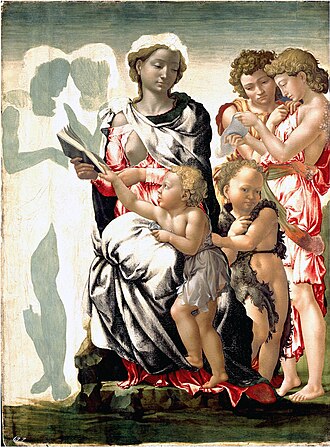 マンチェスターの聖母 - Michelangelo (1494)
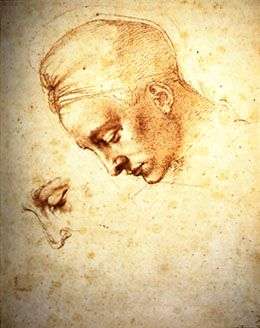 レダと白鳥 - Michelangelo (1530)
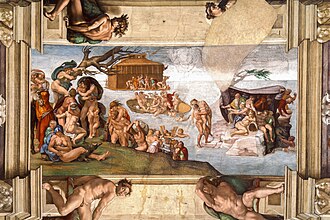 大洪水 - Michelangelo (1508)
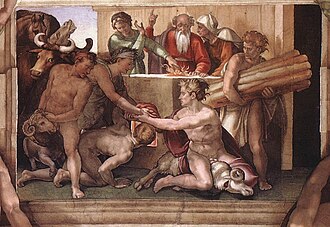 ノアの燔祭 - Michelangelo (1508)
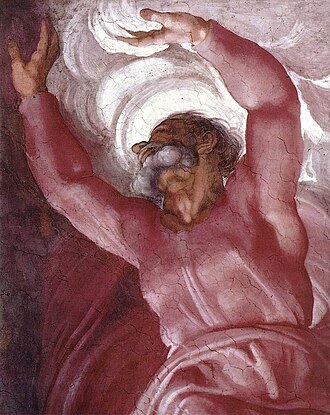 Separation of Light from Darkness - Michelangelo (1512)
関連する画家の作品
 システィーナの聖母 - Raphael (1510s)
 ラ・フォルナリーナ - Raphael
 ウルビーノのヴィーナス - Titian (1538)
 聖母被昇天 - Titian (1510s)
 モナ・リザ - Leonardo da Vinci (1503-1519)
 白貂を抱く貴婦人 - Leonardo da Vinci (1490)
 自画像 - Albrecht Dürer (1500)
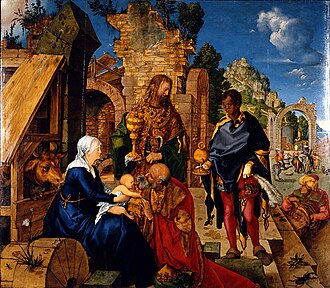 東方三博士の礼拝 - Albrecht Dürer (1504)
 ヴィーナスの誕生 - Sandro Botticelli (c. 1485)
 プリマヴェーラ - Sandro Botticelli (1480s)
 快楽の園 - Hieronymus Bosch
 愚者の船 - Hieronymus Bosch (1500s)