Sistine Chapel lunettes - Rehoboam, Abijah
ミケランジェロ・ブオナローティ · 1511
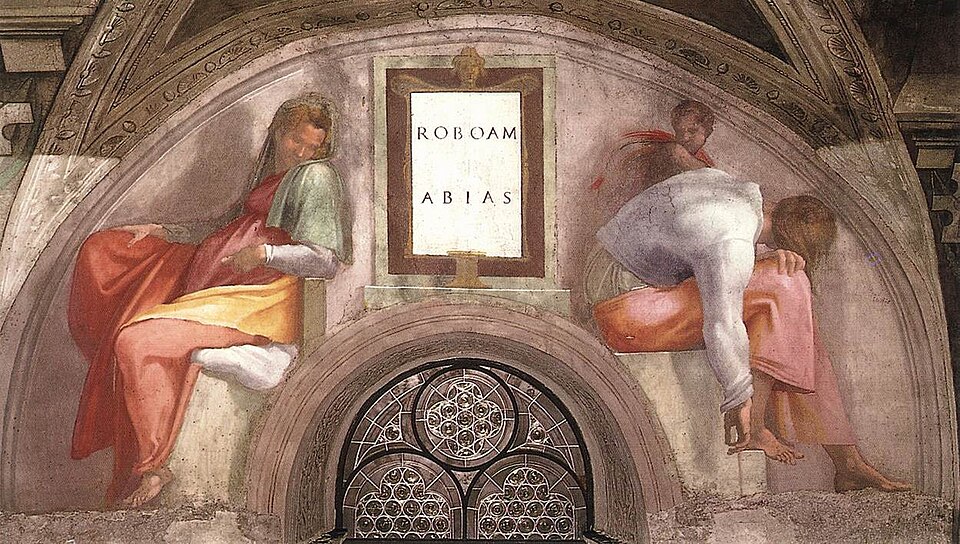
A pregnant woman leans on her chair and seems to show her unborn child; across from her a young man slumps in total abandon. Restorers found something rare here: Michelangelo painted this whole lunette without stopping.
The story behind the painting
Michelangelo frescoed this lunette around 1511 to 1512 as part of the Sistine Chapel decoration, within the ceiling work commissioned by Pope Julius II; Wikidata dates it 1511. The lunettes hold the series of the Ancestors of Christ and were painted, like the vault, in two phases, starting from the wall opposite the altar. In summer 1511 the scaffolding was taken down and rebuilt in the other half of the chapel; the second phase began in October 1511 and ended a year later, just in time for the unveiling on the eve of All Saints 1512. This lunette was probably the tenth painted, the second after the scaffolding was rebuilt.
What to look for
On the left a woman in profile seems to look toward the centre of the chapel, leaning with her head turned and one arm resting on the back of her seat, the only figure in the lunettes with such a backrest. One foot is raised on a step, showing the full sculptural force of her red cloak, lined in yellow, with a green veil and a white cushion. Her left hand shows she is pregnant. On the right a young man bends over himself, face turned to the wall, one hand on his knee, the other arm hanging out. Behind him a child, barely sketched, seems to lift him by the shoulder.
Meaning and intent
The lunettes follow Christ's genealogy from the Gospel of Matthew; Rehoboam and Abijah are in the third lunette of the right wall from the altar, named on a plaque reading ROBOAM, ABIAS. Both halves are filled with figures in varied and very natural poses, a study of ordinary human states, waiting, carrying new life, falling into weariness. The different degrees of finish help define planes in space, and the source compares them to the sculptural unfinished of works such as the Pitti and Taddei Tondi. The child's swelling cloak behind the sleeper is suggested by a single large stroke of red and black ochre.
Legacy
During restoration this lunette proved extraordinary: no sign of division into days of work was found. Particularly inspired, the artist must have painted it in one go, adding fresh plaster as he worked, without interruption. As in the other lunettes of the second phase, the plaque is simplified because the pope wanted a quick finish, and the background is lighter, the figures larger, the execution faster and more fluid. The lunettes, among the most blackened parts of the chapel, were restored with remarkable results in 1986. The young sleeper is studied in pen sketches on two sheets of the Oxford sketchbook at the Ashmolean Museum.
豆知識
- Painted around 1511 to 1512, probably the tenth lunette.
- No division into days was found: painted in one continuous session.
- The woman is the only lunette figure with a chair back.
- Restored in 1986.
画家について
ミケランジェロ・ブオナローティ (1475-1564)
同じ画家の作品: ミケランジェロ・ブオナローティ
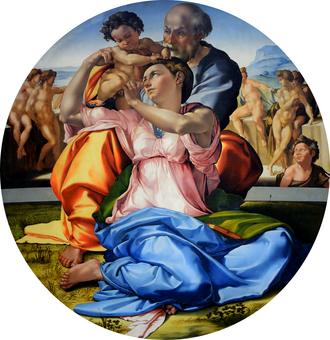 聖家族 - Michelangelo (1500s)
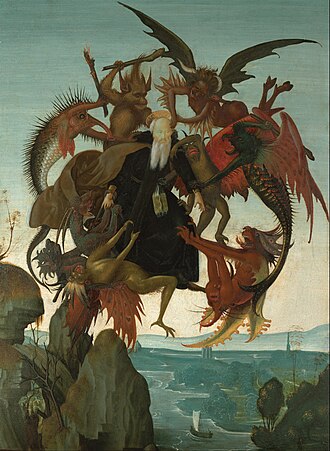 聖アンソニーの苦悩 - Michelangelo (1487)
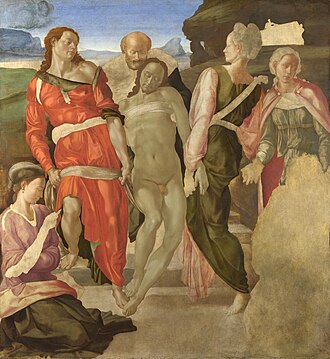 キリストの埋葬 - Michelangelo (1500s)
 マンチェスターの聖母 - Michelangelo (1494)
 レダと白鳥 - Michelangelo (1530)
 大洪水 - Michelangelo (1508)
 ノアの燔祭 - Michelangelo (1508)
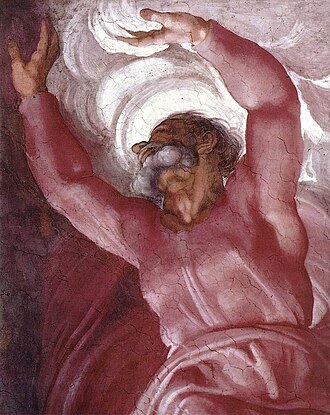 Separation of Light from Darkness - Michelangelo (1512)
関連する画家の作品
 システィーナの聖母 - Raphael (1510s)
 ラ・フォルナリーナ - Raphael
 ウルビーノのヴィーナス - Titian (1538)
 聖母被昇天 - Titian (1510s)
 モナ・リザ - Leonardo da Vinci (1503-1519)
 白貂を抱く貴婦人 - Leonardo da Vinci (1490)
 自画像 - Albrecht Dürer (1500)
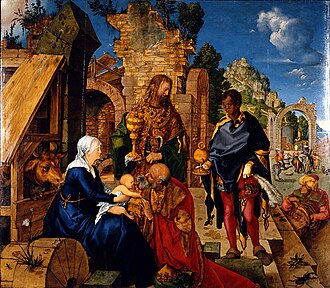 東方三博士の礼拝 - Albrecht Dürer (1504)
 ヴィーナスの誕生 - Sandro Botticelli (c. 1485)
 プリマヴェーラ - Sandro Botticelli (1480s)
 快楽の園 - Hieronymus Bosch
 愚者の船 - Hieronymus Bosch (1500s)