Francisco Goya
1746-1828
Francisco Goya painted kings with unflattering honesty, then, deaf and disillusioned, covered the walls of his own house with nightmares. Often called the last of the Old Masters and the first of the moderns, he looked straight at the follies and horrors of his age.
Origins
Goya was born on 30 March 1746 in Fuendetodos, in Aragon, the fourth child of José Benito de Goya y Franque and Gracia de Lucientes y Salvador. His father, the son of a notary with Basque roots, was a gilder who oversaw much of the ornamentation during the rebuilding of the Basilica of Our Lady of the Pillar in Zaragoza. The family returned to Zaragoza around 1749, and the boy may have attended the free Escuelas Pías de San Antón. There he formed a lifelong friendship with Martín Zapater, to whom he would write 131 letters. At fourteen he began studying with the painter José Luzán, copying prints for four years before deciding to paint from his own invention. In Madrid he studied with Anton Raphael Mengs but clashed with him, and the Royal Academy of San Fernando turned him down in 1763 and again in 1766.
Life and turning points
Without a scholarship, Goya went to Rome at his own expense. In 1771 he won second prize in a competition in Parma, then returned to Zaragoza to paint frescoes, including parts of the cupolas of the Basilica of the Pillar. He studied with Francisco Bayeu and married his sister Josefa on 25 July 1773; of their seven children only Javier reached adulthood. Through Bayeu he won commissions for some 42 tapestry cartoons for the royal palaces. Portraits followed, of the Count of Floridablanca, the Infante Luis and the Duke and Duchess of Osuna. In 1786 he became a salaried painter to Charles III, in 1789 court painter to Charles IV, and in 1799 Prime Court Painter. Around 1793 an undiagnosed illness left him deaf, and his art darkened. He stayed in Madrid through the Peninsular War, painted the Black Paintings in 1819-1823, and in 1824 left for Bordeaux, where he died in 1828.
Style and technique
Goya's early tapestry cartoons are light, popular scenes in the Rococo style, full of human types, fashions and fads. Yet he found the format limiting, since it could not hold the complex colour shifts, impasto and glazing he was developing on canvas. His royal portraits famously refuse to flatter; Charles IV of Spain and His Family is often read as a satire on a corrupt court. He studied Velázquez closely, and works such as La maja desnuda openly owe him a debt. After his deafness his work turned inward, introspective and increasingly dark. Etching and aquatint became a second voice: the 80 prints of the Caprichos, published in 1799, mock the foibles of society with biting wit. Later came the Disasters of War, the Disparates and the Tauromaquia, and finally the Black Paintings, painted in oil directly on the plaster walls of his house.
Stories and anecdotes
Early biographers loved to invent Goya's Roman adventures: travelling with a gang of bullfighters, working as a street acrobat, or plotting to abduct a young nun from her convent. Records from those years are scant. When illness slowed him at the tapestry works, he turned it to advantage, claiming it had freed him to make more personal work. In his royal family portrait he placed Queen Louisa at the centre, where real power was thought to lie, and painted himself at the back left, looking out at us. La maja desnuda, likely commissioned by Manuel Godoy, was never shown publicly in Goya's lifetime; the Inquisition confiscated it as obscene in 1813. At San Antonio de la Florida he painted a miracle of Saint Anthony with no angels at all, played out by ordinary people. He nicknamed his wife Pepa.
Legacy
Goya is considered the most important Spanish artist of the late eighteenth and early nineteenth centuries and one of the most influential figures in Western art. His paintings, drawings and engravings recorded the historical upheavals of his time and shaped major painters of the nineteenth and twentieth centuries. Édouard Manet's Olympia, for instance, recalls The Nude Maja. Works such as The Second of May 1808 and The Third of May 1808, both of 1814, gave war a new and terrible face, and the Disasters of War prints, published 35 years after his death, carried his voice to later generations. In Madrid, visitors can see his work in the Academy of Fine Arts of San Fernando, which received the Majas in 1836, and his frescoes still glow in the cupola of San Antonio de la Florida.
Le saviez-vous ?
- Goya was rejected by the Royal Academy of San Fernando twice, but later became its Director in 1795.
- He wrote 131 letters to his school friend Martín Zapater between 1775 and 1803.
- The Black Paintings were painted on the walls of his house, the Quinta del Sordo, or House of the Deaf Man.
- Some of his tapestry cartoons, such as The Wedding, measured more than 8 by 10 feet.
Œuvres de Francisco Goya
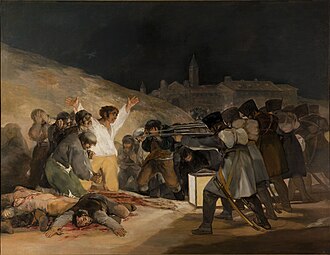 Tres de Mayo - Francisco Goya (1814)
.jpg) La Maja nue - Francisco Goya (1800)
La Maja nue - Francisco Goya (1800).jpg) Saturne dévorant un de ses enfants - Francisco Goya (1819)
Saturne dévorant un de ses enfants - Francisco Goya (1819)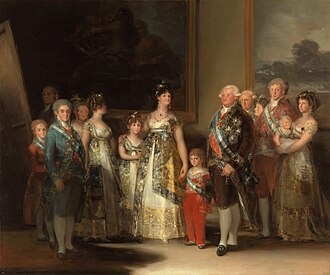 La Famille de Charles IV - Francisco Goya (1800)
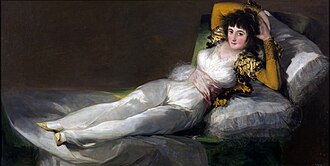 La Maja vêtue - Francisco Goya (1800)
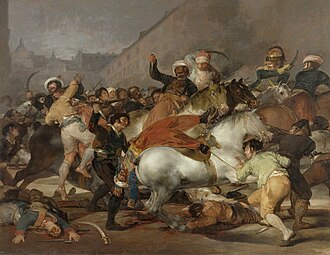 Dos de Mayo - Francisco Goya (1814)
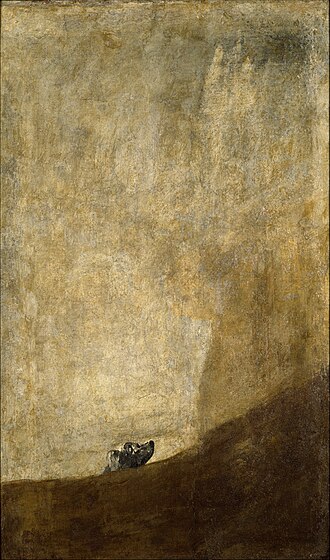 Le Chien - Francisco Goya (1819)
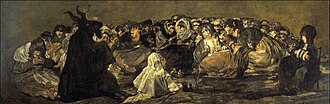 Le Sabbat des sorcières - Francisco Goya (1820s)
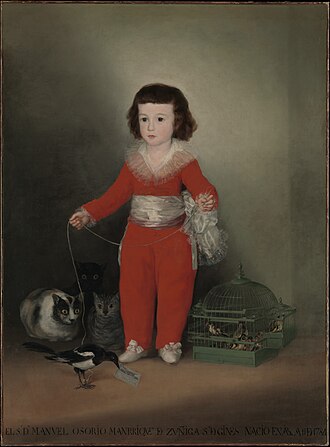 Don Manuel Osorio de Zuniga - Francisco Goya (1787)
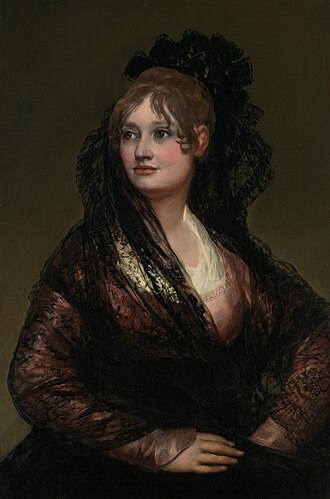 Portrait d'Isabelle Porcel - Francisco Goya (1800s)
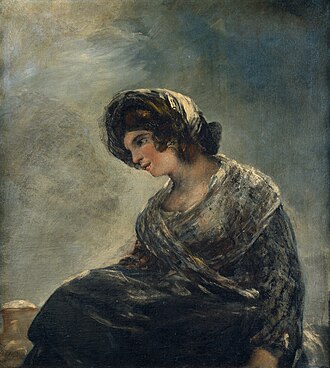 La Laitière de Bordeaux - Francisco Goya (1827)
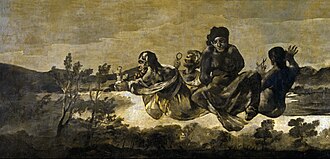 Les Parques - Francisco Goya (1819)
%20por%20Francisco%20de%20Goya.jpg) La Poule aveugle - Francisco Goya (1788)
La Poule aveugle - Francisco Goya (1788)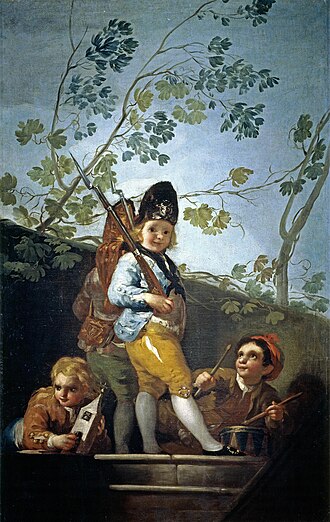 Enfants jouant aux soldats - Francisco Goya (1778)
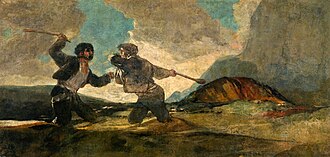 Duel au gourdin - Francisco Goya (1820)