portrait de la marquise de Santa Cruz
Francisco Goya · 1805
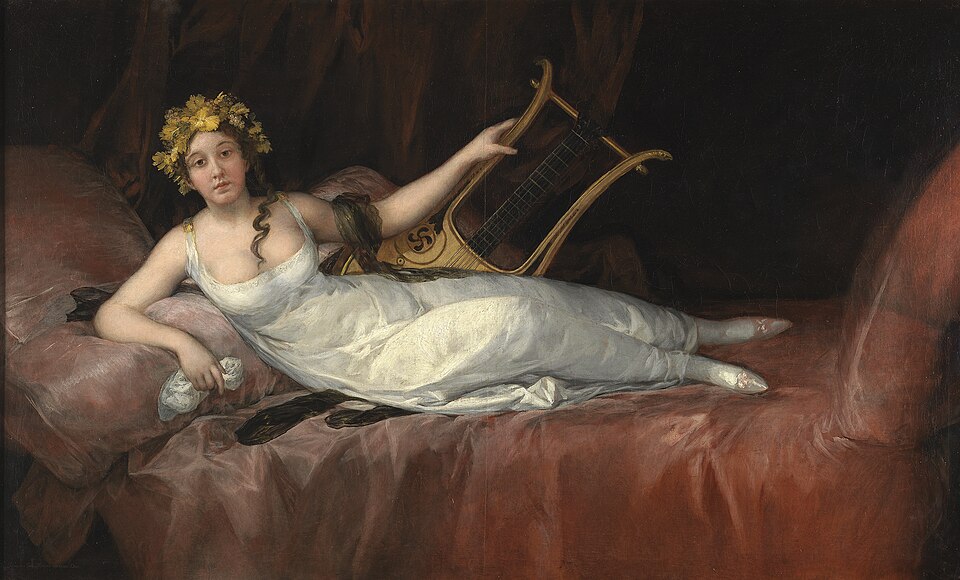
A young woman in pale white reclines on a red divan, flowers in her hair and a lyre-guitar in her hand, as if posing as a muse. Goya painted her in 1805; nearly two centuries later Spain fought to bring the picture home.
The story behind the painting
The sitter is Joaquina Téllez-Girón, Marchioness of Santa Cruz, and Goya, who painted her in 1805, was a friend of her family. The portrait, roughly 125 by 208 cm, is wider than it is tall, which suits a figure lying at full length. Wikidata classes it as a historiated portrait, a likeness in which the sitter takes on a role. Here the role draws on the ancient world: the young marchioness appears less as a society lady than as a figure from mythology or the Greek theatre, while remaining recognisably herself.
What to look for
She lies on her side on a red divan, in a very light white dress, her long brown hair loose. Her head is crowned with yellow flowers, and her left hand balances a lyre-guitar. Notice that her gaze does not meet ours; she seems to look into the distance. Her body does not settle naturally either: rather than sinking into the cushions, she seems to float above the red divan and the pillows. The strong red against the white dress carries much of the picture, and the long horizontal format stretches her across the whole canvas.
Meaning and intent
The theme is almost allegorical, a reference to ancient Greek theatre. The composition recalls Antonio Canova's sculpture of Paolina Borghese as Venus Victrix, and the portrait has been compared to Venus figures by Velázquez and, to some extent, Titian. The flowers on her head refer to Bacchus, while the lyre-guitar, shaped like an ancient lyre, is a homage to art and to Apollo. So the portrait makes a young aristocrat into a muse, joining pleasure and the arts in one reclining figure.
Legacy
In 1983 the painting was exported from Spain illegally, and the Spanish government spent years trying to recover it. It was finally bought back in 1986 and brought to the Museo del Prado after legal negotiations, and the case led Spain to write a new law to better protect the nation's artistic heritage. Another, less detailed version was bought by Imelda Marcos in 1978 and confiscated by the Philippine government in 2014. The painting also inspired a fantasy portrait in the 2015 comedy film Mortdecai.
Le saviez-vous ?
- Painted by Goya in 1805, a friend of the sitter's family.
- Illegally exported in 1983, recovered for the Prado in 1986.
- The case led to a new Spanish heritage law.
- A second, less detailed version was confiscated in the Philippines in 2014.
À propos de l'artiste
Francisco Goya (1746-1828)
femme · musée du Prado · cheveux longs · robe · mode des années 1795-1820 · cheveux bruns · portrait historié · à demi étendu
Autres œuvres de Francisco Goya
 Tres de Mayo - Francisco Goya (1814)
.jpg) La Maja nue - Francisco Goya (1800)
La Maja nue - Francisco Goya (1800).jpg) Saturne dévorant un de ses enfants - Francisco Goya (1819)
Saturne dévorant un de ses enfants - Francisco Goya (1819) La Famille de Charles IV - Francisco Goya (1800)
 La Maja vêtue - Francisco Goya (1800)
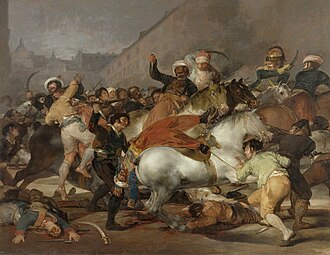 Dos de Mayo - Francisco Goya (1814)
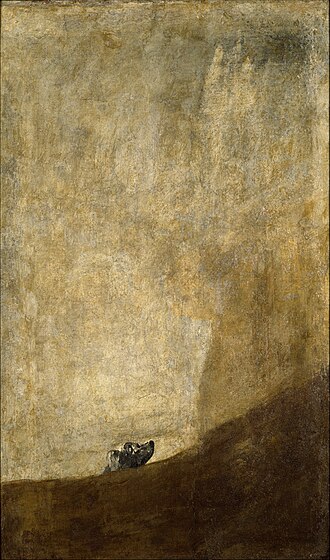 Le Chien - Francisco Goya (1819)
 Le Sabbat des sorcières - Francisco Goya (1820s)
Œuvres d'artistes liés
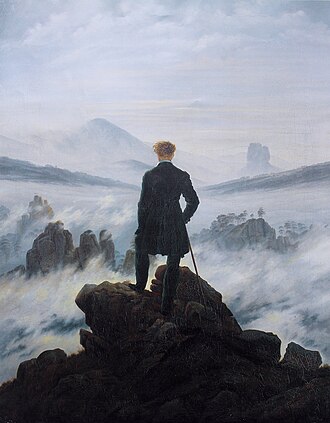 Le Voyageur contemplant une mer de nuages - Caspar David Friedrich (c. 1818)
 L'Abbaye dans une forêt de chênes - Caspar David Friedrich (1800s)
 Le Dernier Voyage du Téméraire - J. M. W. Turner (1839)
 Pluie, Vapeur et Vitesse - J. M. W. Turner (1844)
 La Liberté guidant le peuple - Eugène Delacroix (1830)
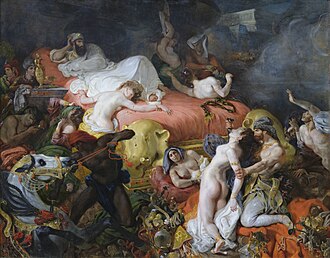 La Mort de Sardanapale - Eugène Delacroix (1827)