les Majas au balcon
.jpg)
Two young women in lace mantillas lean towards each other behind a balustrade, while two cloaked men lurk in the shadows. This is the version in the Rothschild collection, thought to be Goya's original.
The story behind the painting
Goya painted Majas on a Balcony between 1808 and 1814, while Spain was in conflict after the invasion by Napoleon's forces. He considered his maja pictures, like this one and Maja and Celestina on the Balcony, a distraction from more serious work such as the Disasters of War. The painting was probably made for his own pleasure, possibly to decorate his house. The version in the collection of Edmond de Rothschild in Switzerland is thought to be the original, while the one in the Metropolitan Museum of Art is thought to be a copy.
What to look for
Two well-dressed majas sit behind the balustrade, in light colours and richly decorated clothes. Behind them two men stand in plain, heavy clothing, their dark hats and cloaks hiding their features. The top of the balustrade divides the scene in two and forms the diagonal of a square: the pilasters sit in its lower half, and the women lean towards each other in a triangle in the upper half. The area above the balustrade falls into four equal quadrants. This canvas measures about 162 by 107 cm.
Meaning and intent
According to the critic Sebastian Smee, both women are courtesans, and the two men, in capes and cocked hats, are threatening as they lurk in the shadows. The strong contrast between light and dark, women and men, turns a pleasant balcony scene into something uneasy. Goya saw such pictures as lighter work beside the Disasters of War, yet the menace in the background shows that the darkness of those years still entered the scene.
Legacy
The original was one of eight paintings sold by Goya's son Javier to Baron Taylor in 1836, and was shown at the Louvre in Louis Philippe's Spanish gallery from 1838 to 1848. It later passed through the Duke of Montpensier and his son, then Durand-Ruel, to the Rothschilds. While in Paris it inspired Manet's The Balcony of 1868 to 1869, which in turn inspired Magritte's 1950 version with coffins in place of people.
Le saviez-vous ?
- Painted between 1808 and 1814.
- The Rothschild version is thought to be the original.
- Shown at the Louvre's Spanish gallery from 1838 to 1848.
- Inspired Manet's The Balcony, which inspired Magritte.
À propos de l'artiste
Francisco Goya (1746-1828)
femme · homme · scène de genre · position assise · balcon · balustrade · majo
Autres œuvres de Francisco Goya
 Tres de Mayo - Francisco Goya (1814)
.jpg) La Maja nue - Francisco Goya (1800)
La Maja nue - Francisco Goya (1800).jpg) Saturne dévorant un de ses enfants - Francisco Goya (1819)
Saturne dévorant un de ses enfants - Francisco Goya (1819) La Famille de Charles IV - Francisco Goya (1800)
 La Maja vêtue - Francisco Goya (1800)
 Dos de Mayo - Francisco Goya (1814)
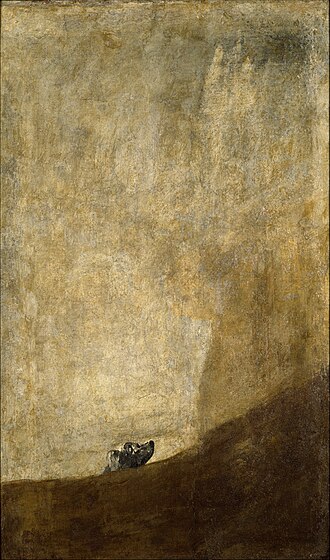 Le Chien - Francisco Goya (1819)
 Le Sabbat des sorcières - Francisco Goya (1820s)
Œuvres d'artistes liés
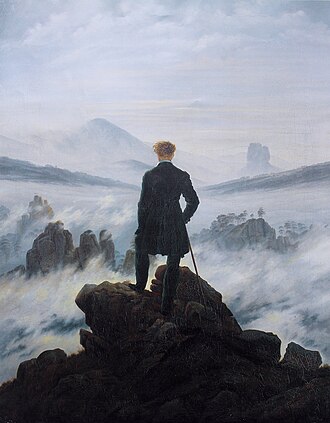 Le Voyageur contemplant une mer de nuages - Caspar David Friedrich (c. 1818)
 L'Abbaye dans une forêt de chênes - Caspar David Friedrich (1800s)
 Le Dernier Voyage du Téméraire - J. M. W. Turner (1839)
 Pluie, Vapeur et Vitesse - J. M. W. Turner (1844)
 La Liberté guidant le peuple - Eugène Delacroix (1830)
 La Mort de Sardanapale - Eugène Delacroix (1827)