Enfants jouant aux soldats
Francisco Goya · 1778
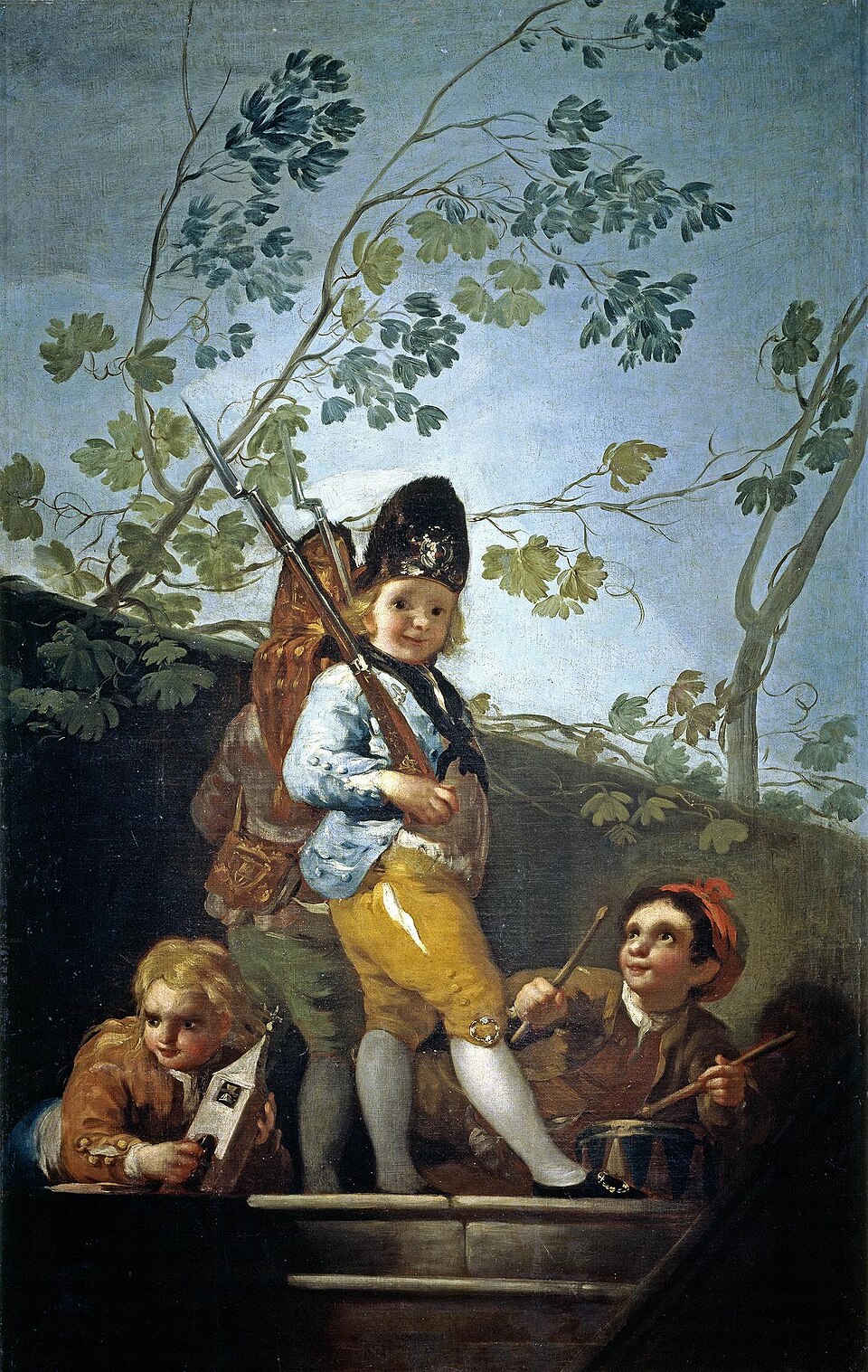
Four boys march across a rise with rifles, a drum and a toy bell tower, and one small soldier turns to grin right at us. Goya made this cheerful parade for a royal bedroom.
The story behind the painting
Boys Playing Soldiers is a tapestry cartoon by Francisco de Goya, conceived for the bedroom of the Princes of Asturias in the Royal Palace of El Pardo. Wikidata dates it to 1778, while the Wikipedia account gives 1778 to 1779. It may have hung above a door. It belonged to a group of similar images devoted to children that decorated the royal chambers, including Boys with a Cart, Boys Picking Fruit and Children Inflating a Bladder. It shares a similar color range with The Crockery Vendor, and both decorated the same wall. A preparatory sketch survives too, kept in the Yanduri Collection in Seville. The weaver later made several changes to the composition to suit the tastes of the time.
What to look for
The canvas is tall, about 146 by 94 cm. Look at the group standing on top of a rise: two boys on foot carry rifles, one plays a drum, and the last holds a miniature bell tower. The low viewpoint makes them seem larger and more present, as if we were looking up at a real regiment. Then find the cheerful little soldier near us who looks straight out at the onlooker; this glance has been considered one of Goya's major achievements in the work. The yellowish and bluish colors create a sunny atmosphere, echoed by the boys' happy faces. Notice how loose brushwork and light give the scene its freshness.
Meaning and intent
The composition has a martial character, but it is funny and childish at the same time. Children imitate the serious business of soldiers, and the result is a gentle comedy. Goya often painted children of different social types, such as majos and aristocrats, and here he gives their play real dignity and warmth. The boy who meets our eyes draws us into the game, as though inviting us to join the march. Intended for a royal bedroom, the picture offers a light and affectionate view of childhood rather than a lesson or a story with a moral.
Legacy
The cartoon is now exhibited at the Museo del Prado in Madrid. Its brushwork and treatment of light have led it to be described as a forerunner of impressionism, like other works by Goya. It also helps us imagine how Goya's tapestry designs worked together: placed above a door and sharing a wall with The Crockery Vendor, it formed part of a larger decorative scheme of children at play. The sketch in Seville and the changes made by the weaver show that these images passed through several hands before they became woven decoration.
Le saviez-vous ?
- Tapestry cartoon for the Princes of Asturias' bedroom at El Pardo.
- Dated 1778 by Wikidata; 1778 to 1779 by Wikipedia.
- A sketch is in the Yanduri Collection, Seville.
- Now exhibited at the Museo del Prado.
À propos de l'artiste
Francisco Goya (1746-1828)
scène de genre · musée du Prado
Autres œuvres de Francisco Goya
 Tres de Mayo - Francisco Goya (1814)
.jpg) La Maja nue - Francisco Goya (1800)
La Maja nue - Francisco Goya (1800).jpg) Saturne dévorant un de ses enfants - Francisco Goya (1819)
Saturne dévorant un de ses enfants - Francisco Goya (1819) La Famille de Charles IV - Francisco Goya (1800)
 La Maja vêtue - Francisco Goya (1800)
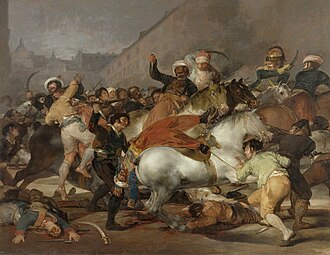 Dos de Mayo - Francisco Goya (1814)
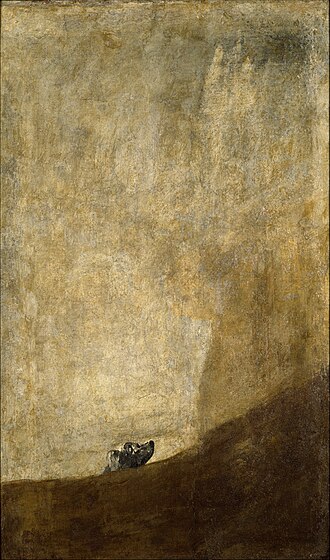 Le Chien - Francisco Goya (1819)
 Le Sabbat des sorcières - Francisco Goya (1820s)