Le Sabbat des sorcières
Francisco Goya · 1820s
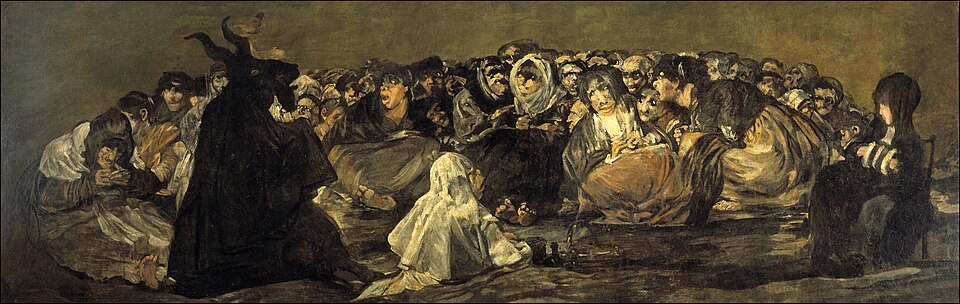
In moonlit silhouette, a goat-headed Satan looms over a circle of terrified old women. Goya painted this nightmare straight onto the wall of his own house, and never told anyone why.
The story behind the painting
Witches' Sabbath, also called The Great He-Goat, is one of the fourteen Black Paintings that Francisco Goya applied in oil to the plaster walls of his house, the Quinta del Sordo, sometime between 1820 and 1823. Goya was then around 75, living in near-solitude outside Madrid, deaf since the early 1790s and tormented by a dread of old age and madness. He had been a successful, royally placed artist, but he withdrew from public life and worked on this series in secret. He gave none of the paintings titles, never mentioned them in his letters, and left no record of his intentions. An 1830 inventory places the mural across a full wall between two windows, opposite A Pilgrimage to San Isidro. It was the broadest of all the Black Paintings.
What to look for
Find the dark mass on the left first: Satan, in what may be clerical clothing, with a goat's beard and horns, preaching from a mound of earth. He is pure silhouette, his heavy body and gaping mouth drawn out of the black. Before him crouches a coven of old women with similar twisted features, some bowing their heads in fear, others staring up in open-mouthed awe; the eyes of some are lined with white paint. Now look far to the right. One woman sits apart, her back to us, her face half hidden beneath a white hood like a nun's habit, with bottles and vials on the ground beside her. Goya began on a black ground and laid on broad, heavy strokes of grey, blue and brown, leaving the black bare for the darkest passages.
Meaning and intent
Because Goya left no word about this series, every reading is an interpretation. Many art historians see the mural as a satire on the credulity of the age, a condemnation of superstition and of the witch trials of the Spanish Inquisition. It is often read as a bitter, silent protest against the royalists and clergy who retook control of Spain after the Peninsular War, when liberals like Goya saw their hopes for reform dashed. Satan rules here not by respect but by fear, a kind of power that has been compared to the king's in Goya's The Junta of the Philippines. The lone hooded woman may be a newcomer about to join the coven, and some suggest she represents Leocadia Weiss, Goya's maid and probable lover. The art historian Fred Licht believed the rough brushwork was deliberate, a way of conveying despair.
Legacy
Goya went into exile in France in 1824, and the house passed through several owners. By the time the Belgian Frédéric Émile d'Erlanger acquired it in 1873, the murals had deteriorated badly. Around 1874 they were taken down and transferred to canvas under the direction of Salvador Martínez Cubells, restorer of the Museo del Prado. In the process, about 140 centimetres were cut from the right-hand side of Witches' Sabbath. The paintings met with little reaction at the Paris Exposition Universelle of 1878, and d'Erlanger donated them to the Spanish state in 1881. Today the work, measuring 140 by 438 centimetres, hangs in the Museo del Prado in Madrid, where it is linked in spirit to Goya's etching The Sleep of Reason Produces Monsters and his Disasters of War prints.
Le saviez-vous ?
- One of Goya's fourteen Black Paintings, painted c. 1820-1823 on the walls of the Quinta del Sordo
- Transferred to canvas around 1874; about 140 cm was cut from the right side
- Unlike most of the Black Paintings, it seems to have been painted directly onto the wall without a preparatory drawing
- Museo del Prado, Madrid; 140 × 438 cm
À propos de l'artiste
Francisco Goya (1746-1828)
scène de genre · musée du Prado
Autres œuvres de Francisco Goya
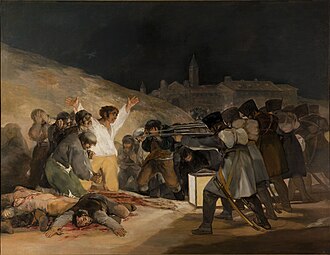 Tres de Mayo - Francisco Goya (1814)
.jpg) La Maja nue - Francisco Goya (1800)
La Maja nue - Francisco Goya (1800).jpg) Saturne dévorant un de ses enfants - Francisco Goya (1819)
Saturne dévorant un de ses enfants - Francisco Goya (1819)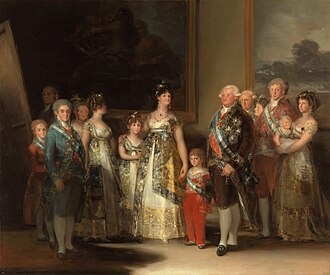 La Famille de Charles IV - Francisco Goya (1800)
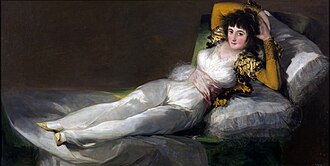 La Maja vêtue - Francisco Goya (1800)
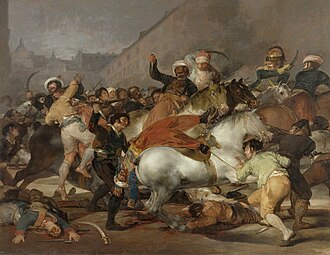 Dos de Mayo - Francisco Goya (1814)
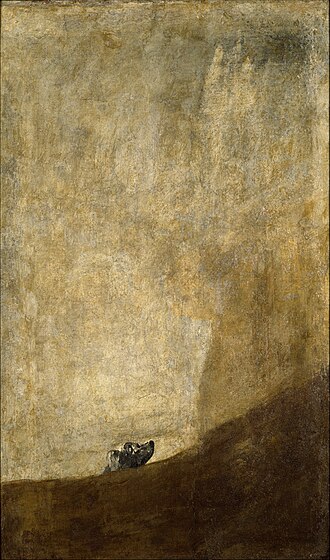 Le Chien - Francisco Goya (1819)
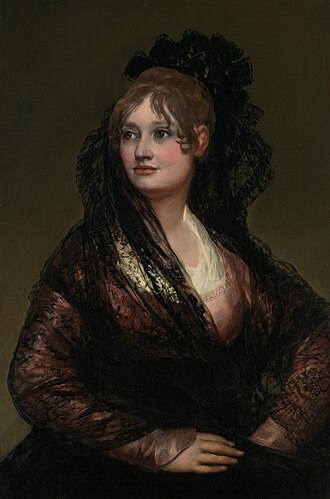 Portrait d'Isabelle Porcel - Francisco Goya (1800s)