La Famille de l'infant Don Louis de Bourbon
Francisco Goya · 1783
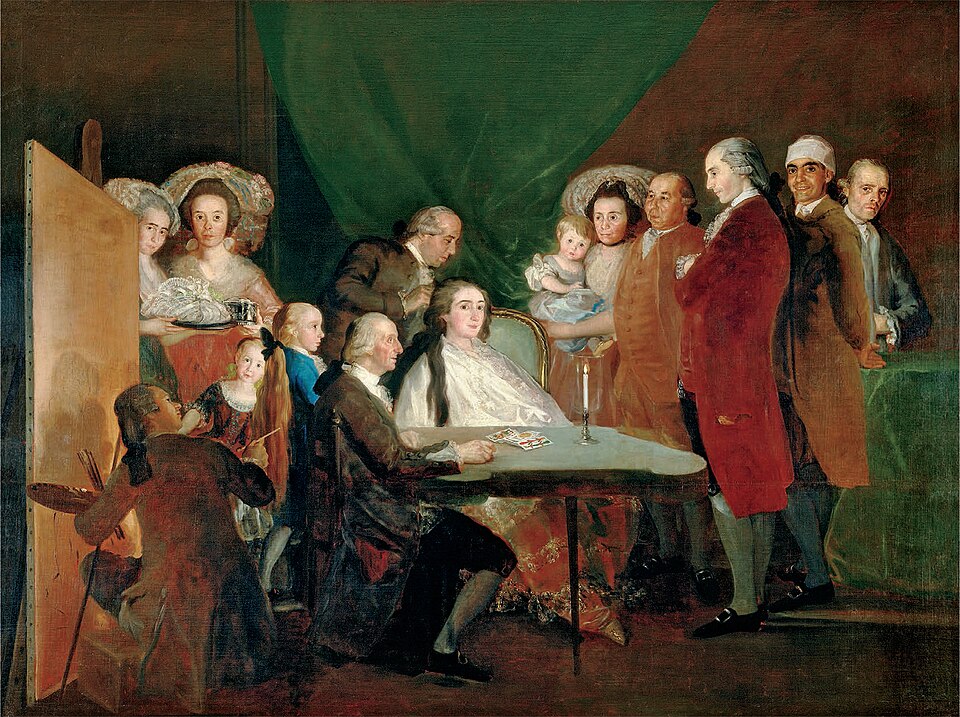
Fourteen people gather by candlelight around a card table while a servant combs out a princess's long hair. Goya slipped himself into the corner of this night scene, painted during a summer of friendship with a king's brother he would never see again.
The story behind the painting
In mid-August 1783 Goya, already prized as a portraitist, was invited to the estate of Arenas de San Pedro near Ávila by Luis of Bourbon, brother of King Charles III. Don Luis was spending his last years there with his wife, María Teresa de Vallabriga, whom he had married after giving up the cardinalate. Goya stayed a month, went hunting with the family and won their close trust. In a letter of 20 September 1783 to Martín Zapater he wrote that Don Luis had tried everything to keep him and made him promise to visit once a year. Goya never kept the promise, and Don Luis died two years later. The painting is dated 1783 to 1784 in Wikipedia, while Wikidata gives 1783.
What to look for
The family gathers round a table where Don Luis, in profile, lays cards on green velvet before his evening farewell. María Teresa sits at the centre while a servant lets down her long hair for the night; her gaze is melancholy and uneasy. Two maids in nightgowns enter from the left with the jewel box. Among the others are the young Don Luis María in blue, the future cardinal; the nurse with little María Josefa; secretaries and courtiers; and the composer and cellist Luigi Boccherini in a long red coat. A man with a bandaged head, probably the secretary Francisco del Campo, laughs heartily. At the far left Goya paints himself, back turned to his patron, in a nod to Velázquez's Las Meninas.
Meaning and intent
This is an informal, intimate portrait that mixes maids, princes, courtiers and townsfolk without regard to rank, far from Goya's later Charles IV of Spain and His Family. A single flickering candle lights a heavy nocturnal mood. Writers on the painting see two themes: the passing of life, suggested by the candle that may go out and the unsteady table, and the isolation of each figure, lost in private thought. Fred Licht argues that Goya removed Las Meninas' mirror only by moving it to the wall facing the family, so he paints what they themselves saw, a turning point in portraiture. Francisco del Campo's laugh is the only festive note among weary adults and innocent children.
Legacy
Stylistically the picture follows the Neoclassical ideas of Anton Raphael Mengs, with sober painting, loose but analytical brushwork, a simplified background and austere colour; critics also point to Corrado Giaquinto, Joseph Wright of Derby and Giandomenico Tiepolo. The work passed to Don Luis's daughter María Teresa, moved around 1820 to the palace of Boadilla del Monte, and appears in inventories of 1832 and 1886. In 1904 it was inherited by the Ruspoli family, later travelled to the Contini Bonacossi collection in Florence, and in 1974 joined the collection of Luigi Magnani. It is now in the Fondazione Magnani-Rocca at Traversetolo, near Parma.
Le saviez-vous ?
- Painted after Goya's month-long stay at Arenas de San Pedro in 1783.
- Fourteen figures, including Goya himself and Luigi Boccherini.
- Goya's self-portrait nods to Velázquez's Las Meninas.
- Now in the Fondazione Magnani-Rocca near Parma.
À propos de l'artiste
Francisco Goya (1746-1828)
portrait de famille · Fondation Magnani-Rocca
Autres œuvres de Francisco Goya
 Tres de Mayo - Francisco Goya (1814)
 La Maja nue - Francisco Goya (1800)
 Saturne dévorant un de ses enfants - Francisco Goya (1819)
 La Famille de Charles IV - Francisco Goya (1800)
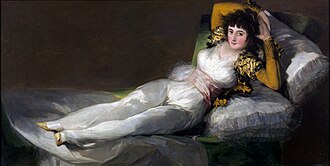 La Maja vêtue - Francisco Goya (1800)
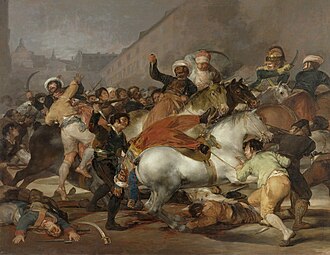 Dos de Mayo - Francisco Goya (1814)
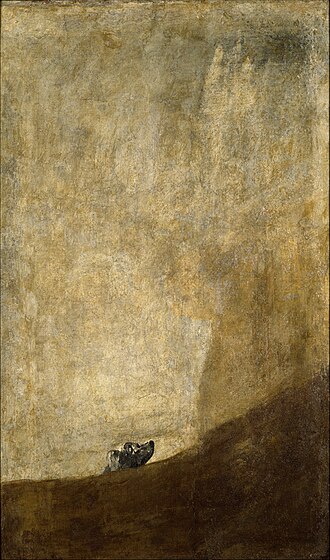 Le Chien - Francisco Goya (1819)
 Le Sabbat des sorcières - Francisco Goya (1820s)
Œuvres d'artistes liés
 Le Voyageur contemplant une mer de nuages - Caspar David Friedrich (c. 1818)
 L'Abbaye dans une forêt de chênes - Caspar David Friedrich (1800s)
 La Liberté guidant le peuple - Eugène Delacroix (1830)
 La Mort de Sardanapale - Eugène Delacroix (1827)
 Le Dernier Voyage du Téméraire - J. M. W. Turner (1839)
 Pluie, Vapeur et Vitesse - J. M. W. Turner (1844)
 L'Enfant bleu - Thomas Gainsborough (1770)
 Les Époux Andrews - Thomas Gainsborough (1748)