Première Renaissance
The Early Renaissance is the moment when Italian painters, starting in Florence, began to make pictures that felt solid, real and full of human feeling.
Sandro Botticelli · Leonardo da Vinci
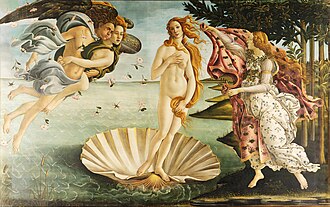 La Naissance de Vénus - Sandro Botticelli (c. 1485)
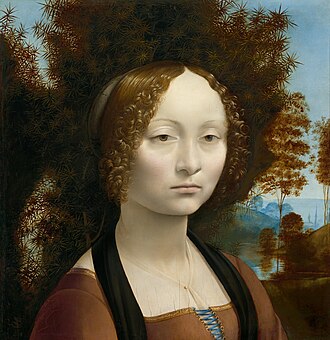 Portrait de Ginevra de' Benci - Leonardo da Vinci (1470s)
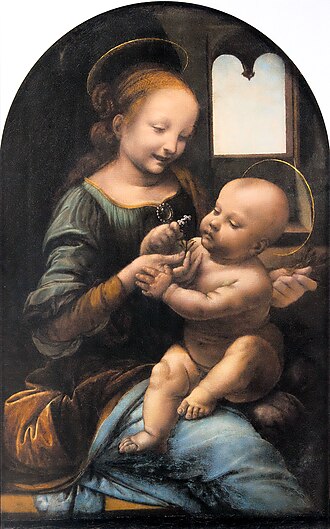 Madonna Benois - Leonardo da Vinci
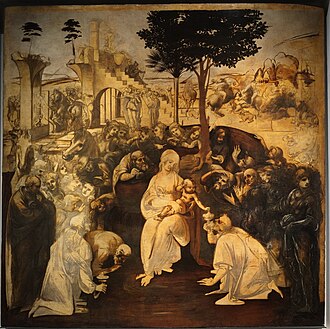 L'Adoration des mages - Leonardo da Vinci (1482)
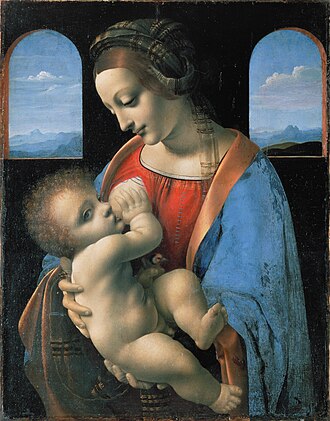 Madone Litta - Leonardo da Vinci (1490)
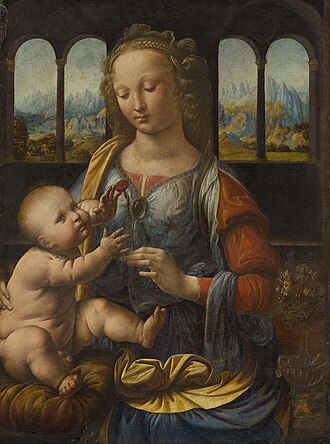 La Madone à l'œillet - Leonardo da Vinci (1475)
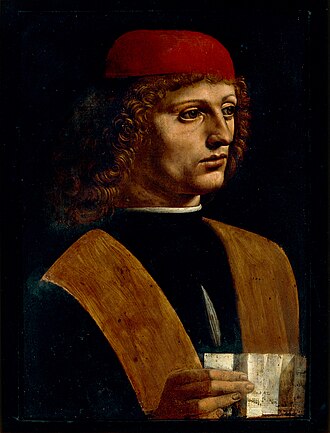 Portrait de musicien - Leonardo da Vinci (1485)
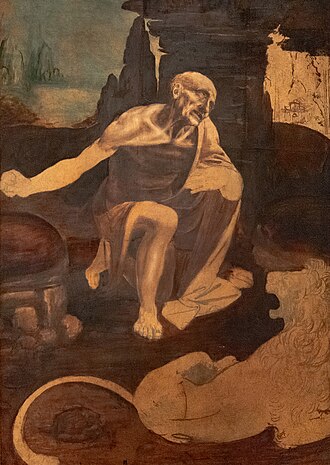 Saint Jérôme - Leonardo da Vinci (1480s)
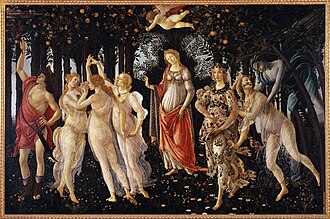 Le Printemps - Sandro Botticelli (1480s)
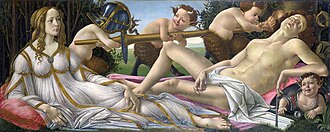 Vénus et Mars - Sandro Botticelli (1485)
.jpg) La Vierge aux rochers - Leonardo da Vinci (1480s)
La Vierge aux rochers - Leonardo da Vinci (1480s)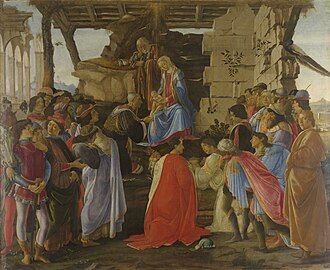 L'Adoration des mages - Sandro Botticelli (1470s)
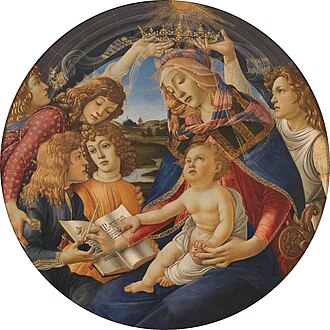 La Madone du Magnificat - Sandro Botticelli (1481)
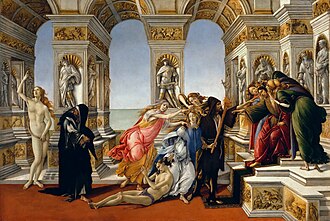 La Calomnie d'Apelle - Sandro Botticelli (1490s)
.jpg) Pallas et le Centaure - Sandro Botticelli (1482)
Pallas et le Centaure - Sandro Botticelli (1482)%20-%20Google%20Art%20Project.jpg) Portrait ideale d'une jeune femme - Sandro Botticelli (1480)
Portrait ideale d'une jeune femme - Sandro Botticelli (1480)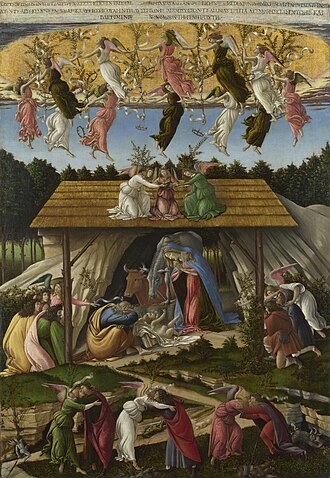 La Nativité mystique - Sandro Botticelli (1500)
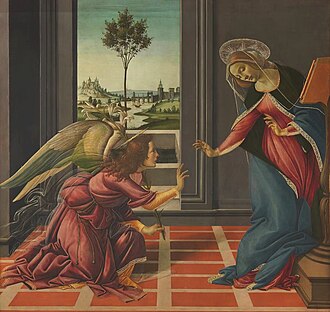 L'Annonciation du Cestello - Sandro Botticelli
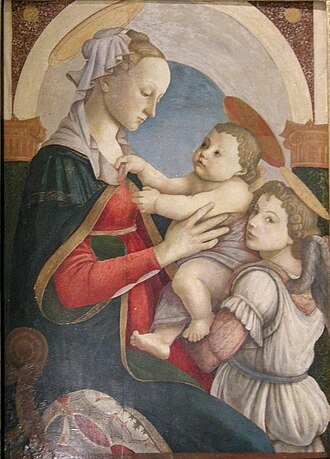 La Vierge à l'Enfant avec un ange - Sandro Botticelli (1465)
.jpg) Portrait d'homme avec médaille de Cosme l'ancien - Sandro Botticelli (1474)
Portrait d'homme avec médaille de Cosme l'ancien - Sandro Botticelli (1474)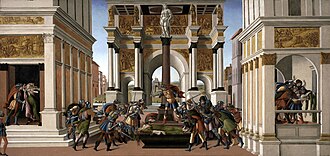 La Tragédie de Lucrèce - Sandro Botticelli (1500)
Envie d'en savoir plus sur Première Renaissance ?
The Early Renaissance is the moment when Italian painters, starting in Florence, began to make pictures that felt solid, real and full of human feeling. Walking into this period is like watching artists discover depth, light and perspective for the first time, one bold experiment after another.
What is the Early Renaissance, in simple words?
It is the first great phase of Renaissance painting in Italy, roughly from 1400 to 1495. Artists took the art of ancient Greece and Rome as their foundation, but mixed it with new ideas and with scientific knowledge of their own day. The result was painting that looked more natural and three-dimensional than the stiff, formal religious pictures that came before, with real-looking bodies, believable spaces and faces that show emotion.
Why is it called the Renaissance?
Renaissance is a French word that literally means "rebirth". It refers to the revival of interest in the classical learning and art of the ancient world. Scholars today point out that the name can be misleading: the Renaissance was not a sudden break with medieval values, and in many parts of Europe early Renaissance art was made at the same time as late medieval art. "Early" simply marks it as the first stage before the High Renaissance.
When and where did it start?
It began in Florence. Many people date the first truly Renaissance works to 1401, when seven young sculptors, including Brunelleschi, Donatello and the winner Lorenzo Ghiberti, competed to design bronze doors for the Baptistery of Florence Cathedral. In painting, Masaccio is said to have begun the Early Renaissance in 1425. Florence was rich thanks to the Medici Bank, and Cosimo de' Medici set a new standard for supporting the arts.
Who were the main painters?
The key name is Masaccio, who carried forward the lifelike style Giotto had begun a century earlier. After him came Fra Angelico, Paolo Uccello and Piero della Francesca. Later in the century Sandro Botticelli, Pietro Perugino and Domenico Ghirlandaio were important in Florence and Rome. In northern Italy Andrea Mantegna stood out, and in Naples Antonello da Messina was among the first Italians to use oil paint, possibly about 1450.
How can I recognise an Early Renaissance painting?
Look for figures that feel solid and stand firmly in space, faces and gestures that look natural, and a careful sense of depth. Painters were deeply concerned with perspective and light. Masaccio's Tribute Money, for example, uses a single vanishing point and strong contrast between light and dark to look three-dimensional. You may also notice classical touches borrowed from ancient Rome, and many religious subjects such as the Madonna and Child.
How is it different from the art that came before?
Earlier Italian painting followed the Italo-Byzantine tradition, which was highly formal and repeated fixed poses from icon painting. Giotto had already moved toward more lifelike figures around 1300, and Early Renaissance painters built on him. Compared with the elegant, gold-rich International Gothic style, Early Renaissance work aimed for realistic space using linear perspective, a study of anatomy and a more scientific handling of light.
What were the painters trying to do?
They wanted pictures that looked like the real world. They studied perspective, light, anatomy and foreshortening. According to the biographer Giorgio Vasari, Uccello was so obsessed with perspective that it disturbed his sleep. Piero della Francesca made systematic, scientific studies of light and linear perspective. The architect and writer Leone Battista Alberti even published a treatise, On Painting, in 1435 to explain these ideas.
Which famous works should I see first?
Good starting points are Masaccio's frescoes in the Brancacci Chapel in Florence, including the Tribute Money and the Expulsion of Adam and Eve. Then look at Uccello's three Battle of San Romano paintings, Piero della Francesca's The History of the True Cross in Arezzo and his Flagellation of Christ, Mantegna's Camera degli Sposi in Mantua, and Botticelli's Birth of Venus, painted for the Medici.
Where can I see these paintings today?
Many are still where they were made. The Brancacci Chapel frescoes are in the Carmelite Church in Florence, Fra Angelico's frescoes are at the Convent of San Marco in Florence, Piero's True Cross cycle is in San Francesco in Arezzo, and Mantegna's painted room is in the Ducal Palace in Mantua. In Rome, the walls of the Sistine Chapel hold frescoes by Botticelli, Perugino, Ghirlandaio and Cosimo Rosselli.
Why does it still matter?
The Early Renaissance laid the groundwork for everything that followed. Masaccio's work inspired later painters including Leonardo da Vinci and Michelangelo, and the skills these artists perfected, such as lighting, perspective, anatomy and characterisation, became the basis of the High Renaissance. For art historians, Renaissance art marks Europe's transition from the medieval period to the early modern age, so this is where much of Western painting as we know it begins.