Fra Angelico
1400-1455
Fra Angelico, a Dominican friar who is said to have never picked up a brush without prayer, painted the quiet cells of San Marco so that each brother could meditate before a scene from the life of Christ. His gentle, luminous art helped open the door to the Renaissance.
Origins
He was born Guido di Pietro around 1395 in the Mugello region of Tuscany, in the town of Vicchio near Fiesole, and had a younger brother, Benedetto. The earliest record of him dates from 17 October 1417, when he belonged to a religious confraternity in Florence, and payments in early 1418 for work at the church of Santo Stefano del Ponte show he was already a painter. By 1423 he had joined the Dominican convent of San Domenico in Fiesole, taking the name Fra Giovanni and living on alms and donations. He first trained as a manuscript illuminator, perhaps working with Benedetto, who also became a Dominican. He may have been influenced by Lorenzo Monaco, though no training with him is documented, and Sienese influences show in his work. Contemporaries called him Fra Giovanni da Fiesole; the name Angelico, the angelic one, came later.
Life and turning points
The source places him at the Dominican friary of Cortona as an assistant painting frescoes from 1408 to 1418, a date that sits uneasily with his birth around 1395, so this early chronology is uncertain. By 1418 he was back in Fiesole, painting works such as the Fiesole Altarpiece. In 1436 he moved with other friars to the newly built convent of San Marco in Florence, where Cosimo de' Medici became his patron and commissioned the frescoes of the convent. In 1445 Pope Eugene IV called him to Rome to paint a chapel at St Peter's, later demolished. In 1447 he worked at Orvieto with his pupil Benozzo Gozzoli, and from 1447 to 1449 he painted the Niccoline Chapel for Pope Nicholas V. From 1449 to 1452 he was prior of the convent at Fiesole. He died in Rome on 18 February 1455 and was buried in Santa Maria sopra Minerva.
Style and technique
Angelico's early works kept a Gothic manner, with gold grounds, azurite and vermilion, but his figures already had more weight and solidity than those of earlier painters like Gentile da Fabriano, their drapery following the bodies beneath. In the Deposition of Christ for Santa Trinita his mature style reached full expression: lifelike figures with varied gestures, and a natural landscape replacing the traditional gold. In the San Marco Altarpiece of 1439 the saints stand firmly in real space, grouped as if talking together, creating the sacra conversazione later used by Bellini, Titian, Perugino and Raphael. He understood linear perspective, setting his Annunciations inside arcades like those Michelozzo and Brunelleschi built. The cell frescoes are shaped to the arched windows and vaults and carry no other decoration, reflecting the Dominican focus on charity; even with Medici patronage he avoided displays of wealth.
Stories and anecdotes
Vasari tells that Angelico was offered the Archbishopric of Florence by Pope Nicholas V and refused, recommending another friar. The source points out that this does not fit the facts: in 1445 the pope was Eugene IV, and Nicholas was elected only in 1447. Accounts of his life describe a friar who never rose above his rank, cared for the poor and was always good-humoured. It is said he never retouched his paintings, perhaps believing they were divinely inspired, that he never handled a brush without fervent prayer, and that he wept when painting a Crucifixion. He liked to say that he who does Christ's work must stay with Christ always. Cosimo de' Medici kept a cell for himself at San Marco as a retreat, and Vasari says Angelico painted a great Crucifixion for the chapter house after Cosimo saw the frescoes.
Legacy
Angelico worked as European art moved from the Medieval tradition into the Early Renaissance, and he was a pioneer of its key trends, linear perspective and a new attention to depth and form. The thirty-eight cells of San Marco, each with its fresco of Christ's life, and the much reproduced Annunciation at the top of the stairs remain among the most beloved images of Florence. His epitaph in Rome, probably by Lorenzo Valla, asks not to be praised as another Apelles but for having given all he had to the poor, and calls him the glory, mirror and ornament of painters. Pope John Paul II beatified him on 3 October 1982 and in 1984 named him patron of artists, especially painters. He is remembered each year on 18 February as Blessed John of Fiesole, known as the Angelic.
Le saviez-vous ?
- His birth name was Guido di Pietro.
- The San Marco Altarpiece of 1439 created the sacra conversazione, a new kind of religious painting.
- The dormitory of San Marco has thirty-eight cells, each decorated with a fresco.
- In 1984 he was declared patron of artists, especially painters.
Renaissance italienne · Première Renaissance
Artistes liés
Leonardo da Vinci · Michel-Ange Buronarroti
Œuvres de Fra Angelico
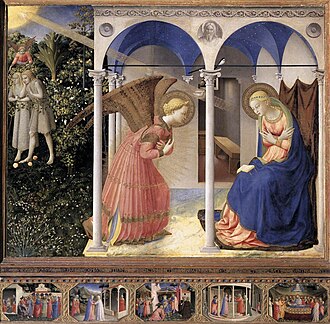 L'Annonciation - Fra Angelico (1425)
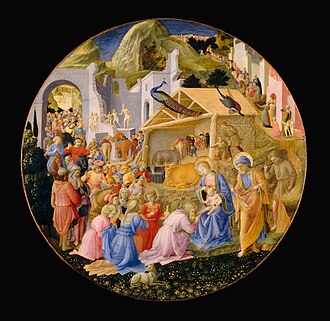 Tondo Cook - Fra Angelico (1430)
%2C%20ante%201432%2C%2001.jpg) La Descente de Croix - Fra Angelico (1432)
La Descente de Croix - Fra Angelico (1432)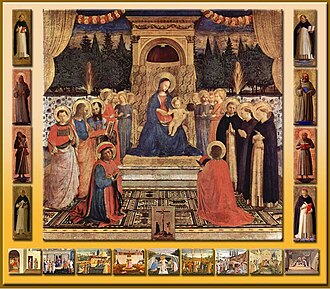 Pala di San Marco - Fra Angelico
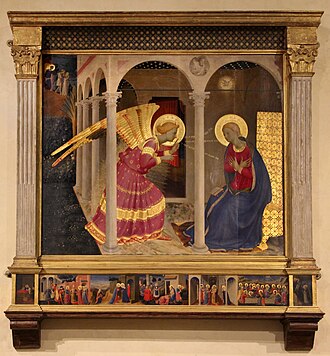 L'Annonciation de Cortone - Fra Angelico (1430s)
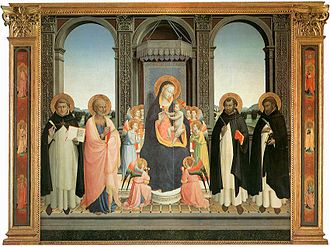 Pala di Fiesole - Fra Angelico (1422)
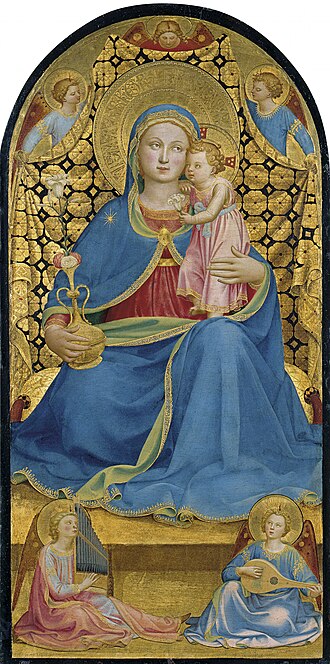 Madonna dell'Umiltà - Fra Angelico (1433)
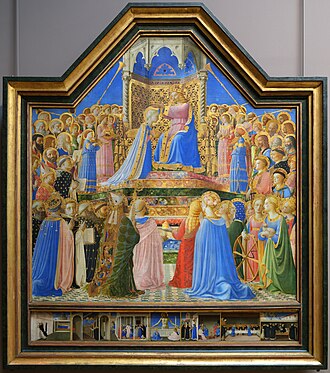 Le Couronnement de la Vierge - Fra Angelico
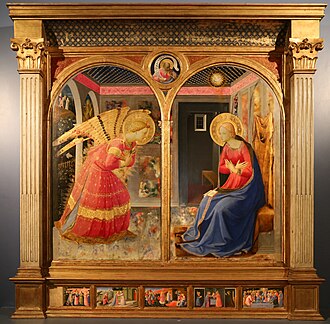 L'Annonciation de San Giovanni Valdarno - Fra Angelico (1430)
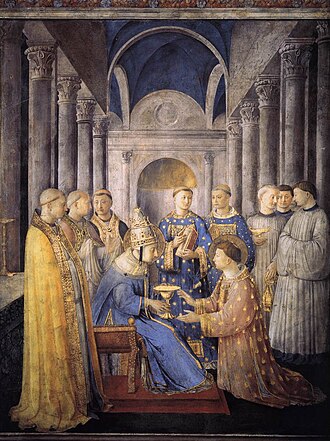 Consécration diaconale de saint Laurent - Fra Angelico (1447)