La Calomnie d'Apelle
Sandro Botticelli · 1490s
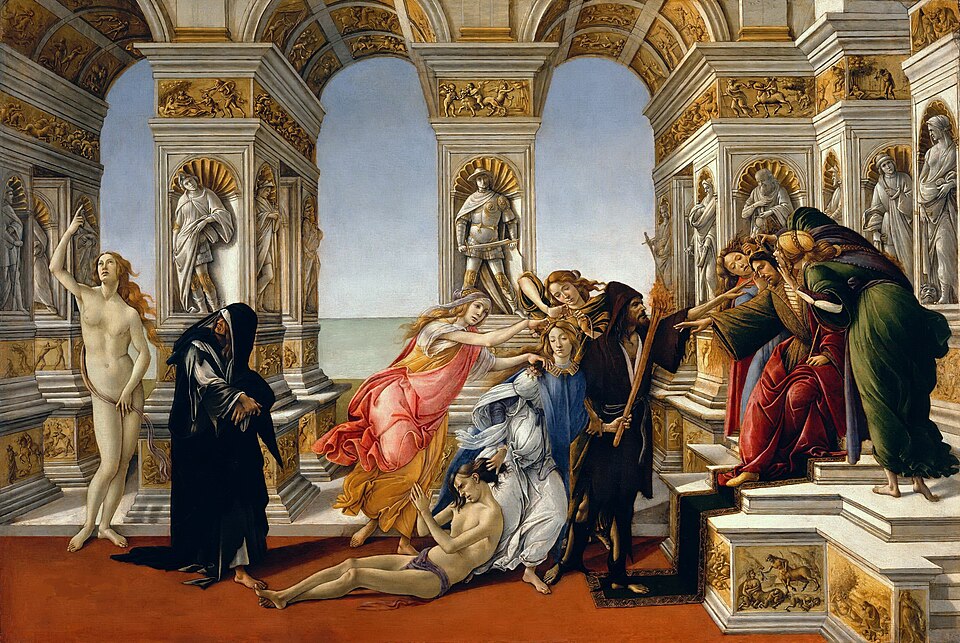
In a gilded hall of statues, a king with donkey's ears reaches toward Slander as she drags her innocent victim by the hair. Botticelli rebuilt a lost Greek masterpiece from words alone.
The story behind the painting
The Calumny of Apelles was completed around 1494-1495 and is probably the last surviving secular painting by Botticelli. It recreates a lost picture by the Greek painter Apelles, known only through a description by the writer Lucian. According to Lucian, Apelles painted it after being falsely denounced to Ptolemy IV of Egypt by a rival artist and nearly executed, until a prisoner confirmed his innocence. The source notes a difficulty: Apelles is usually dated about a century before that conspiracy. The subject was popular in Renaissance Italy. Leon Battista Alberti recommended it to artists in his De pictura of 1435, and Lucian's text was translated four times during the fifteenth century. Wikidata places the work in the 1490s.
What to look for
Read the painting from left to right, like a procession. Truth stands nude, pointing up to Heaven; she is clearly derived from the Venus of Botticelli's Birth of Venus. Beside her, Repentance in black turns back. Then comes the crowd: Perfidy in red and yellow, Calumny in white and blue holding a flaming torch and dragging a half-naked victim by the hair, while Fraud arranges her hair. Rancour, a hooded bearded man, raises his hand toward the king's eyes. On the throne sits a king with the donkey's ears of Midas, as Ignorance and Suspicion whisper into them. Finally, look at the walls: niches filled with statues and reliefs of classical heroes, myths and battles, with a flat sea beyond the windows.
Meaning and intent
The allegory is about how the powerful are misled and the powerless crushed. The king stretches his hand toward Calumny, yet his eyes look down, so he cannot see what is happening. Frederick Hartt felt that some of the painting's oppressive effect comes from its illogical space: most of the architecture shares one vanishing point near Fraud's head, but the central cornice and vaults use a lower one, and the action moving across the picture fights the pull into depth. Many have wondered whether Botticelli had a specific slandered person in mind, perhaps himself or the preacher Savonarola. Hartt noted that Repentance's black robe over white recalls the Dominican habit, though the painting's usual date makes that reading uncertain.
Legacy
The painting is small, 62 by 91 centimetres, comparable to the Mystic Nativity, and like that work it may have been made for Botticelli's own use. Yet Giorgio Vasari later saw it in the collection of the son of the banker Antonio Segna Guidi and said it had been a gift from the painter. It later entered the Medici collection in the Pitti Palace, and by 1773 it was in the Uffizi, where it hangs today. Botticelli filled its walls with quotations from his own earlier works and even recreated another ancient description by Lucian, a family of centaurs by Zeuxis, below the throne. It remains a rare attempt to bring a lost masterpiece of antiquity back to life.
Le saviez-vous ?
- It was completed around 1494-1495 and is probably Botticelli's last surviving secular painting.
- The figure of Truth is derived from the Venus in his Birth of Venus.
- Vasari reported it was a gift from Botticelli to Antonio Segna Guidi.
- By 1773 it was in the Uffizi.
À propos de l'artiste
Sandro Botticelli (1445-1510)
femme · homme · peinture mythologique · Première Renaissance · galerie des Offices · ciel · Vénus
Autres œuvres de Sandro Botticelli
 La Naissance de Vénus - Sandro Botticelli (c. 1485)
 Le Printemps - Sandro Botticelli (1480s)
 Vénus et Mars - Sandro Botticelli (1485)
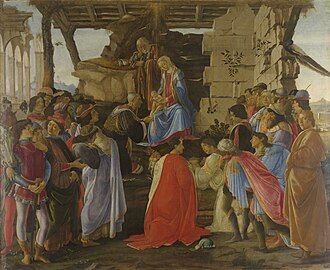 L'Adoration des mages - Sandro Botticelli (1470s)
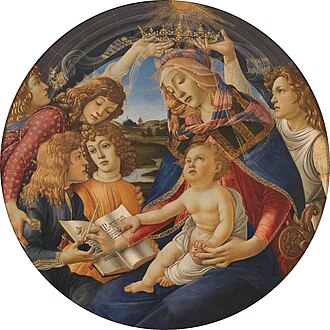 La Madone du Magnificat - Sandro Botticelli (1481)
.jpg) Pallas et le Centaure - Sandro Botticelli (1482)
Pallas et le Centaure - Sandro Botticelli (1482)%20-%20Google%20Art%20Project.jpg) Portrait ideale d'une jeune femme - Sandro Botticelli (1480)
Portrait ideale d'une jeune femme - Sandro Botticelli (1480)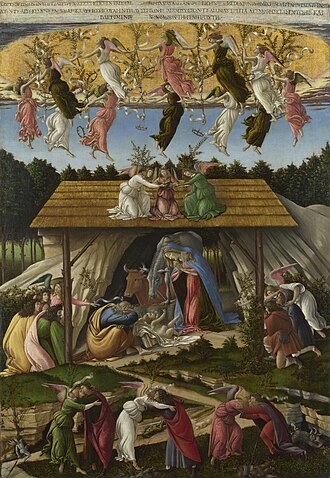 La Nativité mystique - Sandro Botticelli (1500)
Œuvres d'artistes liés
 La Joconde - Leonardo da Vinci (1503-1519)
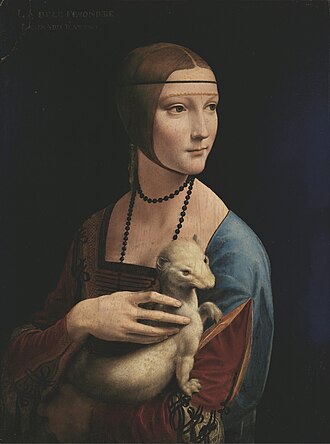 La Dame à l'hermine - Leonardo da Vinci (1490)
.jpg) Vénus d'Urbin - Titian (1538)
Vénus d'Urbin - Titian (1538)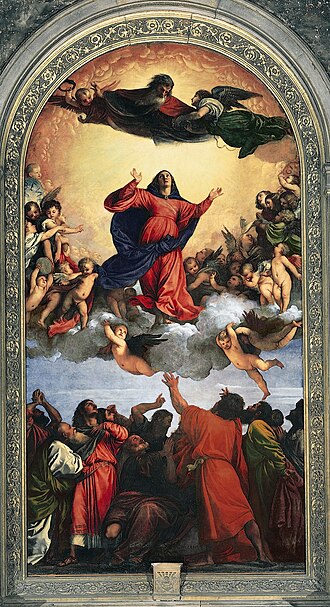 L'Assomption de la Vierge - Titian (1510s)
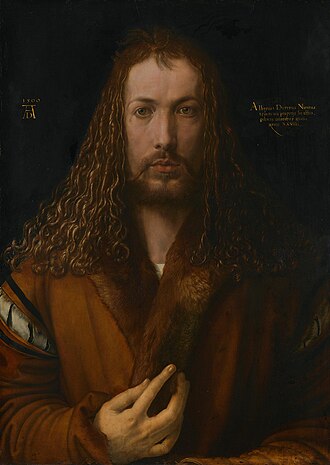 Autoportrait - Albrecht Dürer (1500)
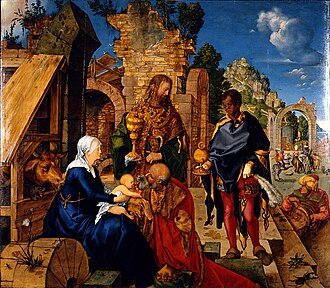 Adoration des mages - Albrecht Dürer (1504)