Piero della Francesca
1415-1492
Piero della Francesca was both painter and mathematician, and his pictures feel like it: calm, luminous figures set in a world of perfect geometry, as serene today as when he painted them.
Origins
Piero was born around 1415 in Borgo Santo Sepolcro, in modern Tuscany, as Piero di Benedetto, son of Benedetto de' Franceschi, a tradesman, and Romana di Perino da Monterchi. His father died before he was born, and he took the name della Francesca from his mother, known as la Francesca after marrying into the Franceschi family. Romana supported his education in mathematics and art. He was most probably apprenticed to the local painter Antonio di Giovanni d'Anghiari, with whom documents show him working in 1432 and 1438. In youth he was trained in mathematics, most likely for trade, and he noticed the Sienese painters working in his town, such as Sassetta.
Life and turning points
In 1439 he worked with Domenico Veneziano on frescoes in Florence, now lost, where he must have met Fra Angelico, Donatello and Brunelleschi, and admired the majestic figures of Masaccio. Back home in 1442, he was elected to the town council. His first commission, the Madonna della Misericordia altarpiece, came in 1445. He worked in Ferrara, Rimini for Sigismondo Malatesta, Rome and Urbino for Duke Federico da Montefeltro. From 1452 he painted the frescoes in San Francesco at Arezzo, finished in 1464. By 1480 his eyesight was failing, but he kept writing. He died in his own house in Sansepolcro on 12 October 1492.
Style and technique
His painting is known for serene humanism, geometric forms and perspective, and his deep interest in the theory of perspective and his contemplative approach show in all his work. The figures of Masaccio were an important inspiration. The Flagellation, painted in Urbino, has an air of geometric sobriety. His double portrait of Federico da Montefeltro and Battista Sforza shows them in profile, inspired by bronze medals and stucco roundels. Dating his undocumented work is difficult because his style does not seem to have changed much over the years. He also wrote three surviving treatises on arithmetic, algebra, geometry, solid geometry and perspective, including On Perspective in Painting.
Stories and anecdotes
In Rimini Piero may have met the architect Leon Battista Alberti, though Alberti is known to have directed his work on the Tempio Malatestiano largely by letter. The Flagellation remains one of the most famous and controversial pictures of the early Renaissance, because no one agrees who the three men in the foreground are. In the late 1450s Piero copied and illustrated several works of Archimedes in a manuscript of 82 leaves. His work on solid geometry was later absorbed into Luca Pacioli's Divina proportione, illustrated by Leonardo da Vinci. In 2013 the Frick Collection gathered seven of the eight paintings by Piero known in the United States.
Legacy
His most famous work, The History of the True Cross in Arezzo, is considered among the masterworks of Renaissance painting. Perugino and Luca Signorelli often visited his workshop, and his influence was strong in the later Ferrarese works of Cosimo Tura. The geometric perfection and almost magical light of his pictures inspired modern painters such as Giorgio de Chirico, Felice Casorati and Balthus. The composer Bohuslav Martinů wrote an orchestral work, Les Fresques de Piero della Francesca, premiered at the Salzburg Festival in 1956. Today he is chiefly appreciated for his art, yet his mathematics remind us how much thought lies beneath his calm.
Le saviez-vous ?
- The Baptism of Christ, now in the National Gallery in London, was made for a priory in Sansepolcro.
- He rented a house in Rimini in 1482.
- He made his will in 1487, leaving his possessions to his family and the Church.
- His frescoes in Santa Maria Maggiore in Rome survive only in fragments.
Première Renaissance · Renaissance italienne
Artistes liés
Sandro Botticelli · Leonardo da Vinci · Fra Angelico · Andrea Mantegna
Œuvres de Piero della Francesca
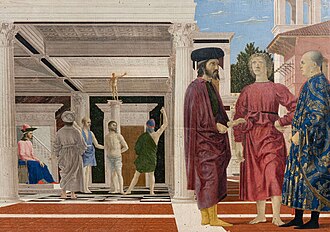 La Flagellation du Christ - Piero della Francesca (1450s)
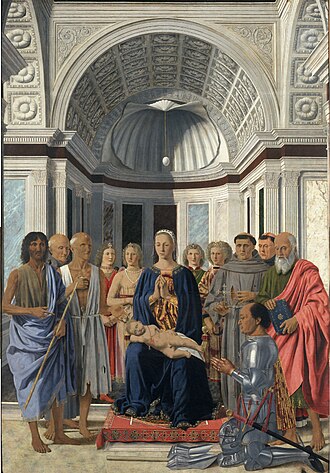 La Conversation sacrée - Piero della Francesca (1472)
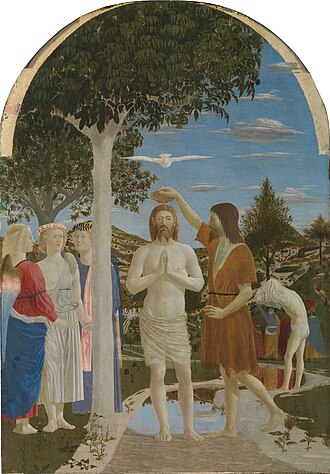 Le Baptême du Christ - Piero della Francesca (1448)
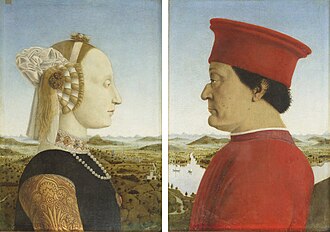 Le Triomphe de la chasteté - Piero della Francesca (1465)
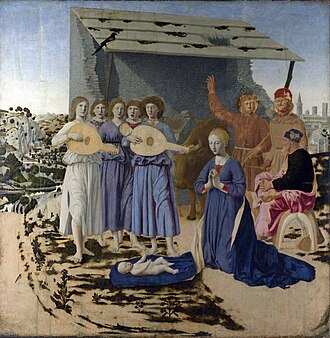 La Nativité - Piero della Francesca (1480s)
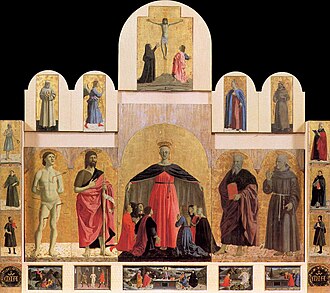 Madonna della Misericordia - Piero della Francesca (1460s)
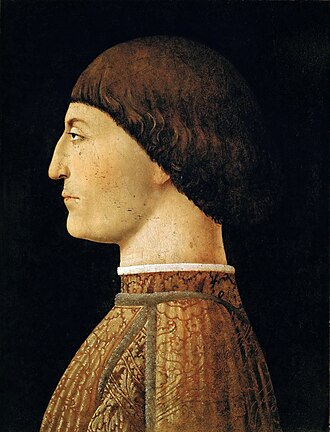 Portrait de Sigismond Malatesta, seigneur de Rimini - Piero della Francesca (1450s)
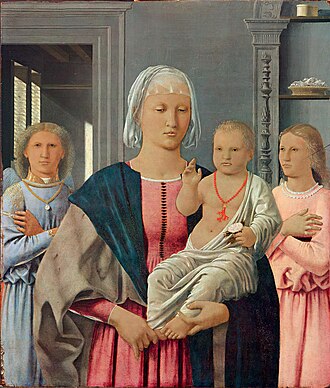 Madonna di Senigallia - Piero della Francesca (1470s)
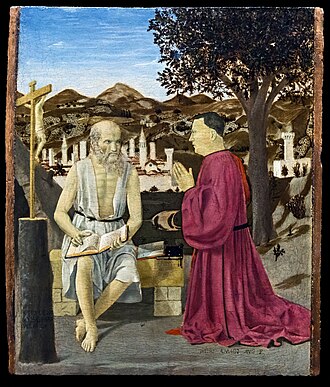 Saint Jérôme et le donateur Girolamo Amadi - Piero della Francesca (1440)
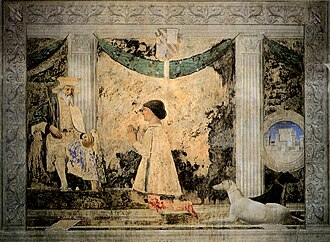 Sigismondo Pandolfo Malatesta en prière devant saint Sigismond - Piero della Francesca (1451)
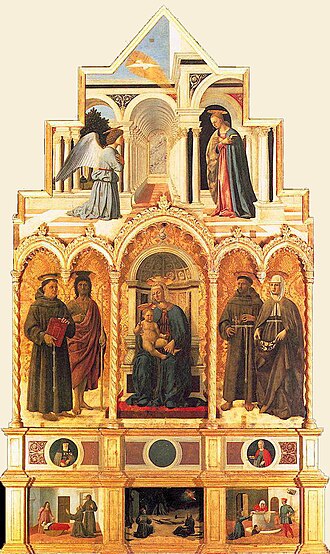 Polyptyque de Sant'Antonio - Piero della Francesca (1469)