Madonna della Misericordia
Piero della Francesca · 1460s
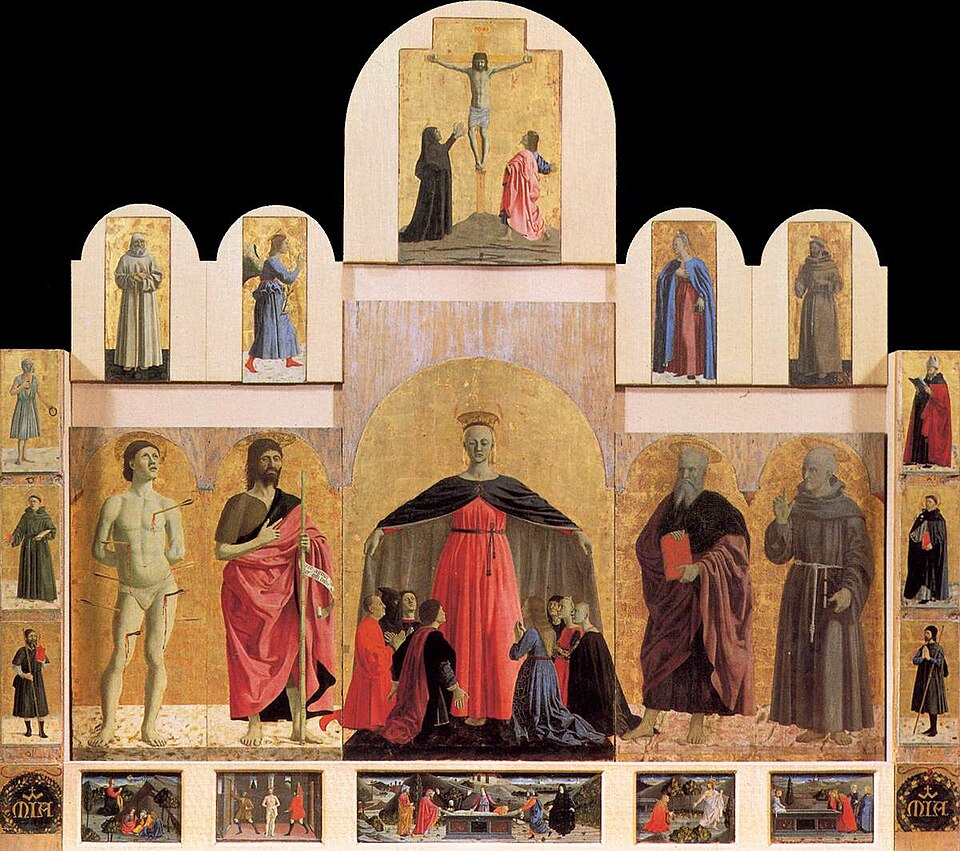
The Madonna opens her great mantle like the walls of a church, and the townspeople who paid for the altarpiece kneel safe inside it. Piero della Francesca promised it in three years and delivered it seventeen years later.
The story behind the painting
In 1445 the Compagnia della Misericordia, a confraternity of Borgo San Sepolcro, commissioned Piero della Francesca, a native of the town, to paint a polyptych for them. Following the taste of the time, the contract asked for precious colours and a gilded background, and set a limit of three years. Piero did not keep to it. He was busy with many other projects, and the polyptych was only finished in 1462, seventeen years later. It is one of his earliest works, which is why Wikidata places it simply in the 1460s, the decade of its completion.
What to look for
The altarpiece is large, about 273 by 330 cm, and built of many panels. The oldest two, left of the centre, show St Sebastian and John the Baptist; Sebastian's nude body recalls Masaccio, whose work Piero would have seen in Florence. Around 1450 he finished St Andrew and St Bernardino. Above sit a Crucifixion, St Benedict, the Angel and the Madonna of the Annunciation, and St Francis. The predella, with five scenes from the life of Jesus, was mostly painted by assistants. The central Madonna della Misericordia was the last part to be done.
Meaning and intent
In the central panel the Madonna enfolds her followers in her mantle, a gesture of merciful protection. The patrons wanted a flat gold background, and Piero solved the problem by placing the kneeling members of the confraternity inside a real three-dimensional space made by the mantle itself, a space that resembles the apse of a church. The Madonna is still larger than the people, as in medieval painting, but her fully solid body, inspired by Masaccio, and the study of perspective, inspired by Brunelleschi, belong plainly to the Renaissance.
Legacy
The polyptych stayed in the town where Piero was born and where it was made. It is kept today in the Museo Civico di Sansepolcro, in Tuscany. Its long making makes it a record of how a painter's ideas grew over nearly two decades, from the early Sebastian to the late central Madonna. It shows how Piero met old-fashioned demands, gold and a giant Virgin, with new ideas of space and volume, so that the people of his own town kneel in a believable world under her cloak.
Le saviez-vous ?
- Commissioned in 1445 by the Compagnia della Misericordia.
- Due in three years, finished only in 1462.
- The central Madonna was the last panel painted.
- Kept in the Museo Civico di Sansepolcro.
À propos de l'artiste
Piero della Francesca (1415-1492)
art religieux · femme · Marie · Première Renaissance · saint Sébastien
Autres œuvres de Piero della Francesca
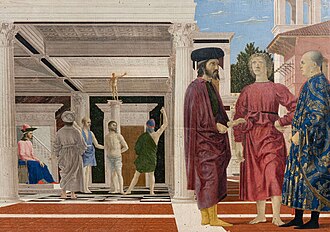 La Flagellation du Christ - Piero della Francesca (1450s)
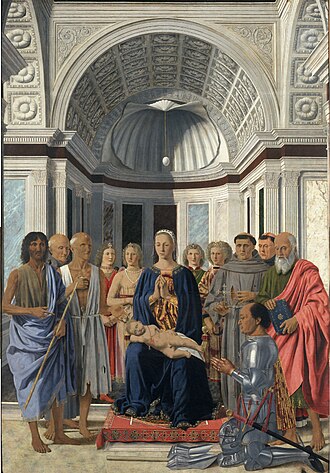 La Conversation sacrée - Piero della Francesca (1472)
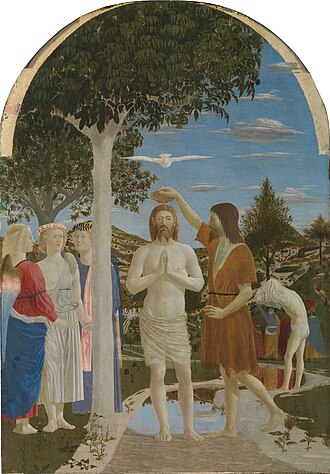 Le Baptême du Christ - Piero della Francesca (1448)
 Le Triomphe de la chasteté - Piero della Francesca (1465)
 La Nativité - Piero della Francesca (1480s)
 Portrait de Sigismond Malatesta, seigneur de Rimini - Piero della Francesca (1450s)
 Madonna di Senigallia - Piero della Francesca (1470s)
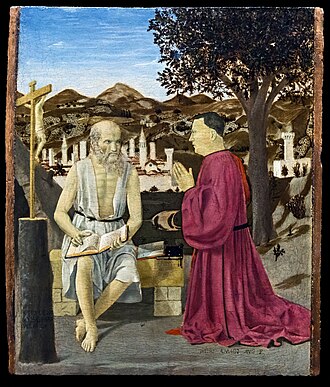 Saint Jérôme et le donateur Girolamo Amadi - Piero della Francesca (1440)
Œuvres d'artistes liés
 La Naissance de Vénus - Sandro Botticelli (c. 1485)
 Le Printemps - Sandro Botticelli (1480s)
 La Joconde - Leonardo da Vinci (1503-1519)
 La Dame à l'hermine - Leonardo da Vinci (1490)
 L'Annonciation - Fra Angelico (1425)
 Tondo Cook - Fra Angelico (1430)
 Lamentation sur le Christ mort - Andrea Mantegna (1483)
 La Vierge de la Victoire - Andrea Mantegna