Diego Velázquez
1599-1660
Diego Velázquez, the leading painter at the court of Philip IV, began in the kitchens of Seville and became one of the greatest artists in Western history. Kings, beggars and gods all came under the same patient, searching eye.
Origins
Velázquez was baptised in the Church of St. Peter in Seville on 6 June 1599, the first child of Juan Rodríguez de Silva, a notary, and Jerónima Velázquez. His paternal grandparents were Portuguese and had settled in Seville decades earlier. He grew up in modest circumstances but showed an early gift for art, and a contract signed on 17 September 1611 bound him to a six-year apprenticeship with the painter Francisco Pacheco. Pacheco was not a brilliant artist, yet he was a deeply learned teacher. In his school the boy studied the classics, learned proportion and perspective, and watched the literary and artistic life of Seville at close range. On 23 April 1618 he married his teacher's daughter, Juana Pacheco. They had two daughters: Francisca, who later married the painter Juan Bautista Martínez del Mazo, and Ignacia, who died in infancy.
Life and turning points
By the early 1620s Velázquez had a reputation in Seville. He first went to Madrid in April 1622 but was not allowed to paint the new king. When the court painter Rodrigo de Villandrando died that December, the powerful Count-Duke of Olivares summoned him back. On 30 August 1623 Philip IV sat for him, and the portrait pleased the king so much that Olivares promised no other painter would ever portray Philip. Madrid became his home for the rest of his life. In 1627 he won a royal competition on the expulsion of the Moors. In 1628 Peter Paul Rubens arrived on a diplomatic mission, and the two visited the Titians at the Escorial together. Rubens stirred his longing for Italy, and in 1629 the king sponsored a trip to Venice, Rome and Naples. Back in Madrid in 1631, he painted the royal family for the new Buen Retiro palace, and in 1656 he completed Las Meninas. He died on 6 August 1660.
Style and technique
Velázquez began with bodegones, kitchen scenes with prominent still-life objects, painted in a precise tenebrist manner with strong light and deep shadow. Old Woman Frying Eggs (1618) and The Waterseller of Seville show an almost startling skill with volumes and textures, perhaps shaped by copies of Caravaggio and by the painted sculpture of Seville's churches. Even his religious pictures used the faces of local people instead of idealised types. In Italy he changed his method: following Bolognese painters such as Guido Reni, he switched from a dark reddish ground to a light grey one, which brought new luminosity, and he kept this practice. Over the years his handling grew freer and bolder. He liked to show gods and heroes as ordinary contemporaries, with the gestures and expressions of everyday life, so that myth and reality seem to sit side by side.
Stories and anecdotes
In Madrid Velázquez painted the poet Luis de Góngora crowned with a laurel wreath, then later painted the wreath out. His portrait of the young king was shown on the steps of San Felipe and greeted with enthusiasm. Among his sitters was the Prince of Wales, the future Charles I, who visited Spain in 1623, although that picture is lost. The Surrender of Breda, his only surviving painting of contemporary history, refuses the usual triumph: the Spanish general stands before his defeated Dutch opponent as an equal and offers him a consoling hand. In Mars Resting the god of war becomes a weary middle-aged man with an unkempt moustache. One of his equestrian portraits of the king served as the model for the bronze statue that now stands in the Plaza de Oriente in Madrid. His royal post even allowed him to paint the Rokeby Venus beyond the reach of the Inquisition.
Legacy
Velázquez is generally counted among the greatest artists in the history of Western art. His paintings became a model for the realist and impressionist painters of the nineteenth century, and in the twentieth century Pablo Picasso, Salvador Dalí and Francis Bacon paid tribute to him by reinterpreting some of his most famous images, above all Las Meninas. Because he worked almost entirely for the crown, most of his paintings entered the Spanish royal collection, and by far the finest group is in the Museo del Prado in Madrid. Some royal portraits were sent abroad as diplomatic gifts, especially to the Austrian Habsburgs, which is why his work can also be found beyond Spain, such as Prince Balthasar Charles with a Dwarf at the Museum of Fine Arts in Boston. To stand before his canvases is to meet a seventeenth-century court with startling directness.
Did you know?
- His earliest works were bodegones, and he was one of the first Spanish artists to paint such kitchen scenes.
- His prize-winning painting on the expulsion of the Moors was destroyed in a palace fire in 1734.
- For his post at court he received a daily allowance equal to that of the royal barbers.
- The Surrender of Breda is his only surviving painting of contemporary history.
Baroque · Spanish Baroque painting
Related artists
Caravaggio · Rembrandt van Rijn · Johannes Vermeer
Paintings by Diego Velázquez
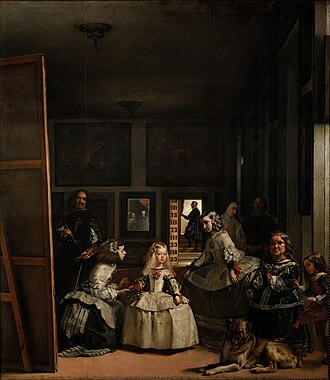 Las Meninas - Diego Velázquez (1656)
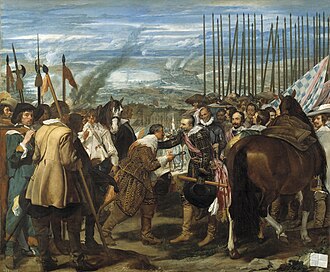 The Surrender of Brea - Diego Velázquez (1635)
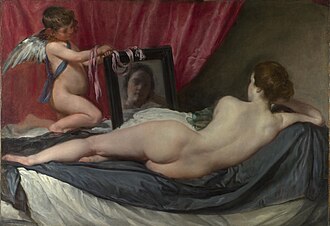 Rokeby Venus - Diego Velázquez (1644)
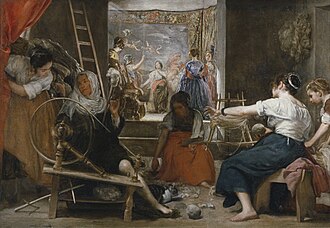 Las Hilanderas - Diego Velázquez
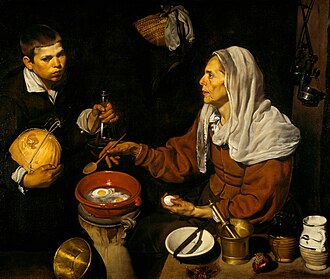 Old Woman Cooking Eggs - Diego Velázquez (1618)
.jpg) Portrait of Innocent X - Diego Velázquez
Portrait of Innocent X - Diego Velázquez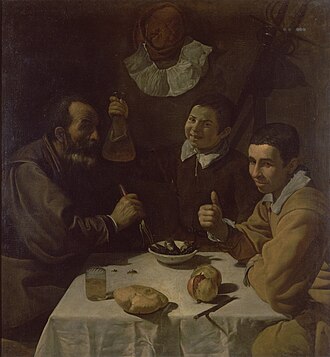 The Lunch - Diego Velázquez (1617)
.jpg) Apollo in the Forge of Vulcan - Diego Velázquez (1630)
Apollo in the Forge of Vulcan - Diego Velázquez (1630).jpg) The Triumph of Bacchus - Diego Velázquez (1628)
The Triumph of Bacchus - Diego Velázquez (1628)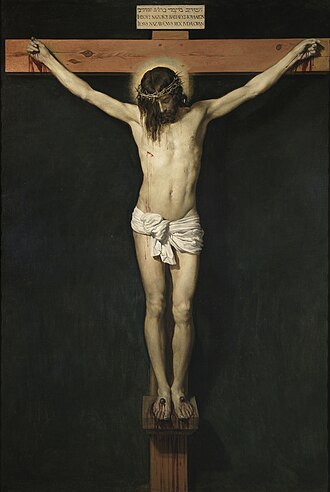 Christ Crucified - Diego Velázquez (1632)
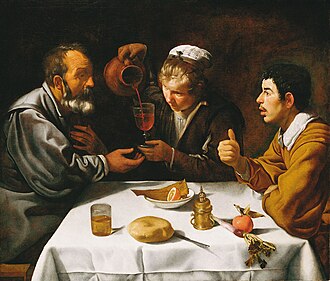 The Farmers' Lunch - Diego Velázquez (1618)
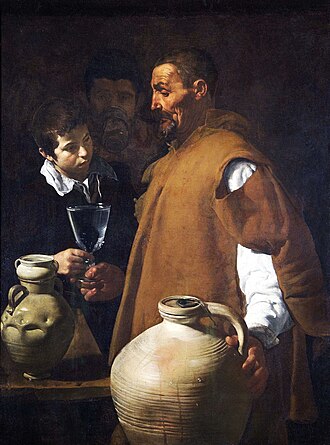 The Waterseller of Seville - Diego Velázquez (1620)
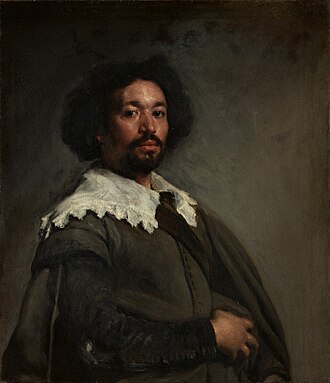 Portrait of Juan de Pareja - Diego Velázquez (1650)
.jpg) Adoration of the Magi - Diego Velázquez (1619)
Adoration of the Magi - Diego Velázquez (1619)%20-%20The%20Three%20Musicians%20-%20413F%20-%20Gem%C3%A4ldegalerie.jpg) Three Musicians - Diego Velázquez (1618)
Three Musicians - Diego Velázquez (1618)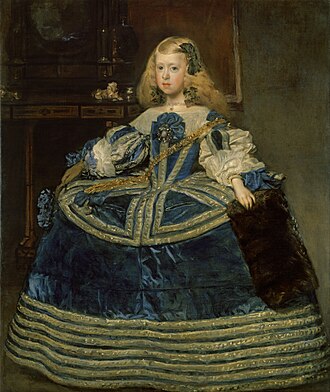 Infanta Margarita Teresa in a Blue Dress - Diego Velázquez (1659)