Las Hilanderas
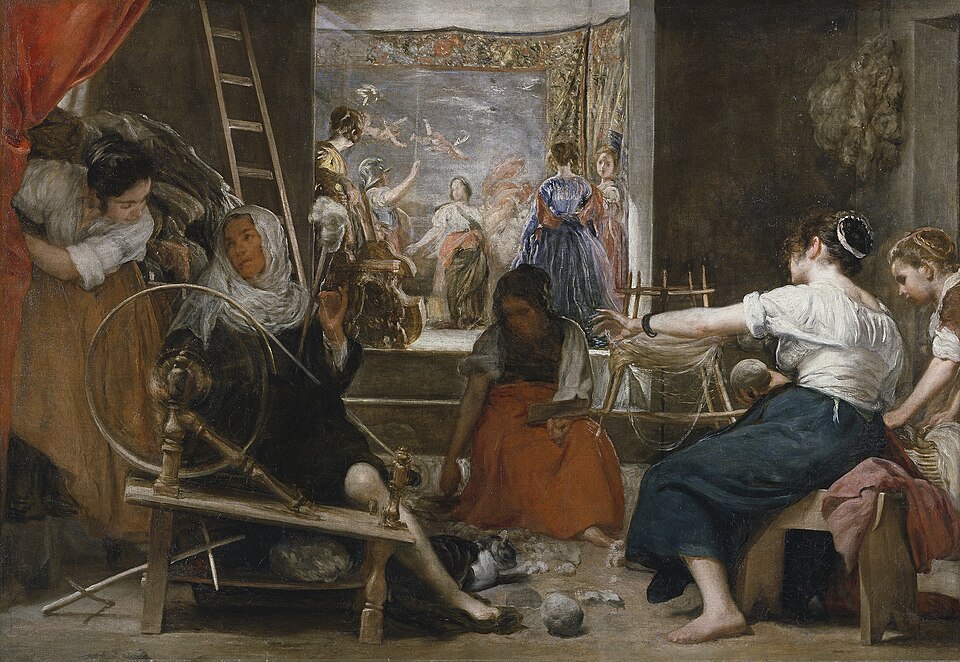
At first glance it is a busy workshop of women spinning wool. Look past them, into the bright room at the back, and an ancient myth about pride and punishment begins to unfold.
The story behind the painting
Las Hilanderas, "The Spinners", was painted by Diego Velázquez for Don Pedro de Arce, a huntsman to King Philip IV of Spain. Its date is debated: most scholars regard it as a late work from 1657 to 1658, pointing to its lightness, its economical use of paint and the clear influence of the Italian Baroque, while others place it between 1644 and 1648, because parts of its form recall the kitchen scenes, or bodegones, of his youth. The painting later entered the Spanish royal collection in the eighteenth century and was probably damaged in the 1734 fire at the Royal Alcázar of Madrid. Afterwards, strips were added to its sides and more than 50 centimetres to its top, so the canvas we know today is larger than the one Velázquez actually painted.
What to look for
Velázquez builds the picture in layers, a method he had used in earlier works such as Kitchen Scene with Christ in the House of Martha and Mary. In the dim foreground, women work at wool. On the left sits an older woman at a spinning wheel; she is the goddess Athena in disguise. On the right, turned away from us in a white top, is the young Arachne. Three helpers assist them. Then let your eye travel back, through an arch, into a raised and brightly lit space, perhaps a stage, where finished tapestries are displayed. The one we can see is Arachne's own work, and it reproduces Titian's The Rape of Europa, a painting that hung in the Spanish royal collection. The contrast between shadowed labour and luminous display is the heart of the scene.
Meaning and intent
For centuries viewers believed the painting simply showed workers in the royal tapestry workshop of Santa Isabel. In 1948 the scholar Diego Angulo noticed that its imagery pointed to Ovid's Fable of Arachne: a mortal weaver who challenged the goddess Athena to a contest, won, and was turned into a spider by the jealous goddess. That reading is now generally accepted. Beyond the myth, the work has been read as an allegory of the arts, with the goddess standing for the fine arts and Arachne for the crafts. Others see a simpler message: that great art needs both great creativity and hard technical labour. Some scholars have even found political allegories in it. The painting holds all these readings at once, which is part of its quiet power.
Legacy
Velázquez scholar Jonathan Brown has called Las Hilanderas and Las Meninas arguably the painter's two greatest works, noting that they are his largest and most complicated compositions from a period when he painted mostly single-figure portraits. The canvas belongs to the Museo del Prado in Madrid. Because of the eighteenth-century additions, the museum has at times displayed it with a frame placed over the enlarged canvas, revealing only the original dimensions Velázquez intended. The work rewards patience: what begins as an everyday scene of women at work turns, with a second look, into a meditation on art, skill and the dangerous rivalry between mortals and gods, painted with an ease that seems almost effortless.
Did you know?
- Its other title is The Fable of Arachne.
- The tapestry at the back copies Titian's The Rape of Europa.
- Its true subject was only identified in 1948, by Diego Angulo.
- The canvas was enlarged after likely fire damage in 1734.
About the artist
Diego Velázquez (1599-1660)
woman · genre art · Museo del Prado · mythological painting
More by Diego Velázquez
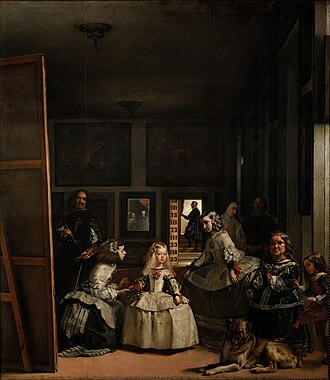 Las Meninas - Diego Velázquez (1656)
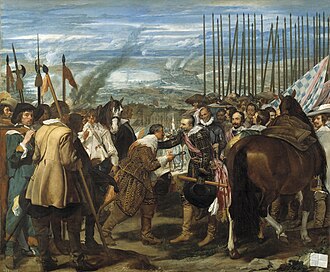 The Surrender of Brea - Diego Velázquez (1635)
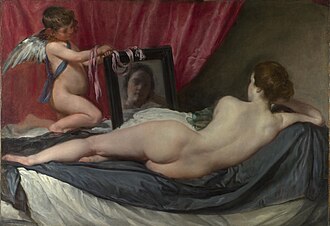 Rokeby Venus - Diego Velázquez (1644)
.jpg) Portrait of Innocent X - Diego Velázquez
Portrait of Innocent X - Diego Velázquez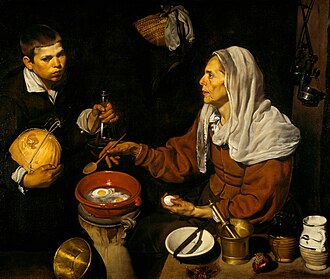 Old Woman Cooking Eggs - Diego Velázquez (1618)
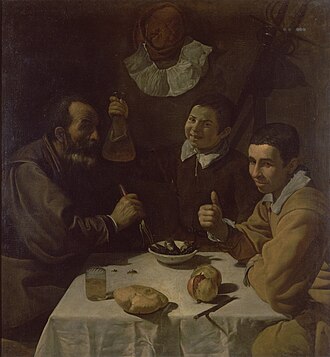 The Lunch - Diego Velázquez (1617)
.jpg) The Triumph of Bacchus - Diego Velázquez (1628)
The Triumph of Bacchus - Diego Velázquez (1628).jpg) Apollo in the Forge of Vulcan - Diego Velázquez (1630)
Apollo in the Forge of Vulcan - Diego Velázquez (1630)
Paintings by related artists
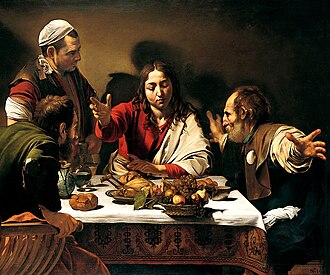 Supper at Emmaus - Caravaggio (1601)
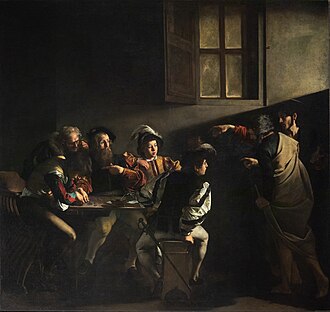 The Calling of Saint Matthew - Caravaggio (1609)
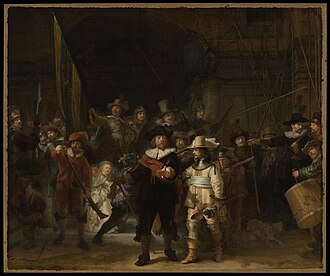 The Night Watch - Rembrandt van Rijn (1642)
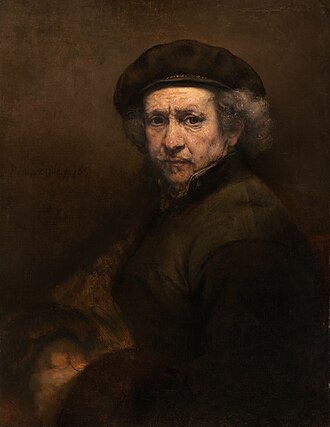 Self-Portrait - Rembrandt van Rijn (1659)
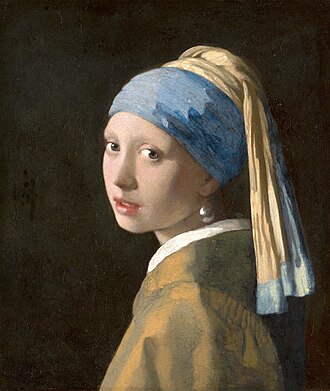 Girl with a Pearl Earring - Johannes Vermeer (1665)
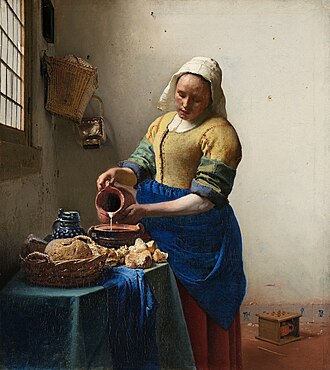 The Milkmaid - Johannes Vermeer (c. 1658)