Philip IV in Brown and Silver
Diego Velázquez · 1635
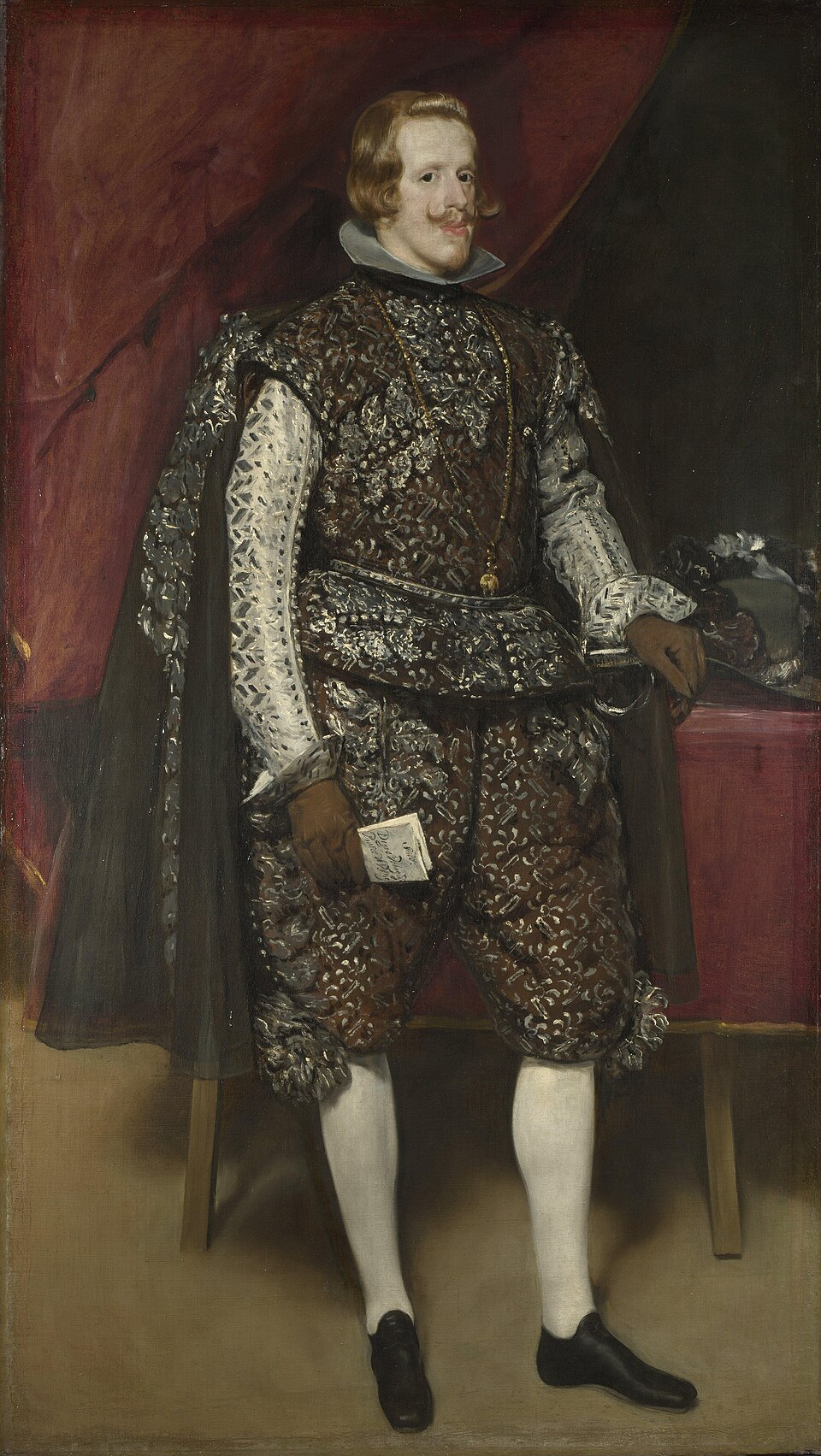
For once, Philip IV is not in black. Velázquez dressed him in brown embroidered with silver, painted in quick small strokes, and signed his name on a letter in the king's hand, a rare gesture for a painter who seldom signed at all.
The story behind the painting
This was the main portrait of Philip IV that Velázquez painted in the 1630s, and it became the model for many workshop versions. Its date is uncertain: the National Gallery gives 1631 to 1632, the writer Carrassat gives 1635, which Wikidata follows, and there is some evidence that the portrait took several years to complete. What is certain is that it was the first portrait Velázquez made after his first trip to Italy, because it adopts the softer, more colourful palette of the Venetian school. It is sometimes simply called the Silver Philip.
What to look for
The king is shown life-size, about 199.5 by 113 cm. Unlike most portraits of him, he does not wear his usual all-black costume but a brown and silver embroidered one, painted with small rapid strokes. He wears the insignia of the Order of the Golden Fleece on a golden chain. Look at the paper in his hand: it is a fictive petition from the painter to the king, and it carries Velázquez's signature. Several pentimenti, visible corrections, show him fine-tuning the composition as he worked. The silver embroidery is where the new Venetian lightness of his brush is easiest to enjoy.
Meaning and intent
The signature itself is a sign of how much this work mattered to Velázquez, since he signed only a few of his paintings. By placing his name on a petition addressed to Philip, he showed himself as a servant of the king inside the picture. The change from black to brown and silver, and from a darker manner to a brighter palette, marks the painter's growth after Italy. The portrait is at once an official image of the monarch and a quiet declaration by the court painter of what he had learned abroad.
Legacy
It almost certainly hung in the library of the Escorial from the mid-seventeenth century until 1809, when Joseph Bonaparte removed it and gave it to a General Desolle. It then passed to William Thomas Beckford and to the 10th Duke of Hamilton, and the National Gallery bought it at the Hamilton Palace sale in 1882. In 1936 a cleaning by Helmut Ruhemann, under director Kenneth Clark, set off a fierce controversy, with artists such as Alfred Munnings attacking it in the press. Clark later said such quarrels came about every twenty-five years. The painting appeared in the 1947 Exhibition of Cleaned Pictures.
Did you know?
- The main portrait of Philip IV by Velázquez in the 1630s.
- Dated 1631 to 1632 by the National Gallery, 1635 by Carrassat.
- Signed on the petition the king holds.
- Its 1936 cleaning caused a public controversy.
About the artist
Diego Velázquez (1599-1660)
portrait · man · National Gallery · Philip IV of Spain
More by Diego Velázquez
 Las Meninas - Diego Velázquez (1656)
 The Surrender of Brea - Diego Velázquez (1635)
 Rokeby Venus - Diego Velázquez (1644)
 Las Hilanderas - Diego Velázquez
.jpg) Portrait of Innocent X - Diego Velázquez
Portrait of Innocent X - Diego Velázquez Old Woman Cooking Eggs - Diego Velázquez (1618)
 The Lunch - Diego Velázquez (1617)
.jpg) The Triumph of Bacchus - Diego Velázquez (1628)
The Triumph of Bacchus - Diego Velázquez (1628)
Paintings by related artists
 Supper at Emmaus - Caravaggio (1601)
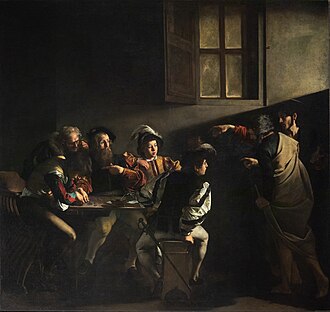 The Calling of Saint Matthew - Caravaggio (1609)
.jpg) The Elevation of the Cross - Peter Paul Rubens (1609)
The Elevation of the Cross - Peter Paul Rubens (1609)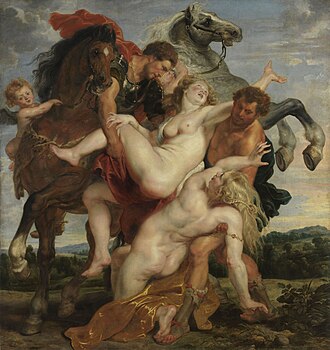 The Rape of the Daughters of Leucippus - Peter Paul Rubens (1618)
%20-%20Google%20Art%20Project.jpg) Charles I in Three Positions - Anthony van Dyck (1635)
Charles I in Three Positions - Anthony van Dyck (1635)%20with%20M.%20de%20St%20Antoine%20-%20Google%20Art%20Project.jpg) Charles I (1600-1649) with M. de St Antoine - Anthony van Dyck (1636)
Charles I (1600-1649) with M. de St Antoine - Anthony van Dyck (1636)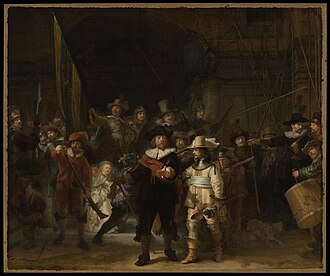 The Night Watch - Rembrandt van Rijn (1642)
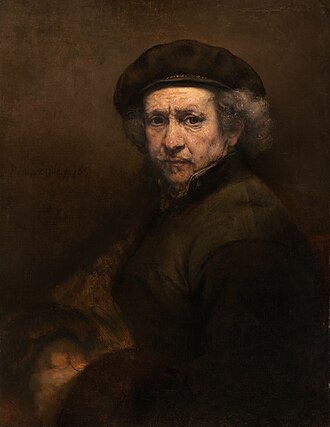 Self-Portrait - Rembrandt van Rijn (1659)
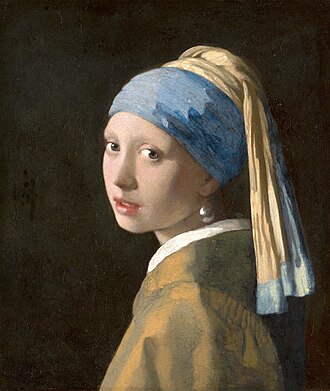 Girl with a Pearl Earring - Johannes Vermeer (1665)
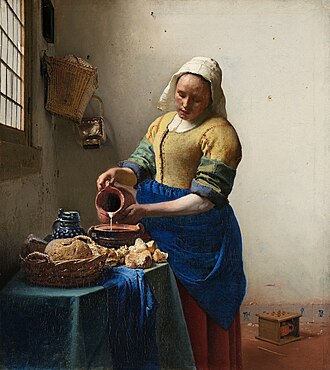 The Milkmaid - Johannes Vermeer (c. 1658)