Coronation of the Virgin
Diego Velázquez · 1634
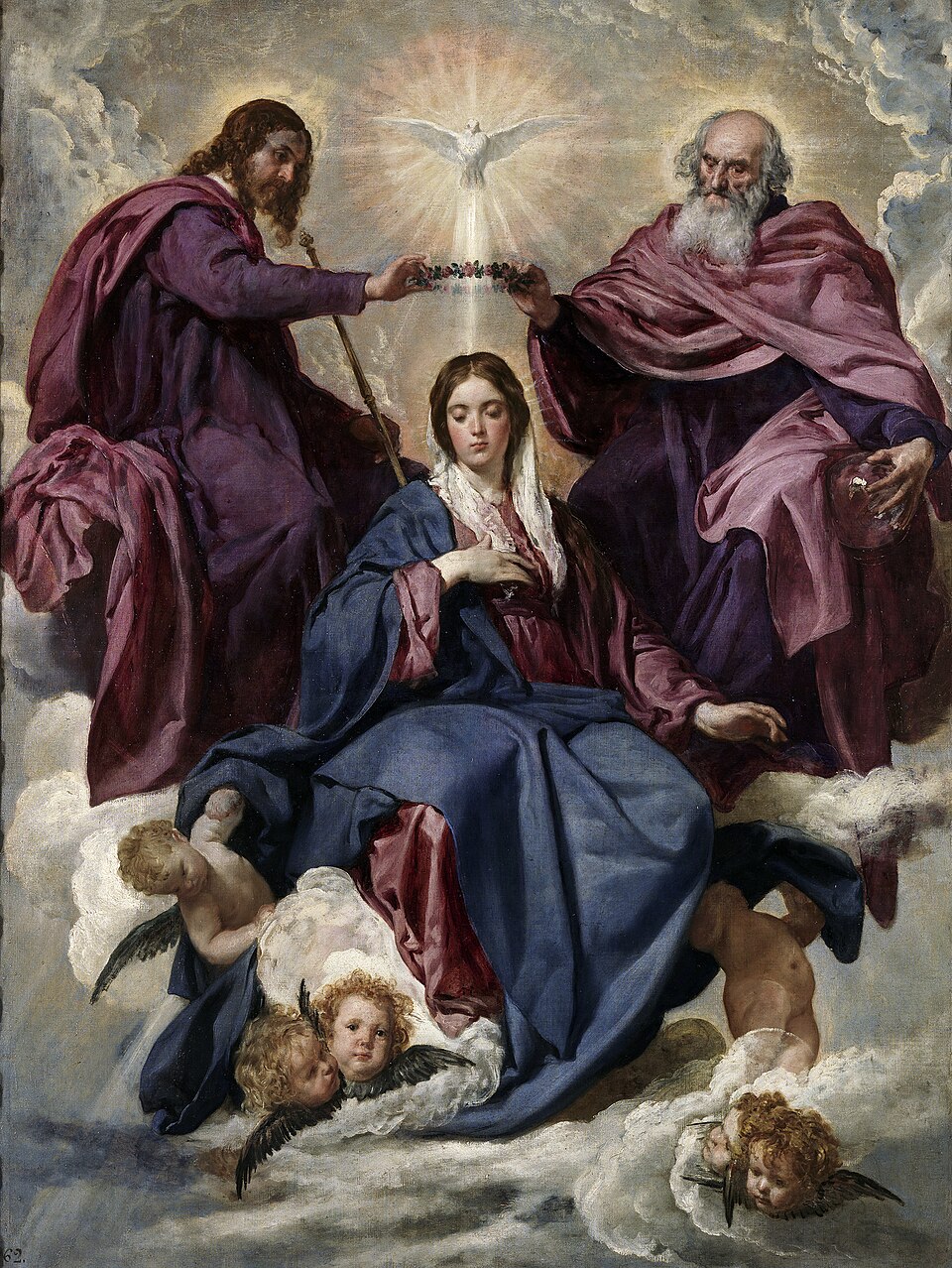
Christ and God the Father hold a crown above Mary's head, the dove of the Holy Spirit between them. Velázquez, a painter of kings, rarely painted heaven. When he did, he shaped it like a heart.
The story behind the painting
The Coronation of the Virgin shows the Holy Trinity crowning Mary, a theme of Marian art. It was probably commissioned for the oratory of Queen Elisabeth of France, wife of Philip IV of Spain, in the Real Alcázar of Madrid, where it joined Marian scenes by the Naples painter Andrea Vaccaro brought to Madrid by Cardinal Gaspar de Borja y Velasco. Its date varies by source: English Wikipedia gives 1635 to 1636, Wikidata 1634, and the same article also mentions a Prado dating of 1641 to 1642.
What to look for
The composition rests on an inverted triangle, giving balance and harmonious lines and recalling, in colour and form, a heart. Mary has a modest, emotional expression with lowered eyes, and she points to her own heart. God the Father, a dignified old man, is on the right, long haired Christ on the left, and the dove hovers between them. The three heads and the dove sit on one level line, the triangle's base. Velázquez used blues, violets and Venetian carmine instead of traditional reds. The cherubs below have been compared to Murillo's.
Meaning and intent
The painting is known as a rare religious work by an artist better known for portraits, and for a naturalness and simplicity not found in other Baroque religious painters. The level heads express the equality of the three persons of the Trinity, while the heart shape draws the viewer into Mary's devotion. His colour choices followed the advice of his teacher Francisco Pacheco in the book Arte de la Pintura, even though Velázquez was by then already an acclaimed artist.
Legacy
Writers have wondered who posed for Mary. She may be the same model Velázquez used for the Rokeby Venus. In 1999 José López-Rey wrote that Velázquez seemed to work in both cases, and in the Fable of Arachne, from the same model or the same idea of a beautiful young woman, yet created one image of divine and one of earthly beauty. Neil MacLaren did not endorse these suggestions. The painting now hangs in the Museo del Prado in Madrid.
Did you know?
- Probably painted for Queen Elisabeth of France's oratory in the Alcázar of Madrid.
- Dated 1635-1636 by Wikipedia, 1634 by Wikidata.
- Built on an inverted triangle recalling a heart.
- In the Museo del Prado.
About the artist
Diego Velázquez (1599-1660)
religious art · woman · Mary · Museo del Prado · Jesus Christ · angel · Coronation of the Virgin · orb · God the Father
More by Diego Velázquez
 Las Meninas - Diego Velázquez (1656)
 The Surrender of Brea - Diego Velázquez (1635)
 Rokeby Venus - Diego Velázquez (1644)
 Las Hilanderas - Diego Velázquez
 Portrait of Innocent X - Diego Velázquez
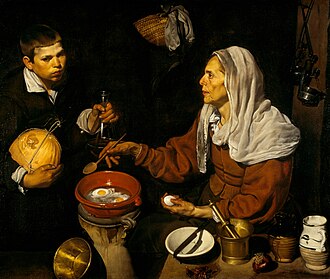 Old Woman Cooking Eggs - Diego Velázquez (1618)
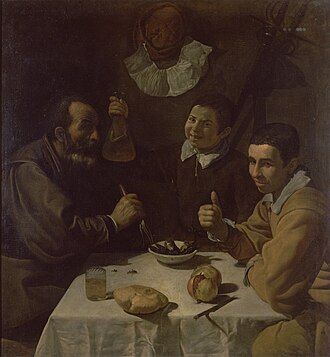 The Lunch - Diego Velázquez (1617)
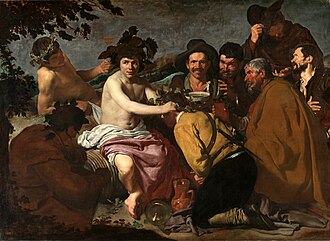 The Triumph of Bacchus - Diego Velázquez (1628)
Paintings by related artists
 Supper at Emmaus - Caravaggio (1601)
 The Calling of Saint Matthew - Caravaggio (1609)
 Saint Francis in Meditation - Francisco de Zurbarán (1639)
 The Immaculate Conception - Francisco de Zurbarán (1661)
 Charles I in Three Positions - Anthony van Dyck (1635)
 Charles I (1600-1649) with M. de St Antoine - Anthony van Dyck (1636)
 The Elevation of the Cross - Peter Paul Rubens (1609)
 The Rape of the Daughters of Leucippus - Peter Paul Rubens (1618)
 The Night Watch - Rembrandt van Rijn (1642)
 Self-Portrait - Rembrandt van Rijn (1659)
 A Militiaman Holding a Berkemeyer, Known as the ‘Merry Drinker’ - Frans Hals (1620s)
 Laughing Cavalier - Frans Hals (1624)