Las Meninas
Diego Velázquez · 1656
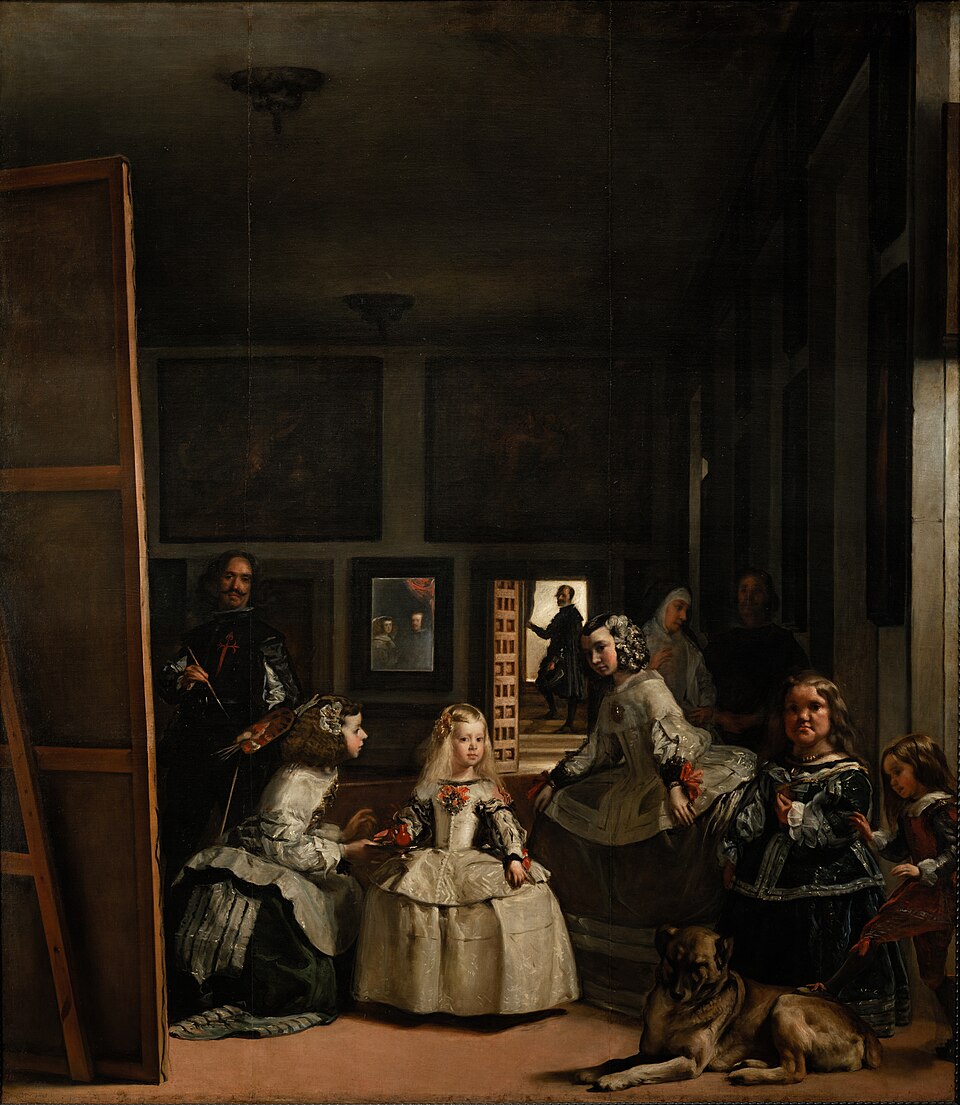
A masterpiece of the Spanish Golden Age, Las Meninas is a painting that continues to captivate art lovers with its complex and enigmatic composition, raising questions about reality and illusion.
The story behind the painting
Las Meninas, painted in 1656, is a group portrait set in the studio of Diego Velázquez in the Royal Alcázar of Madrid. The painting depicts a moment in the life of the Spanish royal family, specifically the Infanta Margaret Theresa, surrounded by her entourage of maids of honour, chaperone, bodyguard, two dwarfs, and a dog. Velázquez, the leading artist in the court of King Philip IV of Spain, was not only the painter but also the curator of the king's extensive collection of European art. He enjoyed a close relationship with Philip IV, who often watched him work and even had his own chair in the studio. The painting is believed to have been created during a period of significant change in Velázquez's life, as he had recently been appointed palace chamberlain and was responsible for the decoration and interior design of the palace.
What to look for
In this painting, look for the complex interplay of gazes between the figures and the viewer. Velázquez portrays himself working on a large canvas, looking outwards beyond the pictorial space to where a viewer would stand. The mirror in the background reflects the upper bodies of the king and queen, who appear to be placed outside the picture space. The five-year-old Infanta Margaret Theresa is surrounded by her attendants, including two ladies-in-waiting, a chaperone, a bodyguard, and two dwarfs. The room is presented as a simple box with a single vanishing point, creating a sense of depth and perspective. The use of light and shadow adds to the sense of realism, drawing the viewer's eye to the central figures.
Meaning and intent
Las Meninas is a painting that challenges the viewer to question what is real and what is illusion. The use of a mirror in the background creates a sense of ambiguity, as it reflects the king and queen, who may or may not be present in the room. The painting has been interpreted as a commentary on the social status of the artist, as Velázquez portrays himself as an equal to the royal family. The Italian Baroque painter Luca Giordano described Las Meninas as the 'theology of painting', highlighting its significance as a masterpiece of Western art.
Legacy
Las Meninas has had a profound influence on Western art, inspiring countless artists, including Pablo Picasso, Salvador Dalí, and Francis Bacon. The painting has been the subject of extensive scholarly debate, with interpretations ranging from a simple group portrait to a complex exploration of representation and spectatorship. Today, Las Meninas hangs in the Museo del Prado in Madrid, where it remains one of the museum's most prized possessions. Its enduring legacy is a testament to Velázquez's skill as a painter and his ability to capture the essence of the Spanish Golden Age.
Did you know?
- Did you know that Las Meninas is considered one of the most widely analysed works in Western painting?
- Did you know that Velázquez was appointed palace chamberlain in 1651, a post that brought him status and material reward?
- Did you know that the painting has undergone several restorations, including a major cleaning in 1984 to remove a 'yellow veil' of dust that had gathered since the previous restoration in the 19th century?
Wikipedia · Wikipedia - Diego Velázquez · Wikidata
About the artist
Diego Velázquez (1599-1660)
Museo del Prado · dog · group portrait · mirror
More by Diego Velázquez
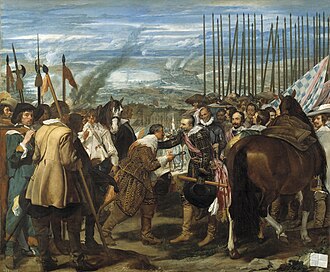 The Surrender of Brea - Diego Velázquez (1635)
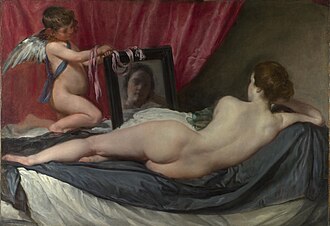 Rokeby Venus - Diego Velázquez (1644)
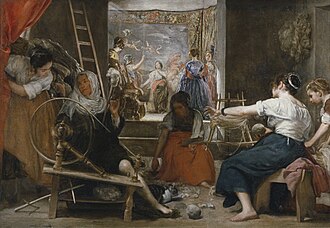 Las Hilanderas - Diego Velázquez
.jpg) Portrait of Innocent X - Diego Velázquez
Portrait of Innocent X - Diego Velázquez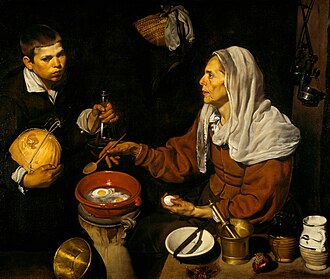 Old Woman Cooking Eggs - Diego Velázquez (1618)
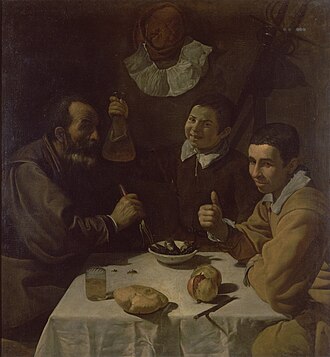 The Lunch - Diego Velázquez (1617)
.jpg) The Triumph of Bacchus - Diego Velázquez (1628)
The Triumph of Bacchus - Diego Velázquez (1628).jpg) Apollo in the Forge of Vulcan - Diego Velázquez (1630)
Apollo in the Forge of Vulcan - Diego Velázquez (1630)
Paintings by related artists
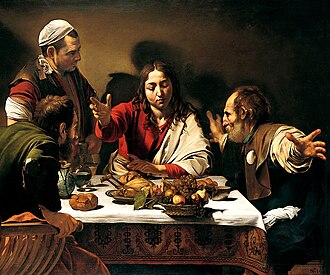 Supper at Emmaus - Caravaggio (1601)
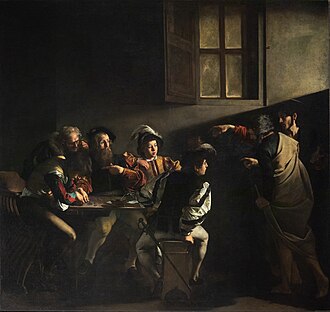 The Calling of Saint Matthew - Caravaggio (1609)
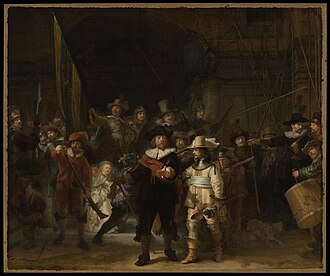 The Night Watch - Rembrandt van Rijn (1642)
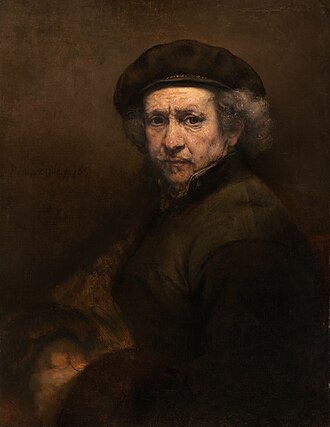 Self-Portrait - Rembrandt van Rijn (1659)
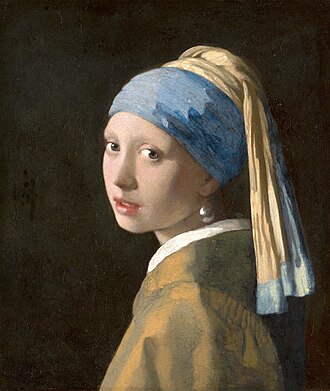 Girl with a Pearl Earring - Johannes Vermeer (1665)
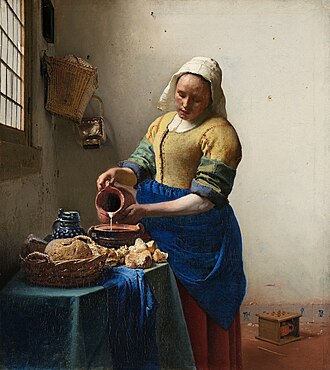 The Milkmaid - Johannes Vermeer (c. 1658)