Rokeby Venus
Diego Velázquez · 1644
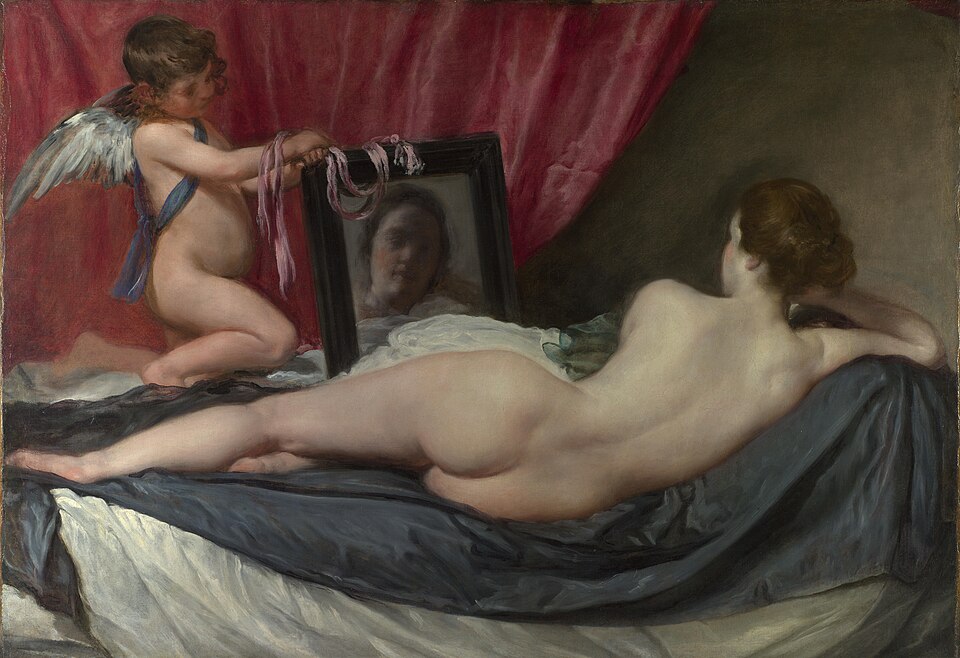
The goddess of love turns her back to us, and her face appears only as a blurred reflection in a mirror held by Cupid. In a country where nudes were almost forbidden, Velázquez painted one of the most daring and quietly mysterious nudes in Western art.
The story behind the painting
The Rokeby Venus is the only surviving female nude by Diego Velázquez, the leading painter of the Spanish Golden Age. Wikidata dates it to 1644, while Wikipedia gives a completion between 1647 and 1651, probably during the artist's visit to Italy. Nudes were extremely rare in seventeenth-century Spain, where art was actively policed by members of the Inquisition, yet nudes by foreign artists were keenly collected at court. Velázquez looked to Italian precedents such as Giorgione's Sleeping Venus and Titian's Venus of Urbino, and combined two established types: Venus reclining on a bed, and Venus gazing into a mirror. The model is widely thought to have been painted from life, but her identity remains speculation; one claim links her to a mistress Velázquez is said to have had in Italy.
What to look for
Venus lies on her bed with her back to us and her knees tucked, the sheets folding to echo the sweeping curve of her body. The usual attributes are gone: no jewels, roses or myrtle, and Cupid holds the mirror without his bow and arrows. Unlike most earlier Venuses she is a brunette. The colour scheme is restrained to reds, whites and greys, even within her skin, though technical analysis shows the grey sheet was originally a deep mauve that has faded. Her skin is painted with smooth, blended handling, against livelier brushwork in the fabrics. Pink silk ribbons curl over the mirror's frame. Look for pentimenti in her raised arm, shoulder and head, and for the seemingly unfinished area between her foot and Cupid's leg, probably deliberate.
Meaning and intent
The mirror is the painting's riddle. Venus is often described as looking at herself, yet we see her reflected face turned toward us, an impossibility now called the Venus effect. The reflection is blurred and larger than life. The critic Natasha Wallace suggested this vagueness is the key: the work is less a specific woman or even a goddess than an image of self-absorbed beauty. The ribbons have prompted debate too, read as the fetters Cupid uses to bind lovers, a means of hanging the mirror, or a recent blindfold. Julián Gallego found Cupid's expression so melancholy that he saw the ribbons binding the god to Beauty, and called the picture Love conquered by Beauty. When first inventoried, it was cautiously described simply as a nude woman.
Legacy
The painting hung in the houses of Spanish courtiers until 1813, when it was brought to England to hang at Rokeby Park in Yorkshire, which gave it its name. In 1906 the National Art Collections Fund acquired it for the National Gallery in London, where it hangs today. In 1914 the suffragette Mary Richardson attacked it and badly damaged the canvas, but it was fully restored and returned to view; in 2023 Just Stop Oil protesters smashed its protective glass. A cleaning in 1965 to 1966 showed it in good condition, with very little later overpaint. Its turned-away pose and central mirror mark a real departure in the long tradition of painting Venus.
Did you know?
- It is the only surviving female nude by Velázquez; three others are recorded in old inventories.
- Venus's face in the mirror faces us, an impossibility known as the Venus effect.
- The grey sheet was originally a deep mauve that has faded over time.
- It is named after Rokeby Park in Yorkshire, where it hung from 1813.
About the artist
Diego Velázquez (1599-1660)
woman · mythological painting · National Gallery · nude · nudity · Cupid · bed · Venus · mirror · drapery
More by Diego Velázquez
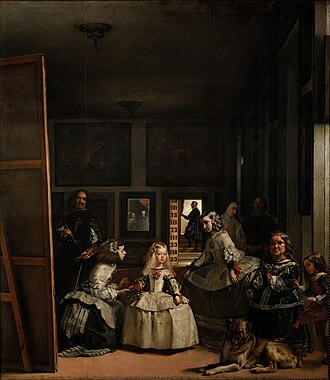 Las Meninas - Diego Velázquez (1656)
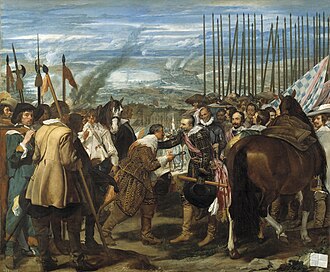 The Surrender of Brea - Diego Velázquez (1635)
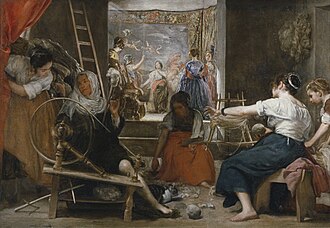 Las Hilanderas - Diego Velázquez
.jpg) Portrait of Innocent X - Diego Velázquez
Portrait of Innocent X - Diego Velázquez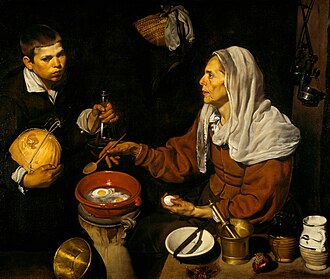 Old Woman Cooking Eggs - Diego Velázquez (1618)
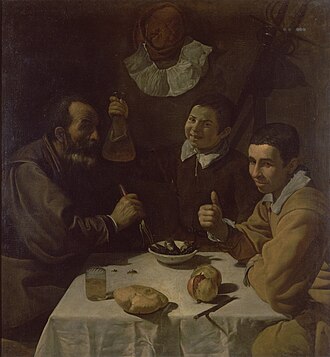 The Lunch - Diego Velázquez (1617)
.jpg) The Triumph of Bacchus - Diego Velázquez (1628)
The Triumph of Bacchus - Diego Velázquez (1628).jpg) Apollo in the Forge of Vulcan - Diego Velázquez (1630)
Apollo in the Forge of Vulcan - Diego Velázquez (1630)
Paintings by related artists
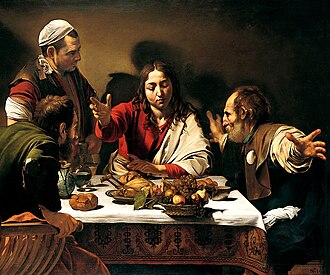 Supper at Emmaus - Caravaggio (1601)
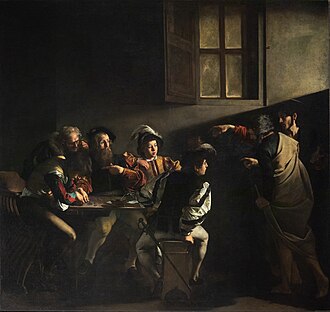 The Calling of Saint Matthew - Caravaggio (1609)
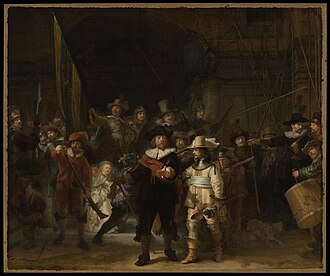 The Night Watch - Rembrandt van Rijn (1642)
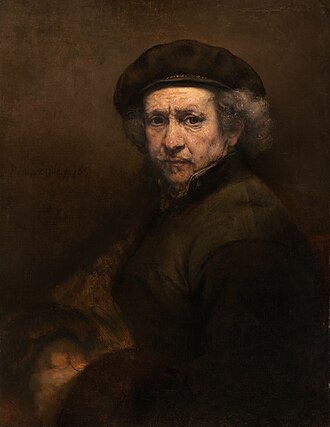 Self-Portrait - Rembrandt van Rijn (1659)
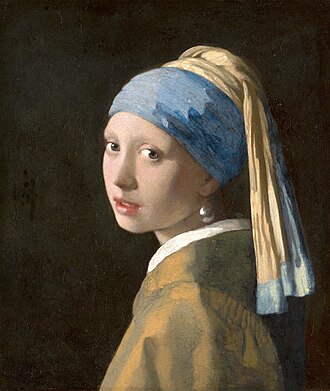 Girl with a Pearl Earring - Johannes Vermeer (1665)
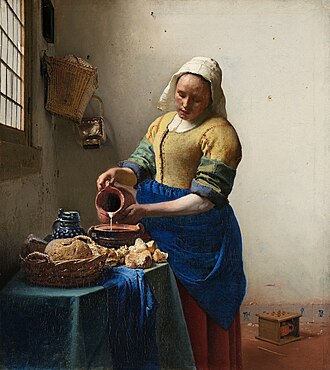 The Milkmaid - Johannes Vermeer (c. 1658)