Prince Balthasar Charles With a Dwarf
Diego Velázquez · 1631
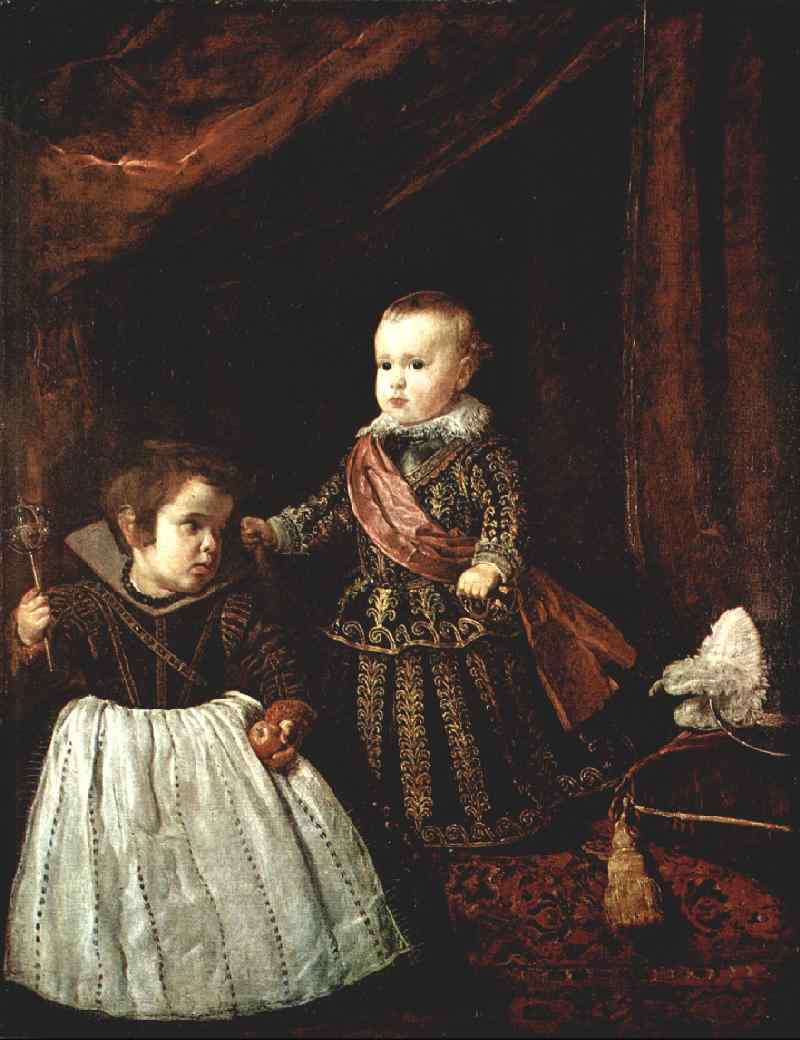
A tiny heir to the Spanish throne stands in state while a court dwarf seems to step in from another world. Velázquez's first portrait of Prince Balthasar Charles still keeps scholars arguing about who that dwarf is, and when he arrived.
The story behind the painting
The painting dates from 1631 and shows Balthasar Charles, Prince of Asturias, together with a court dwarf. It is the first of several portraits Velázquez painted of the young prince, the son of King Philip IV, so this is where a long series of images of the boy begins. Yet even its making is debated. The scholar Bernardino de Pantorba argued that the dwarf was added later, painted separately from the original portrait of the prince, perhaps after 1634, when the documented dwarf Francisco Lezcano entered the prince's service. Others accept the date of 1631 to 1632 for the whole composition.
What to look for
Compare the two figures. The prince is painted with meticulous detail, while the dwarf is livelier and more loosely handled, which is why some writers think they belong to different moments. Look at the dwarf's clothes: José Camón Aznar pointed to a lace trimmed collar and a skirt like garment and argued that the dwarf is in fact female. Then look at the carpet. A horizontal line divides it, and the part under the prince is drawn in a steeper, more vertical perspective with finer detail than the part where the dwarf stands. The canvas measures about 128 by 102 cm.
Meaning and intent
Julián Gállego read the dwarf as a symbolic counterpoint to the grave dignity of the Habsburg heir. He went further, suggesting that the prince may be a picture within the picture: the dwarf stands in real space in front of a painted replica of an earlier 1631 portrait of the prince, which would explain the divided carpet and the two different styles. If so, the painting becomes a conceptual game between reality and artifice, and it would reconcile the proposed early date with the dwarf's later looking brushwork. None of these readings is settled, and the uncertainty is part of the picture's fascination.
Legacy
The painting's known history begins in Italy. Henry Howard, 4th Earl of Carlisle, acquired it in Parma in the middle of the eighteenth century, and it stayed with his family for more than a century. In 1900 George James Howard, 9th Earl of Carlisle, sold it to the dealers Knoedler and Co., who received it in October 1900. It was then sold to the Museum of Fine Arts in Boston and officially entered the museum's collection on 2 February 1901. It has remained there ever since, the opening image in Velázquez's long series of portraits of the young prince.
Did you know?
- Painted in 1631, the first of Velázquez's portraits of Prince Balthasar Charles.
- Scholars disagree on whether the dwarf was added later and even on the dwarf's sex.
- Owned by the Earls of Carlisle from the mid eighteenth century until 1900.
- In the Museum of Fine Arts, Boston, since 1901.
About the artist
Diego Velázquez (1599-1660)
portrait · Museum of Fine Arts Boston
More by Diego Velázquez
 Las Meninas - Diego Velázquez (1656)
 The Surrender of Brea - Diego Velázquez (1635)
 Rokeby Venus - Diego Velázquez (1644)
 Las Hilanderas - Diego Velázquez
 Portrait of Innocent X - Diego Velázquez
 Old Woman Cooking Eggs - Diego Velázquez (1618)
 The Lunch - Diego Velázquez (1617)
 The Triumph of Bacchus - Diego Velázquez (1628)
Paintings by related artists
 Supper at Emmaus - Caravaggio (1601)
 The Calling of Saint Matthew - Caravaggio (1609)
 Saint Francis in Meditation - Francisco de Zurbarán (1639)
 The Immaculate Conception - Francisco de Zurbarán (1661)
 Charles I in Three Positions - Anthony van Dyck (1635)
 Charles I (1600-1649) with M. de St Antoine - Anthony van Dyck (1636)
 The Elevation of the Cross - Peter Paul Rubens (1609)
 The Rape of the Daughters of Leucippus - Peter Paul Rubens (1618)
 The Night Watch - Rembrandt van Rijn (1642)
 Self-Portrait - Rembrandt van Rijn (1659)
 A Militiaman Holding a Berkemeyer, Known as the ‘Merry Drinker’ - Frans Hals (1620s)
 Laughing Cavalier - Frans Hals (1624)