The Jester Named Don John of Austria
Diego Velázquez · 1632
.jpg)
A court jester stands dressed as a great commander, baton in one hand, sword in the other, with a sea battle smoking behind him. Velazquez gave him the name of a famous war hero, and nobody is quite sure whether it was a joke, a tribute or a jab.
The story behind the painting
This portrait belongs to Velazquez's series of court jesters made for the household of King Philip IV of Spain, where jesters and dwarfs were familiar figures, entertainers who contrasted with the formality of court life. The date is uncertain: the Wikipedia article places it around 1630 to 1650, while Wikidata gives 1632. The identity of the sitter is still debated by historians. Court archives list an entertainer named Don Juan at around the time the painting is thought to have been made, and it is believed that the man shown was this court fool. His nickname tied him to one of the most celebrated Spaniards of the previous century.
What to look for
The canvas is tall, about 210 by 123 cm, and the man stands full length. He wears an exaggerated military costume, the dress of a commander. His left hand holds a baton, his right grips a sword. Unlike many images of jesters, he is not caught in a funny or exaggerated pose. Look at the floor, where trophies lie scattered, and at the background, where a naval battle is taking place. These details, like the costume itself, which imitates Jusepe de Ribera's painting of Don Juan of Austria on horseback, seem to point to the real Don John and his greatest victory. The source describes the work as a mix of realism, satire and social commentary.
Meaning and intent
The historical Don John of Austria was the illegitimate son of the Holy Roman Emperor Charles V and half-brother of King Philip II. As a commander he won the Battle of Lepanto, where the Holy League of Catholic states defeated the Ottoman Empire, and he became so popular that some feared he might claim the Spanish throne from its true heir. Dressing a court entertainer in the hero's armour and placing Lepanto behind him may therefore be a form of mockery of that famous figure. Yet the jester's sober bearing keeps the painting from being simply a joke, and that tension is what makes it hard to read with certainty.
Legacy
The painting can be read alongside another of Velazquez's jester portraits, The Jester Barbarroja, which shows Cristobal de Castaneda y Pernia, a jester at the court of Philip IV, also dressed in military clothes and with a stern look. The work has moved through several royal and academic homes: the Palacio del Buen Retiro from 1701 to 1716, the Royal Palace of Madrid from 1772 to 1816, and the Real Academia de Bellas Artes de San Fernando from 1816 to 1827. Since 1827 it has been in the Museo del Prado in Madrid, where visitors can still stand before this jester and wonder whom he is really laughing at.
Did you know?
- Part of Velazquez's series of court jester portraits.
- Dated around 1630 to 1650 by Wikipedia, 1632 by Wikidata.
- The background naval battle may allude to Lepanto.
- In the Museo del Prado since 1827.
About the artist
Diego Velázquez (1599-1660)
portrait · Museo del Prado · body armor · jester
More by Diego Velázquez
 Las Meninas - Diego Velázquez (1656)
 The Surrender of Brea - Diego Velázquez (1635)
 Rokeby Venus - Diego Velázquez (1644)
 Las Hilanderas - Diego Velázquez
.jpg) Portrait of Innocent X - Diego Velázquez
Portrait of Innocent X - Diego Velázquez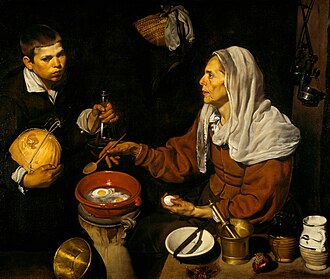 Old Woman Cooking Eggs - Diego Velázquez (1618)
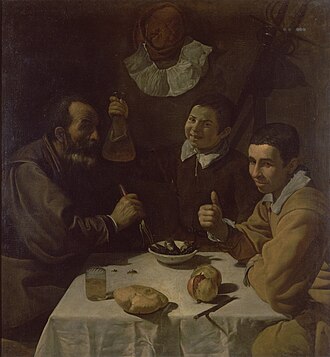 The Lunch - Diego Velázquez (1617)
.jpg) The Triumph of Bacchus - Diego Velázquez (1628)
The Triumph of Bacchus - Diego Velázquez (1628)
Paintings by related artists
 Supper at Emmaus - Caravaggio (1601)
 The Calling of Saint Matthew - Caravaggio (1609)
.jpg) The Elevation of the Cross - Peter Paul Rubens (1609)
The Elevation of the Cross - Peter Paul Rubens (1609)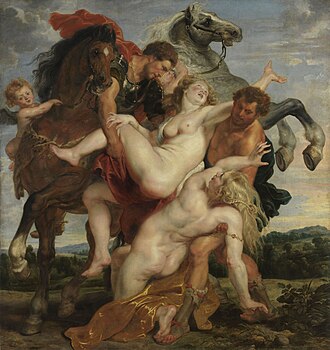 The Rape of the Daughters of Leucippus - Peter Paul Rubens (1618)
%20-%20Google%20Art%20Project.jpg) Charles I in Three Positions - Anthony van Dyck (1635)
Charles I in Three Positions - Anthony van Dyck (1635)%20with%20M.%20de%20St%20Antoine%20-%20Google%20Art%20Project.jpg) Charles I (1600-1649) with M. de St Antoine - Anthony van Dyck (1636)
Charles I (1600-1649) with M. de St Antoine - Anthony van Dyck (1636)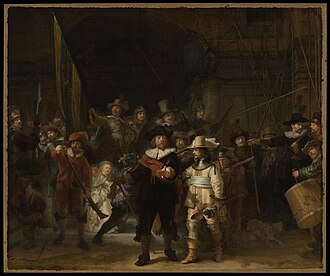 The Night Watch - Rembrandt van Rijn (1642)
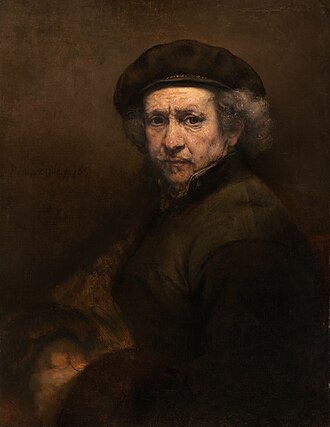 Self-Portrait - Rembrandt van Rijn (1659)
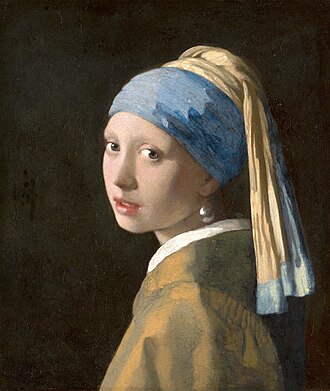 Girl with a Pearl Earring - Johannes Vermeer (1665)
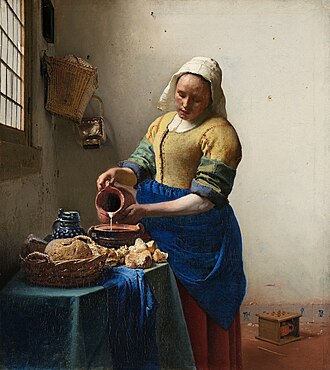 The Milkmaid - Johannes Vermeer (c. 1658)
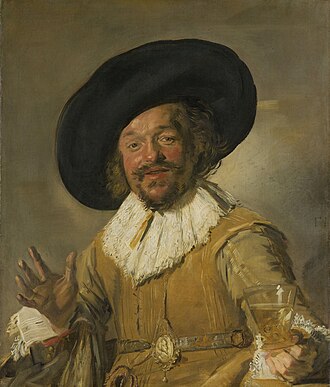 A Militiaman Holding a Berkemeyer, Known as the ‘Merry Drinker’ - Frans Hals (1620s)
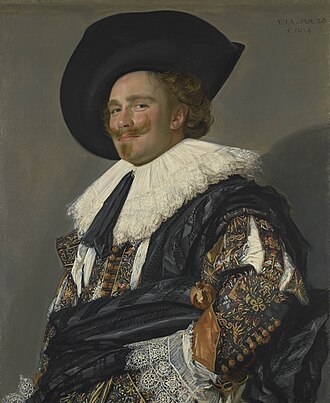 Laughing Cavalier - Frans Hals (1624)