Frans Hals
1591-1666
Frans Hals caught people mid-laugh, mid-glance, mid-thought, with brushstrokes he never tried to hide. He spent his whole working life in Haarlem, made clients come to him, and two centuries later Van Gogh and Manet found in him a joy no smooth painting could give.
Origins
Frans Hals was born in 1582 or 1583 in Antwerp, then part of the Spanish Netherlands, the son of the cloth merchant Franchois Fransz Hals van Mechelen and his second wife, Adriaentje van Geertenryck. During the Fall of Antwerp in 1584 and 1585 the family, like many others, fled north to Haarlem in the new Dutch Republic, where Hals lived for the rest of his life. Many of his later Haarlem clients were also émigrés from the south. He studied under the Flemish émigré Karel van Mander, though van Mander's Mannerist influence is barely visible in his work. In 1610 he joined the Haarlem Guild of Saint Luke and began earning money restoring the town council's art collection.
Life and turning points
Around 1610 Hals married Anneke Harmensdochter, who died in 1615 after the birth of their third child. In 1617 he married Lysbeth Reyniers, and they had eight children. His earliest known painting is the portrait of Jacobus Zaffius of 1611, and his breakthrough came with the life-size Banquet of the Officers of the St George Militia Company in 1616. He also served in the local civic guard, and in 1644 he became chairman of the Guild of Saint Luke. He lived so long that he went out of fashion and fell into debt, and in 1652 he sold his belongings to settle with a baker. From 1664 the city paid him a pension, a rare sign of esteem. He died in Haarlem on 26 August 1666 and was buried in the Grote Kerk.
Style and technique
Hals was a portrait specialist of the Dutch Golden Age, painting couples, families, civic guards, hospital regents and also tronies for the open market. His sitters range from mayors and merchants to fishwives, singers and tavern heroes, each caught with a different pose and expression. He was a master of the visible brushstroke, once seen as a flaw: fluid strokes left plainly on the surface that still conjure form and space. It looks fast, but most works were built up in layers in the usual way. Over the years his bright colours gave way to blacks and greys, perhaps because of his sitters' sober Protestant dress, and in late works such as the Regents and Regentesses of the Old Men's Almshouse his touch grew looser and more dignified.
Stories and anecdotes
Unlike Rembrandt, who moved house to suit his patrons, Hals stayed in Haarlem and insisted that clients come to him. According to the Haarlem archives, he refused to finish a militia portrait in Amsterdam, and Pieter Codde completed it. Old tales of Hals beating his first wife were confused with another Haarlem man of the same name; at the time of the charges, Anneke had already died. Stories of his heavy drinking were largely embellished by early biographers such as Arnold Houbraken, and there is no direct evidence for them. Experts disagree about how many paintings are his: Seymour Slive's catalogue lists 222, while Claus Grimm accepted only 145. His most famous sitter was René Descartes, painted in 1649.
Legacy
After his death Hals was held in low esteem for some two centuries, and paintings now among the pride of public galleries once sold for almost nothing. His reputation rose again from the 1860s thanks to the critic Théophile Thoré-Bürger. Impressionists and realists including Monet, Manet, Courbet and Whistler learned from his technique, and Lovis Corinth named him his biggest influence. Vincent van Gogh wrote to his brother Theo about the joy of seeing a Frans Hals, so unlike paintings where everything is carefully smoothed out. Several of his greatest works belong to the city of Haarlem and hang in the Frans Hals Museum, and a crater on Mercury bears his name.
Did you know?
- Five of his sons became painters, and his brother Dirck Hals was a painter too.
- Only once did he paint a married couple together on one canvas, Isaac Massa and Beatrix van der Laen, around 1622.
- Empress Catherine the Great acquired ten of his works.
- He appeared on the Dutch 10 guilder banknote of 1968.
Dutch Golden Age painting · Baroque
Related artists
Rembrandt van Rijn · Johannes Vermeer
Paintings by Frans Hals
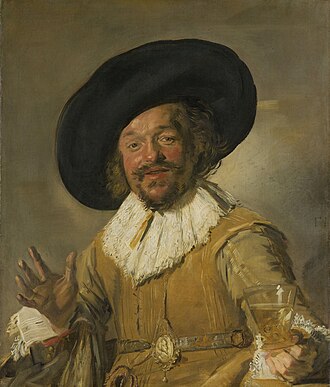 A Militiaman Holding a Berkemeyer, Known as the ‘Merry Drinker’ - Frans Hals (1620s)
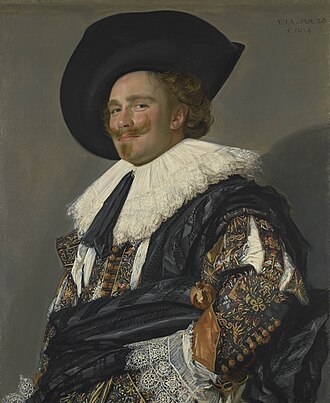 Laughing Cavalier - Frans Hals (1624)
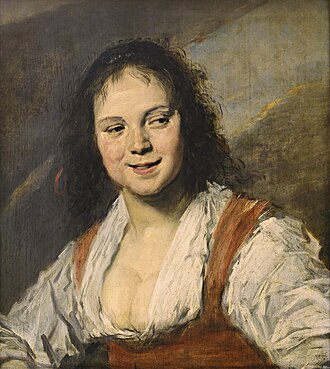 Gipsy Girl - Frans Hals (1628)
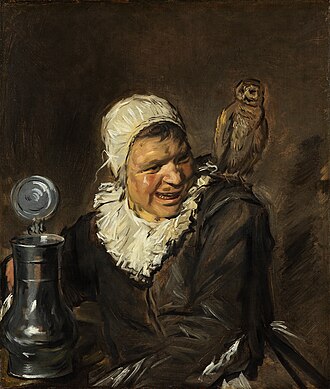 Malle Babbe - Frans Hals (1640s)
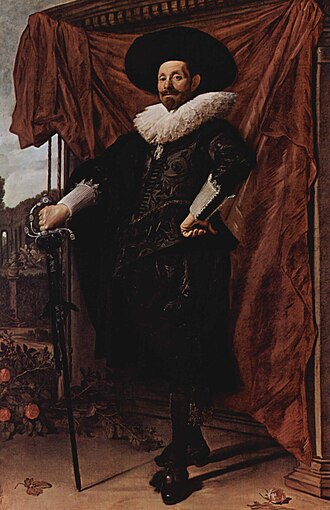 Willem van Heythuysen posing with a sword - Frans Hals (1625)
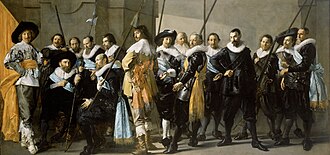 Militia Company of District XI under the Command of Captain Reynier Reael - Frans Hals (1630s)
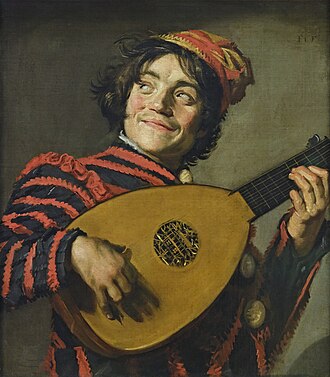 Jester with lute - Frans Hals (1623)
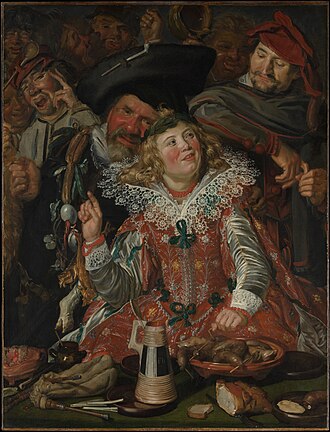 Merrymakers at Shrovetide - Frans Hals (1610s)
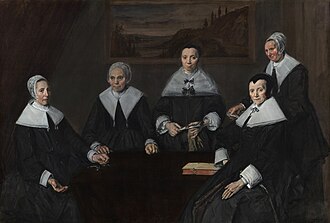 Regentesses of the Old Men's Alms House - Frans Hals (1664)
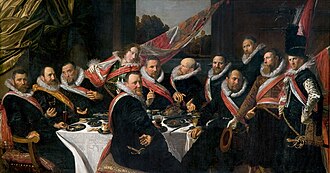 The Banquet of the Officers of the St George Militia Company in 1616 - Frans Hals (1616)