Caspar David Friedrich
1774-1840
Caspar David Friedrich painted lone figures before night skies, morning mists, bare trees and Gothic ruins, and turned landscape itself into a language of feeling and faith. Forgotten when he died, he is now seen as the central painter of German Romanticism.
Origins
Friedrich was born on 5 September 1774 in Greifswald on the Baltic coast, then part of Swedish Pomerania, the sixth of ten children of a candle-maker and soap boiler who raised them in a strict Lutheran faith. Records disagree about the family's means: some say the children had private tutors, others that they grew up in relative poverty. Death came early. His mother died when he was seven, two sisters died in the following years, and in 1787 he saw his younger brother Johann Christoffer fall through the ice of a frozen lake and drown; some accounts say the boy died trying to rescue Caspar David. In 1790 he began studying with Johann Gottfried Quistorp at the University of Greifswald, who took students drawing outdoors and introduced him to the theologian Ludwig Gotthard Kosegarten, who taught that nature was a revelation of God.
Life and turning points
From 1794 to 1798 Friedrich studied at the Academy of Copenhagen, where he could see the royal collection of Dutch landscapes. He then settled for good in Dresden, working mainly in ink, watercolour and sepia, and travelling to the Baltic coast, Bohemia and the Harz Mountains. A prize at Goethe's Weimar competition in 1805 made his name. His first major painting, the Tetschen Altar of 1808, a cross alone on a mountain top, provoked a public dispute over whether landscape belonged on an altar. He was elected to the Berlin Academy in 1810 and later joined the Saxon Academy, but never received the professorship he hoped for. In 1818 he married Caroline Bommer; they had three children. From the 1820s his reputation declined and he grew solitary and poor. A stroke in 1835 limited him to small works, and he died in Dresden on 7 May 1840.
Style and technique
Friedrich's great innovation was to make landscape a self-contained emotional subject rather than a backdrop for human drama. He often painted a Rückenfigur, a person seen from behind gazing at the view, inviting the viewer to share that moment of contemplation. His studies were made in pencil, often with topographical notes, but the subtle effects of light on clouds and water in his paintings were rendered from memory. He was among the first to paint winter as stark and empty, without the skaters and wanderers of older winter scenes. Bare oaks and tree stumps usually stand for death, while the cross, a clearing sky, the slender moon and anchors on the shore speak of hope. He wrote that the artist should paint not only what he sees before him but also what he sees within him, and advised closing the bodily eye to see the picture first with the spiritual eye.
Stories and anecdotes
Goethe, who judged the Weimar competition, praised Friedrich's sepia drawings warmly when the other entries had disappointed him. When the critic Basilius von Ramdohr attacked the Tetschen Altar, Friedrich answered with the only detailed explanation he ever wrote of one of his own works, comparing the rays of the evening sun to the light of God. In 1820 the future Tsar Nicholas I visited his studio and took paintings back to Saint Petersburg, and the poet Vasily Zhukovsky supported him for decades, helping him greatly at the end. His friend, the Norwegian painter Johan Christian Dahl, complained that the public saw his pictures only as curiosities and missed his faithful study of nature. Friends called him the most solitary of the solitary; he would walk alone through woods and fields, often setting out before sunrise.
Legacy
Friedrich's death in 1840 passed almost unnoticed, and his quiet pictures came to seem relics of a bygone age. Rediscovery began in the early 20th century, notably with a Berlin exhibition of thirty-two of his paintings in 1906. He influenced Arnold Böcklin, Russian painters such as Ivan Shishkin, the Symbolists and Edvard Munch, and later Max Ernst and the Surrealists; René Magritte's The Human Condition echoes his motifs. His popularity rose under the Nazis in the 1930s and then fell sharply because of that association. Since the 1970s a major international revival has restored him as one of the most important artists of German Romanticism and a national cultural icon. The figures in his paintings still stand with their backs to us, looking out, and we look with them.
Did you know?
- The art department of the University of Greifswald is named the Caspar-David-Friedrich-Institut in his honour.
- His son Gustav Adolf, named after the Swedish king, also became a painter.
- By 1804 he had made 18 etchings and four woodcuts, cut by his furniture-maker brother.
- He was buried in Dresden's Trinity Cemetery, whose entrance he had painted in 1825.
Romanticism · Romantisme · German Romanticism
Related artists
Francisco Goya · Eugène Delacroix · J. M. W. Turner · Thomas Gainsborough
Paintings by Caspar David Friedrich
 Wanderer above the Sea of Fog - Caspar David Friedrich (c. 1818)
 The Abbey in the Oakwood - Caspar David Friedrich (1800s)
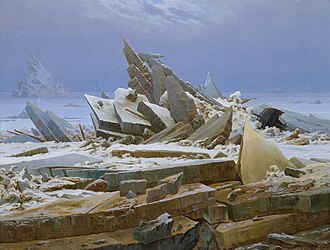 The Sea of Ice - Caspar David Friedrich (1820s)
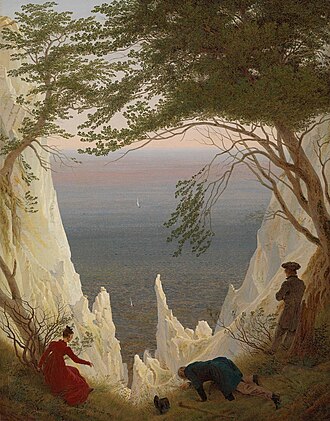 Chalk Cliffs at Ruegen - Caspar David Friedrich (1818)
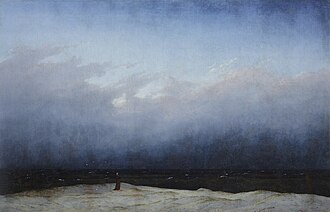 The Monk by the Sea - Caspar David Friedrich (1808)
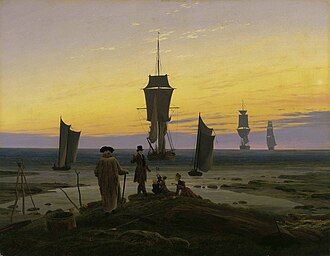 Life stages - Caspar David Friedrich (1834)
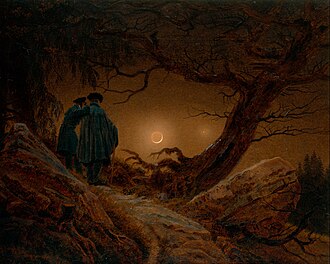 Two men contemplating the Moon - Caspar David Friedrich (1810s)
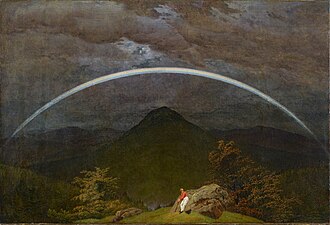 Mountain Landscape with Rainbow - Caspar David Friedrich (1809)
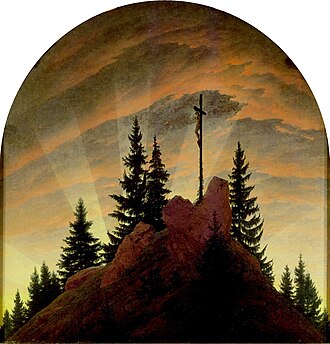 Altarpiece Tetschen - Caspar David Friedrich (1807)
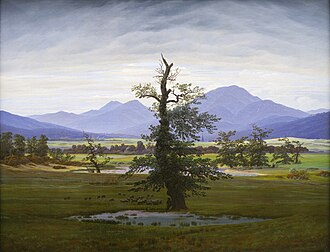 Solitary Tree - Caspar David Friedrich (1822)
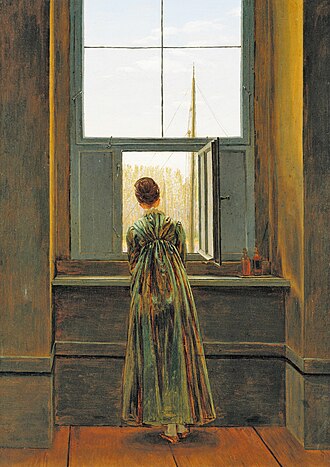 Woman at a Window - Caspar David Friedrich (1822)
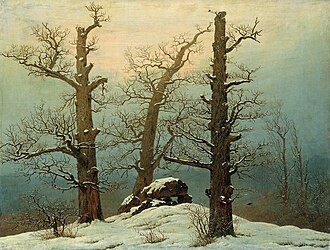 Cairn in Snow - Caspar David Friedrich (1807)
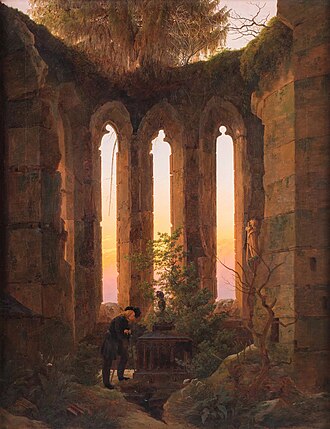 Hutten's Grave - Caspar David Friedrich (1823)
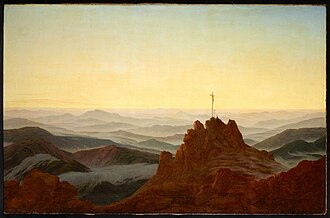 Morning in the Riesengebirge - Caspar David Friedrich (1810s)
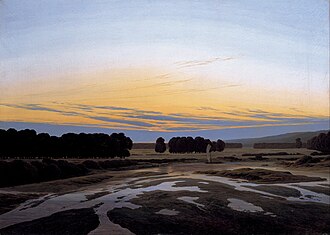 The big enclosure - Caspar David Friedrich (1830s)
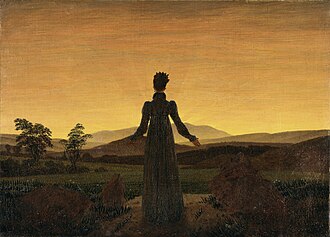 Woman in Front of the Setting Sun - Caspar David Friedrich (1818)
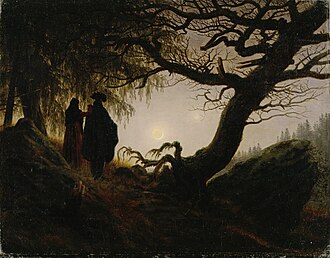 Man and Woman contemplating the moon - Caspar David Friedrich (1824)
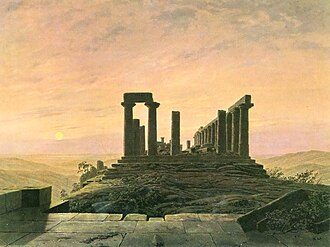 Temple of Juno in Agrigento - Caspar David Friedrich (1828)
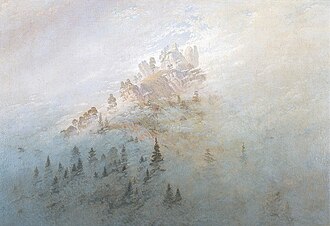 Morning mist in the mountains - Caspar David Friedrich (1808)
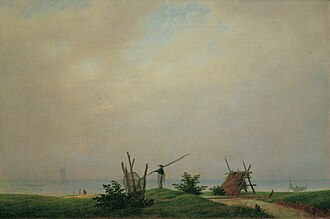 Seashore with fisherman - Caspar David Friedrich (1800s)
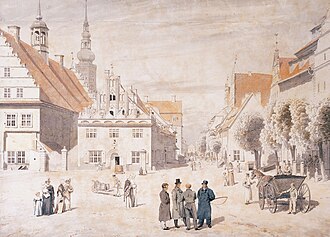 The Marketplace in Greifswald - Caspar David Friedrich (1818)
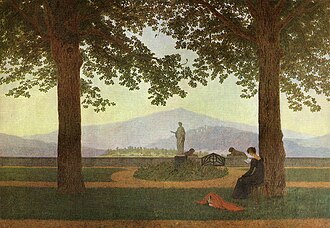 The Garden Terrace - Caspar David Friedrich (1810s)