The Abbey in the Oakwood
Caspar David Friedrich · 1800s
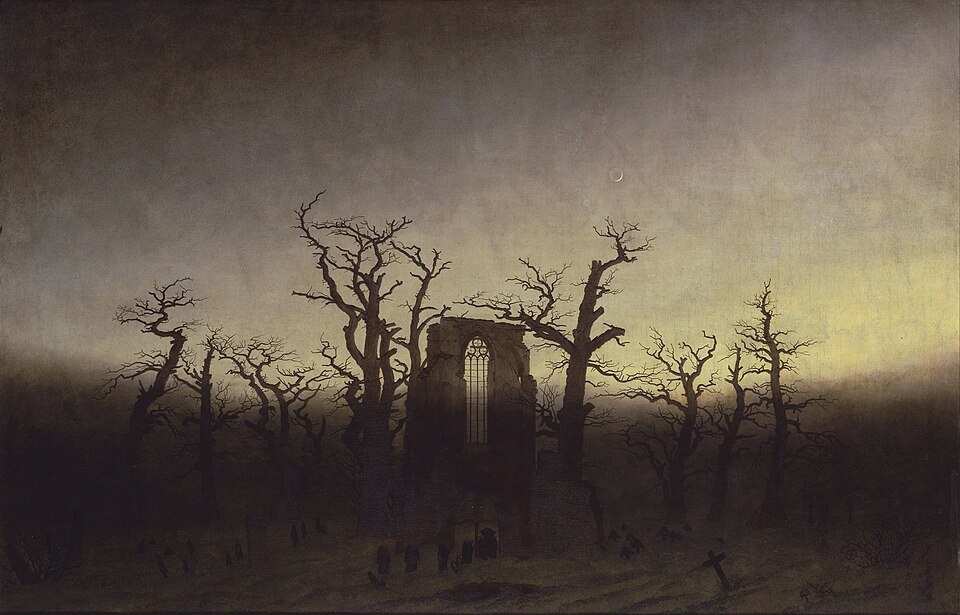
A line of monks carries a coffin through the snow toward a ruined church, lit by only two candles. Above them, bare oaks reach into a fading sky where a thin crescent moon is rising.
The story behind the painting
Caspar David Friedrich painted The Abbey in the Oakwood in Dresden between 1809 and 1810. It arrived at a hopeful moment in his career: he had just won his first public success and critical attention with the controversial Tetschen Altar. Although his pictures are landscapes, Friedrich composed them in the studio, working from freely drawn outdoor sketches and choosing their most evocative elements. This painting grew from studies of the ruins of Eldena Abbey, which return in several of his other works, and its trees also reappear, slightly altered, elsewhere. He may have begun it in June 1809 after a stay in Rügen and Neubrandenburg. On 24 September 1810, shortly before the Berlin Academy exhibition, Carl Frederick Frommann described the setting sun and half-moon of the nearly finished canvas.
What to look for
Begin at the bottom, where the light has already gone. The lower third of the picture lies in darkness. Out of the snow a newly dug grave opens in the foreground, and near it several crosses can be faintly made out. Now find the procession: monks, some carrying a coffin, moving toward the gate of a ruined Gothic church at the centre. Only two candles light their way. Let your eye climb the ruin to its broken window, empty of any glass. Around it stand leafless oaks. Only the highest part of the ruins and the tips of the trees catch the last rays of the setting sun, and in the sky a waxing crescent moon appears. The canvas is large, about 110 by 171 centimetres, so the cold silence has room to spread.
Meaning and intent
The scene is a meditation on the passage of time and on death. A funeral moves into a ruin, and the contrast is pointed: nature endures, while the works of human hands are temporary. Friedrich returned to this theme often; this is one of more than two dozen of his paintings that include cemeteries or graves. Eldena Abbey may also have held personal meaning for him. It was destroyed during the Thirty Years War by invading Swedish troops, who later used its bricks for fortifications. Friedrich drew a parallel between that destruction and the use of Greifswald churches as barracks by occupying French soldiers in his own day. Read this way, the funeral becomes a symbol of the burial of Germany's hopes for resurrection.
Legacy
The painting was first shown at the Prussian Academy of Arts exhibition of 1810 together with The Monk by the Sea. At Friedrich's own request, The Abbey in the Oakwood was hung beneath its companion, so the two could be read as a pair. After the exhibition, King Frederick William III bought both pictures for his collection. That decision kept them together, and they have stayed together: today the two paintings hang side by side in the Alte Nationalgalerie in Berlin. Standing before them, visitors can still experience the dialogue Friedrich wanted, the lonely figure by the sea and the solemn procession among the ruins, two quiet reflections on human life set against the vastness of nature.
Did you know?
- Painted in Dresden between 1809 and 1810.
- First exhibited in 1810 with The Monk by the Sea, hung beneath it at Friedrich's request.
- Bought by King Frederick William III; now in the Alte Nationalgalerie, Berlin.
- Size: 110.4 × 171 cm.
More by Caspar David Friedrich
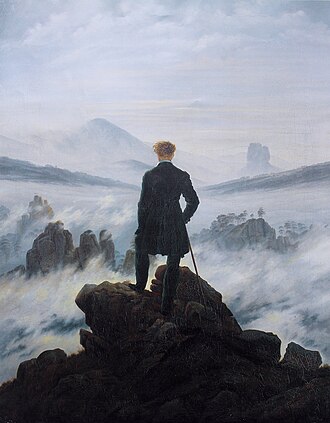 Wanderer above the Sea of Fog - Caspar David Friedrich (c. 1818)
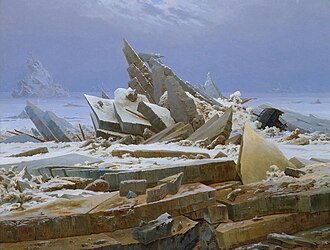 The Sea of Ice - Caspar David Friedrich (1820s)
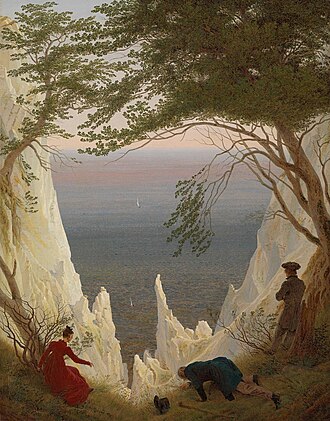 Chalk Cliffs at Ruegen - Caspar David Friedrich (1818)
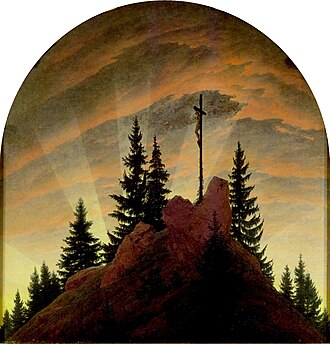 Altarpiece Tetschen - Caspar David Friedrich (1807)
Paintings by related artists
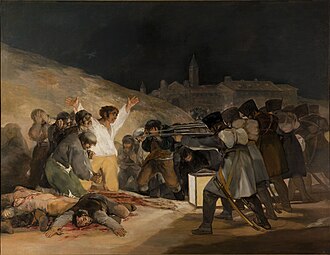 The Third of May 1808 - Francisco Goya (1814)
.jpg) La Maja nue - Francisco Goya (1800)
La Maja nue - Francisco Goya (1800)