The big enclosure
Caspar David Friedrich · 1830s
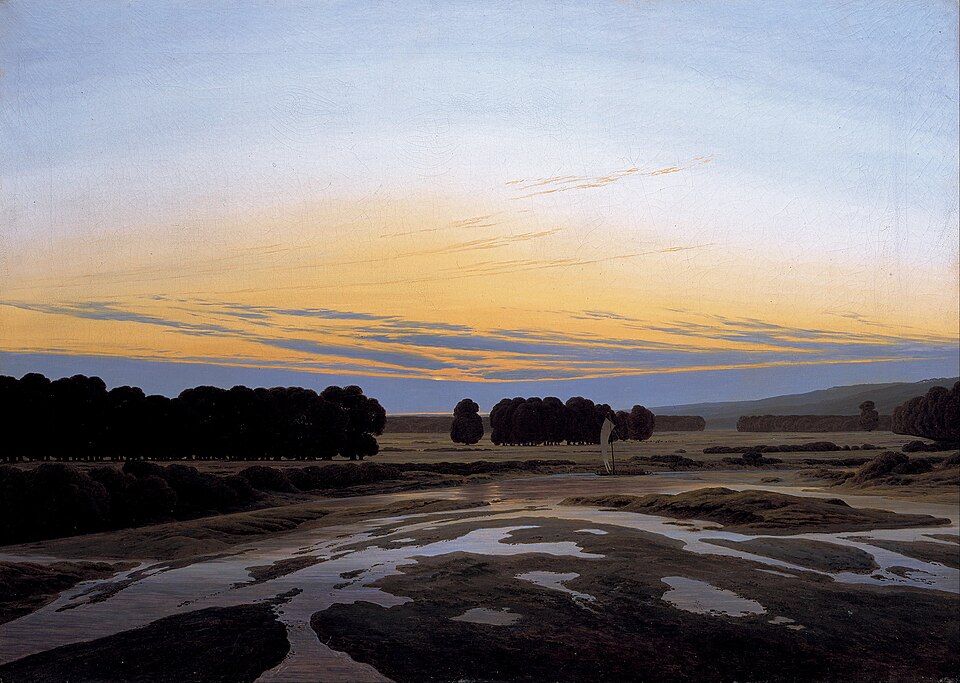
The last light of a late summer evening spreads blue and gold over a wide, wet meadow by the Elbe. One small boat is the only sign of people. Friedrich turned a flood plain near Dresden into a meditation on the end of a day, and of a life.
The story behind the painting
The Great Enclosure, also called the Ostra Enclosure, shows the floodplain beside the Elbe about four kilometres northwest of Dresden, where Friedrich lived. Wikipedia dates the oil on canvas to 1831, while Wikidata only gives the 1830s. A smaller oil, Sketch of the Great Enclosure, probably served as the preparatory study. Friedrich was one of the leading painters of German Romanticism, and though he loaded nature with allegory, he stayed attentive to real moments he had experienced. As he wrote, the artist should paint not only what he sees before him, but also what he sees within him.
What to look for
The viewpoint is raised above the ground, as if from a bridge over the river. Below lies the horizontal sweep of the meadow, its muddy earth and large puddles mirroring the sky. Above, the sky bends in intersecting curves; Willi Wolfradt notes that the curve begins in the distant grove and is echoed in the sandbanks, while Werner Hofmann sees it converging in a central hyperbola. The foreground is barren and muted, painted in strong light and shade. The only human presence is a small boat on the river, moving toward us. Its tiny size against the land and sky is the point.
Meaning and intent
The raised viewpoint suggests a passage from the natural world to the spiritual one, and twilight itself is a moment of transition. The puddles hold the heavens down on earth, so that the physical and the cosmic seem to merge. The little ship shows how slight human influence is beside the greatness of nature. For a Christian believer, the vast sunset colours accent themes of mortality and spiritual transcendence. Friedrich's contemporary Ludwig Tieck said the painter strove to evoke a feeling mingled with sadness and solemnity, and this quiet, glowing evening may be one of his most complete expressions of it.
Legacy
Werner Busch called the picture the crowning achievement of Friedrich's late work, and it is admired as unique in its accurate yet surreal sunset. In 1832 Johann Philipp Veith made a reproduction titled Evening on the Elbe. That same year the Saxon Art Association acquired the painting, and in December 1832 Gottlob Adolf Ernst von Nostitz und Jänkendorf won it in one of the association's raffles. The Dresden collection acquired it in 1909 from Ella von Nostitz und Jänckendorf. Today it hangs in the Albertinum, in the Galerie Neue Meister of the Staatliche Kunstsammlungen Dresden.
Did you know?
- Shows the Ostra floodplain on the Elbe near Dresden.
- Dated 1831 by Wikipedia, the 1830s by Wikidata.
- Won in an art association raffle in December 1832.
- In the Galerie Neue Meister, Dresden, since 1909.
About the artist
Caspar David Friedrich (1774-1840)
landscape painting · Staatliche Kunstsammlungen Dresden
More by Caspar David Friedrich
 Wanderer above the Sea of Fog - Caspar David Friedrich (c. 1818)
 The Abbey in the Oakwood - Caspar David Friedrich (1800s)
 The Sea of Ice - Caspar David Friedrich (1820s)
 Chalk Cliffs at Ruegen - Caspar David Friedrich (1818)
 The Monk by the Sea - Caspar David Friedrich (1808)
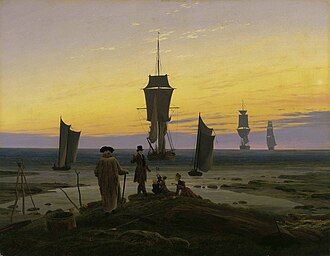 Life stages - Caspar David Friedrich (1834)
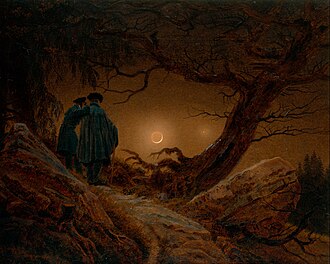 Two men contemplating the Moon - Caspar David Friedrich (1810s)
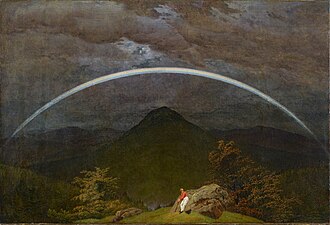 Mountain Landscape with Rainbow - Caspar David Friedrich (1809)
Paintings by related artists
 The Third of May 1808 - Francisco Goya (1814)
 La Maja nue - Francisco Goya (1800)
 Liberty Leading the People - Eugène Delacroix (1830)
 Death of Sardanapalus - Eugène Delacroix (1827)
 The Fighting Temeraire - J. M. W. Turner (1839)
 Rain, Steam and Speed - The Great Western Railway - J. M. W. Turner (1844)
 The Blue Boy - Thomas Gainsborough (1770)
 Mr and Mrs Andrews - Thomas Gainsborough (1748)