Woman at a Window
Caspar David Friedrich · 1822
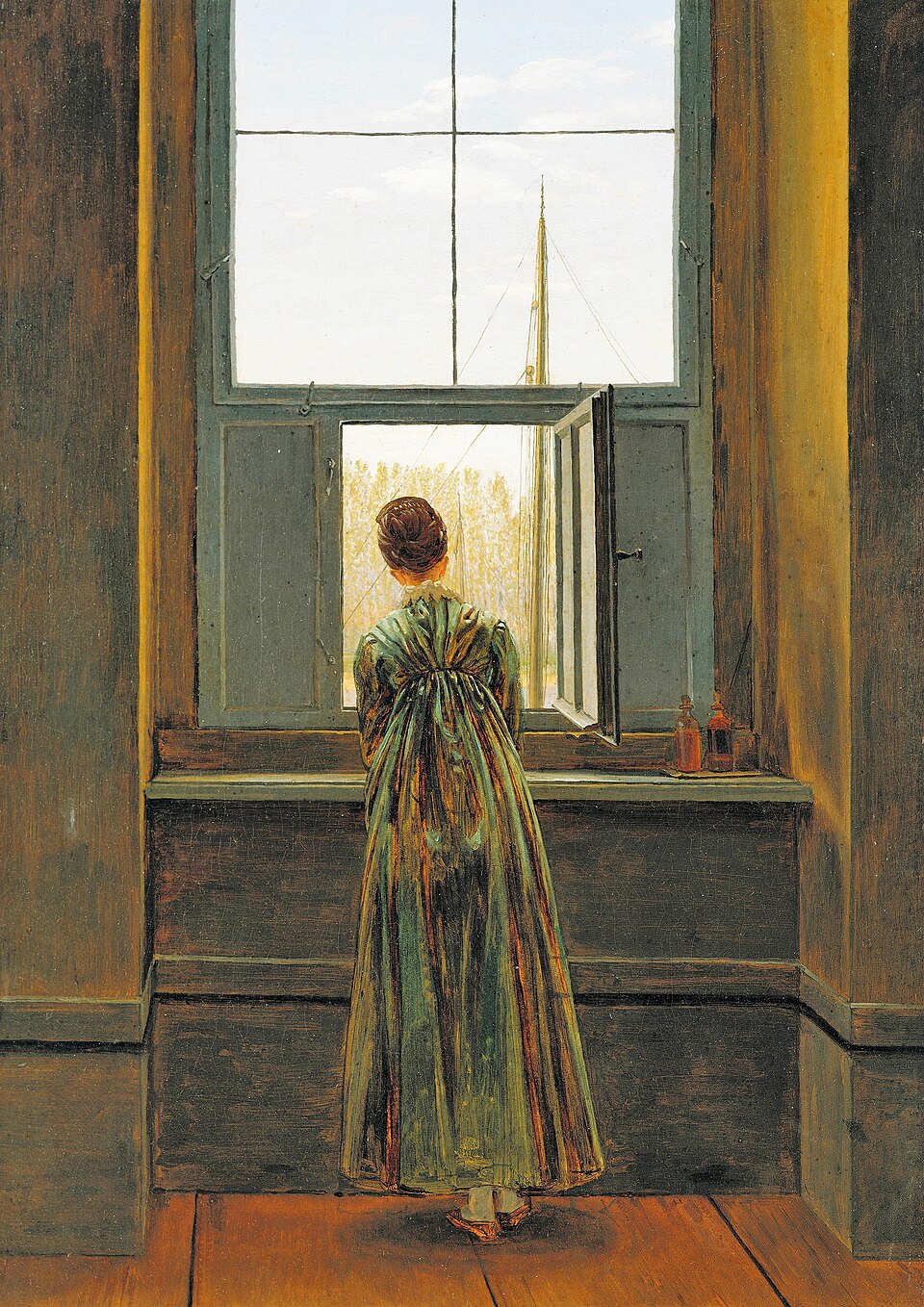
A woman in a green dress leans at an open window, her back to us, looking at ship masts on the river Elbe. Friedrich painted his wife Caroline in his bare Dresden studio, and lets us share her longing without ever seeing her face.
The story behind the painting
Friedrich painted Woman at a Window in 1822, four years after marrying Caroline Bommer in Dresden in 1818. The woman is Caroline, and the view is from his studio in their apartment overlooking the Elbe. After his marriage, his art placed new emphasis on figures and on domestic life, and Caroline appears in several of his works, including The Chalk Cliff on Rügen. He had long been drawn to this window: in 1806 he made a sepia sketch, View from the Artist's Atelier. He submitted the painting to the Dresden Academy, but did not finish it in time for the main exhibition. It measures about 44 by 37 cm.
What to look for
The room is almost empty. Floorboards, shutters, moulding and window sill form a strict, symmetrical geometry that leads the eye to the opening. Caroline, in a modest green dress, leans slightly, and the tilt of her body is echoed by the masts of the ships on the river. Beyond the window you see poplars on the far bank. Two bottles stand on the shelf to her right. Above her head the window frame forms a cross, and her posture has been called prayer-like. One scholar notes that the lines converge just left of centre, marking where Friedrich himself stood.
Meaning and intent
Caroline is a Rückenfigur, a figure seen from behind, Friedrich's favourite device. She stands in for us: we look out as she does, sharing a feeling of yearning and uncertainty. The window echoes the canvas itself, so the painting becomes a window within a window. Unlike his landscapes, where the figure seems joined to nature, here the woman is separated from the world outside, the ordered room set against the irregular view. One writer described the viewer as in a position of exile from what we can only partially see. Her relaxed, informal stance also makes it an intimate moment from Friedrich's home.
Legacy
The painting reflects a turning point in Friedrich's life and art. After what he called a crisis in 1816, his marriage and new friendships in Dresden with younger artists such as Georg Friedrich Kersting, Carl Gustav Carus and Johan Christian Dahl, with whom he shared a house, all shaped his work. Woman at a Window is now one of the best-known examples of his use of the window and the figure seen from behind. It belongs to the Alte Nationalgalerie in Berlin, where it continues to invite visitors to stand, like Caroline, and look beyond.
Did you know?
- Painted in 1822, about 44 x 37 cm.
- The woman is Friedrich's wife Caroline, in his Dresden studio.
- The view shows ship masts on the Elbe and poplars on the far bank.
- Now in the Alte Nationalgalerie, Berlin.
About the artist
Caspar David Friedrich (1774-1840)
genre art · Romanticism · Alte Nationalgalerie
More by Caspar David Friedrich
 Wanderer above the Sea of Fog - Caspar David Friedrich (c. 1818)
 The Abbey in the Oakwood - Caspar David Friedrich (1800s)
 The Sea of Ice - Caspar David Friedrich (1820s)
 Chalk Cliffs at Ruegen - Caspar David Friedrich (1818)
 The Monk by the Sea - Caspar David Friedrich (1808)
.jpg) Life stages - Caspar David Friedrich (1834)
Life stages - Caspar David Friedrich (1834) Two men contemplating the Moon - Caspar David Friedrich (1810s)
 Mountain Landscape with Rainbow - Caspar David Friedrich (1809)
Paintings by related artists
 The Third of May 1808 - Francisco Goya (1814)
.jpg) La Maja nue - Francisco Goya (1800)
La Maja nue - Francisco Goya (1800) The Fighting Temeraire - J. M. W. Turner (1839)
 Rain, Steam and Speed - The Great Western Railway - J. M. W. Turner (1844)