Cairn in Snow
Caspar David Friedrich · 1807
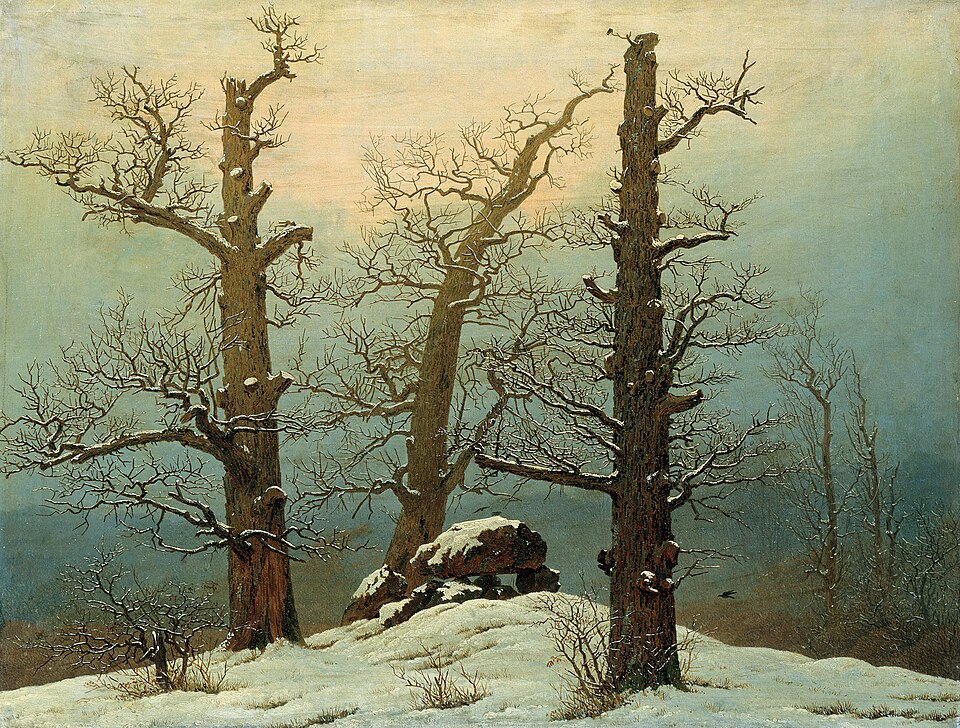
Three broken oaks stand guard over an ancient stone grave in the snow, while ravens circle. One of Friedrich's first oil paintings, it turns a winter hilltop into a meditation on death, endurance and a defeated country.
The story behind the painting
Cairn in Snow, in German Hünengrab im Schnee, literally Giant's grave in the snow, was probably painted around 1807, which makes it one of Friedrich's first oil paintings. Its elements come from different places in eastern Germany. The cairn is thought to be based on the Neolithic burial site near Gützkow in West Pomerania, a megalith Friedrich had sketched since at least 1802 and which was destroyed before 1818. He sketched the trees at Neubrandenburg, most clearly in an 1807 sepia drawing called Dolmen by the sea, and the hill is near Wustrow. He built the scene, piece by piece, from places he knew.
What to look for
The canvas measures 61 by 80 cm. A stone cairn or dolmen sits on a hilltop among three leafless oaks. The tops of two trees are broken off, and the third is bent by the prevailing wind, which gives the work a haunted, spectral air. The old branches look as if they have been chopped away. Then search for the birds: there are four ravens, two above the cairn, one to the right, and a fourth high in the tree on the right. The snow, the grey sky and the dark wood set a quiet, melancholy mood.
Meaning and intent
The painting mixes Christian and pagan symbols. Trees and forests stood for endurance, long life and immortality, and ancient sacred groves were linked with secrecy and initiation. The three trees around the cairn recall the three crosses on Golgotha, and the stone chamber recalls the tomb of Christ. The ancient stone speaks of permanence, the oaks of strength that bends in the storm without being defeated, and the scene of life continuing in the middle of winter. Critics have also read it as a reflection on life and death and on Germany after Napoleon defeated Prussia at Jena and Auerstedt in 1806.
Legacy
The first owner was Karl Schildener, a professor at Greifswald University, and the painting was described in a Greifswald academic journal in 1828. In 1845 it was sold at auction in Leipzig and bought by Friedrich's friend, the painter Johan Christian Dahl, who imitated it in his own Megalithic Tomb in Winter. It later left the estate of Dahl's only surviving son, Johann Siegwald Dahl, and entered the Galerie Neue Meister in Dresden in 1905. Similar oaks return in Monk in the Snow, The Abbey in the Oakwood and Oak tree in snow.
Did you know?
- Probably painted around 1807, one of Friedrich's first oils.
- The cairn is thought to be based on a megalith near Gützkow.
- Four ravens are hidden in the scene.
- In the Galerie Neue Meister, Dresden, since 1905.
About the artist
Caspar David Friedrich (1774-1840)
landscape painting · tree · sky · Romanticism · Staatliche Kunstsammlungen Dresden · snow · bird
More by Caspar David Friedrich
 Wanderer above the Sea of Fog - Caspar David Friedrich (c. 1818)
 The Abbey in the Oakwood - Caspar David Friedrich (1800s)
 The Sea of Ice - Caspar David Friedrich (1820s)
 Chalk Cliffs at Ruegen - Caspar David Friedrich (1818)
 The Monk by the Sea - Caspar David Friedrich (1808)
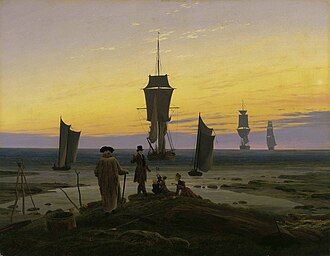 Life stages - Caspar David Friedrich (1834)
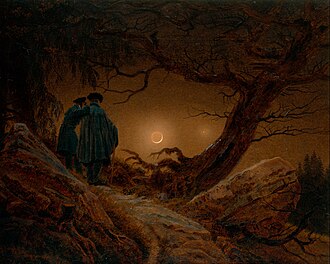 Two men contemplating the Moon - Caspar David Friedrich (1810s)
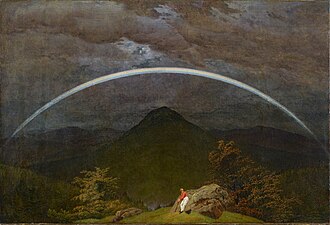 Mountain Landscape with Rainbow - Caspar David Friedrich (1809)
Paintings by related artists
 The Third of May 1808 - Francisco Goya (1814)
 La Maja nue - Francisco Goya (1800)
 Liberty Leading the People - Eugène Delacroix (1830)
 Death of Sardanapalus - Eugène Delacroix (1827)
 The Fighting Temeraire - J. M. W. Turner (1839)
 Rain, Steam and Speed - The Great Western Railway - J. M. W. Turner (1844)
 The Blue Boy - Thomas Gainsborough (1770)
 Mr and Mrs Andrews - Thomas Gainsborough (1748)