Morning mist in the mountains
Caspar David Friedrich · 1808
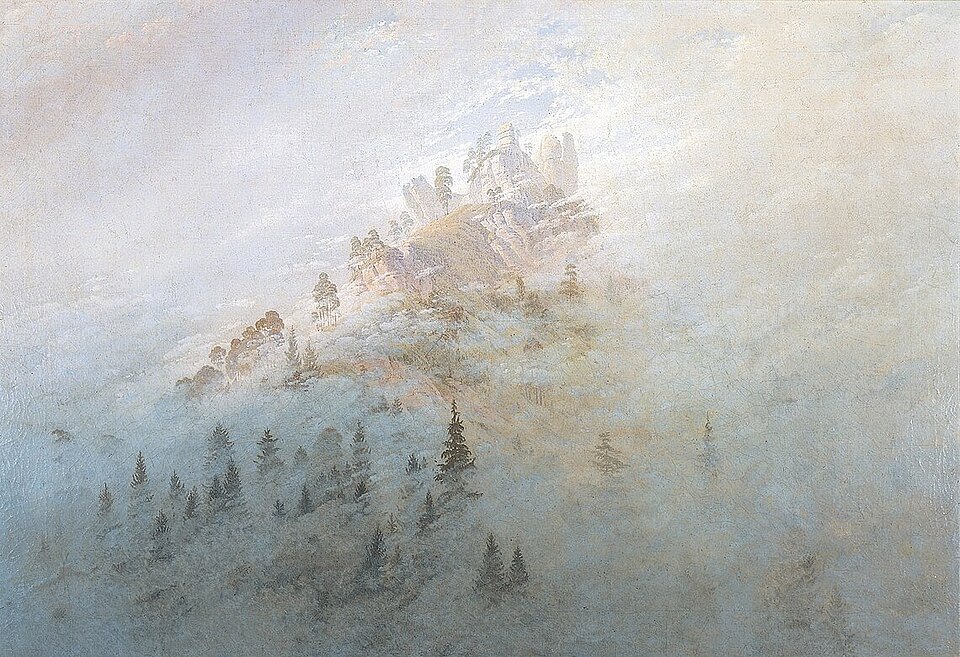
A single wooded mountain rises out of drifting mist and cloud. Only at the very top does the sky open, and if you look closely you find a tiny cross standing in clear blue air.
The story behind the painting
Friedrich painted Morning Mist in the Mountains around 1808, in the years of his Tetschen Altar, as one of several early landscapes with a cross. The mountain is modelled on the Honigsteine near Rathen in Saxon Switzerland, though Friedrich freely combined viewpoint and elements; he had sketched its triangular shape on the back of an earlier drawing. Other suggested models are the Schrammsteine or a mix of studies with no single source. The unsigned canvas reached the collection in Rudolstadt at an unknown date, wrongly listed as a landscape of the Schwarza valley. Only after the varnish was renewed in 1941 was Friedrich suspected as its author, then dated to about 1820.
What to look for
The composition is pared down: one pyramid-like mountain covered with spruce and pine, wrapped in bands of mist, the sky mostly closed by clouds. At the summit the sky opens, and a small cross or crucifix appears on the rocky peak. The wide fields of mist and cloud stress the grandeur of the mountain. Werner Busch points to the tallest spruce and the summit cross, placed at equal distances left and right of the centre and rising highest out of the mist. Scholars call the precise detail and fresh colour typical of Friedrich's early work.
Meaning and intent
Helmut Börsch-Supan sees the mountain as a symbol of the divine in nature, pointing with its cross from the misty earthly realm into the clear sky. The three-part rocky summit may allude to the Trinity, and the trees that hold on to the slope may stand for the faithful. Busch reads the balance between spruce and cross as a hint of revelation or redemption. For Johannes Grave the picture is about seeing and hiding: the tiny cross draws us closer to the canvas, so our eyes move between what is shown and the paint itself, continuing the play of mist and cloud.
Legacy
A note in the Viennese journal Prometheus in 1808, describing a mountain wrapped in clouds with a cross in clear blue air on its highest rock, is linked to this painting and supports today's dating. The canvas is one of the main attractions of the Thuringian State Museum Heidecksburg in Rudolstadt. In 2024 it travelled to the three great exhibitions for Friedrich's 250th birthday in Hamburg, Berlin and Dresden, and in 2025 to the Metropolitan Museum of Art in New York. Contemporary artists, among them Hiroyuki Masuyama, have drawn inspiration from it, and the photographer Frank Richter published walking routes comparing it with today's Honigsteine.
Did you know?
- Painted around 1808, the time of the Tetschen Altar.
- Modelled on the Honigsteine in Saxon Switzerland.
- Recognised as a Friedrich only after cleaning in 1941.
- Shown at the 2024 anniversary exhibitions and in New York in 2025.
About the artist
Caspar David Friedrich (1774-1840)
landscape painting · Romanticism
More by Caspar David Friedrich
 Wanderer above the Sea of Fog - Caspar David Friedrich (c. 1818)
 The Abbey in the Oakwood - Caspar David Friedrich (1800s)
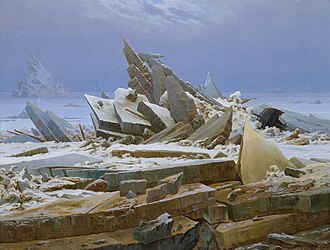 The Sea of Ice - Caspar David Friedrich (1820s)
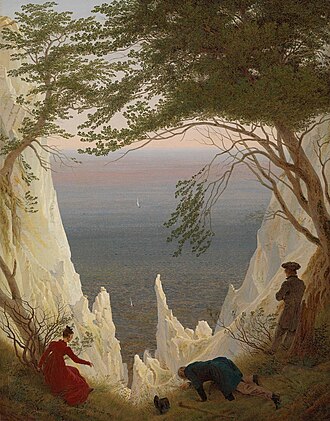 Chalk Cliffs at Ruegen - Caspar David Friedrich (1818)
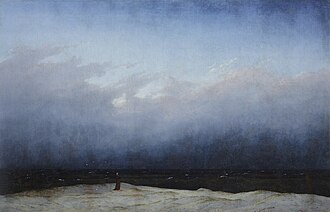 The Monk by the Sea - Caspar David Friedrich (1808)
 Life stages - Caspar David Friedrich (1834)
 Two men contemplating the Moon - Caspar David Friedrich (1810s)
 Mountain Landscape with Rainbow - Caspar David Friedrich (1809)
Paintings by related artists
 The Third of May 1808 - Francisco Goya (1814)
 La Maja nue - Francisco Goya (1800)
 Liberty Leading the People - Eugène Delacroix (1830)
 Death of Sardanapalus - Eugène Delacroix (1827)
 The Fighting Temeraire - J. M. W. Turner (1839)
 Rain, Steam and Speed - The Great Western Railway - J. M. W. Turner (1844)
 The Blue Boy - Thomas Gainsborough (1770)
 Mr and Mrs Andrews - Thomas Gainsborough (1748)