Two men contemplating the Moon
Caspar David Friedrich · 1810s
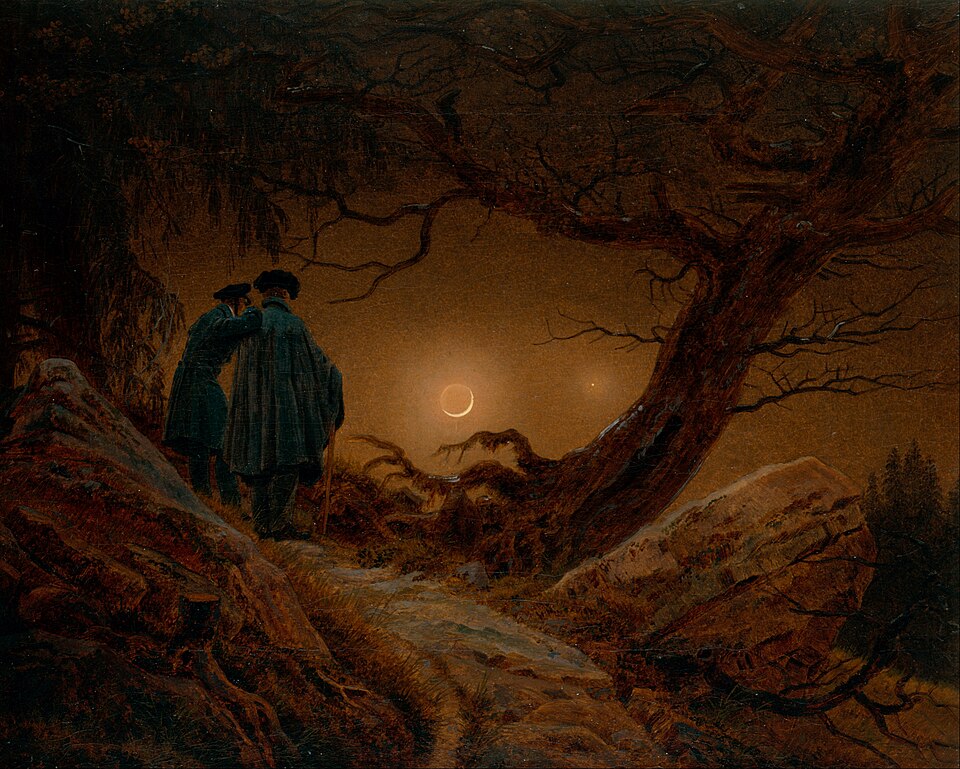
Two friends stand on a mountain path at nightfall, one leaning on the other's shoulder, watching a thin crescent moon. We never see their faces, only what they see. Samuel Beckett said a version of this scene was the source of Waiting for Godot.
The story behind the painting
Caspar David Friedrich painted this scene in several versions, and their dating and authorship are still debated. The small canvas in Dresden, about 33 by 44.5 cm, from around 1819 to 1820, is generally held to be the original; Wikidata simply places it in the 1810s. Friedrich exchanged it with his friend, the Norwegian painter Johan Christian Dahl, for one of Dahl's own works. In 1830 Dahl listed it as a moonlit landscape with two male figures watching the rising half-moon, and in 1840 he sold it to the Royal Art Gallery in Dresden. Variants with a man and a woman are in Berlin and a private collection.
What to look for
Two figures stand on a path leading up from the bottom centre. The one on the right wears a grey-green cape and the black beret of old German dress and holds a stick; the slimmer one on the left wears a frock coat and the black cap of an early student fraternity, and leans on his companion's shoulder. Both look at the crescent of the waxing moon and the evening star; the moon's dark side glows faintly with earthshine. An uprooted, moss-grown oak, held up by a boulder, reaches toward a spruce on the left. The painting is almost monochrome, browns and greys of nightfall.
Meaning and intent
As often with Friedrich there is no middle ground: the dark earthly foreground meets the luminous sky, and the abyss at the men's feet is felt through that contrast. Werner Busch sees the golden section in the layout as signalling a transcendent experience of nature. Who are the men? Friedrich's friend Wilhelm Wegener said they were Friedrich himself, on the right, and his pupil August Heinrich. Dahl agreed about Heinrich but named the older man as Christian Wilhelm Bommer, Friedrich's brother-in-law, though in 1819 Bommer was only 18 and Heinrich 25. Other historians placed the scene on Rügen or in the Harz Mountains.
Legacy
The image has been called a defining picture of German Romanticism. Dahl said Friedrich painted an unknown number of copies and that others copied it too, which is why the versions are hard to date. A later version, from about 1825 to 1830, is in the Metropolitan Museum of Art in New York; the Dresden picture is truer to Friedrich's sketches from nature. Standing before Man and Woman Contemplating the Moon, the playwright Samuel Beckett said it was the source of Waiting for Godot. A small painting of two figures seen from behind thus reached far beyond its own century.
Did you know?
- Dresden version, about 1819-1820, 33 x 44.5 cm, generally held to be the original.
- Exchanged by Friedrich with Johan Christian Dahl, who sold it to Dresden in 1840.
- The figures may be Friedrich and his pupil August Heinrich.
- Samuel Beckett linked the scene to Waiting for Godot.
About the artist
Caspar David Friedrich (1774-1840)
genre art · man · landscape painting · sky · Staatliche Kunstsammlungen Dresden · rock · night
More by Caspar David Friedrich
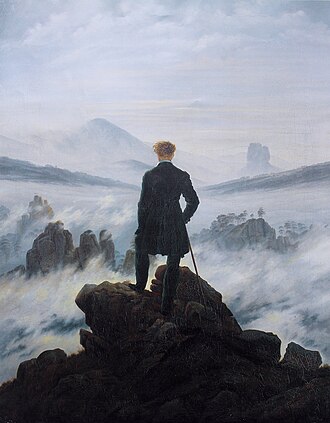 Wanderer above the Sea of Fog - Caspar David Friedrich (c. 1818)
 The Abbey in the Oakwood - Caspar David Friedrich (1800s)
 The Sea of Ice - Caspar David Friedrich (1820s)
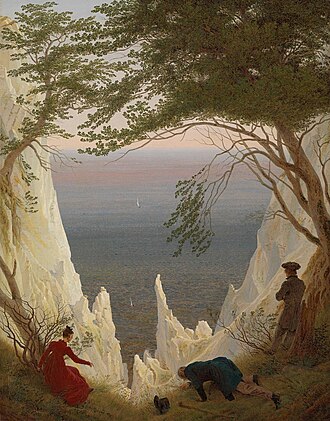 Chalk Cliffs at Ruegen - Caspar David Friedrich (1818)
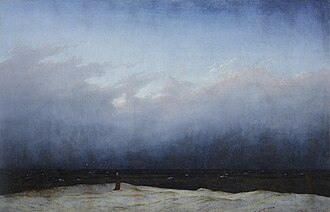 The Monk by the Sea - Caspar David Friedrich (1808)
.jpg) Life stages - Caspar David Friedrich (1834)
Life stages - Caspar David Friedrich (1834)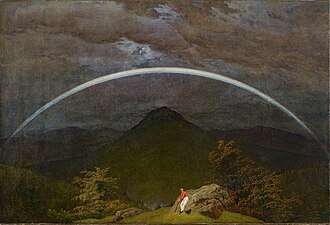 Mountain Landscape with Rainbow - Caspar David Friedrich (1809)
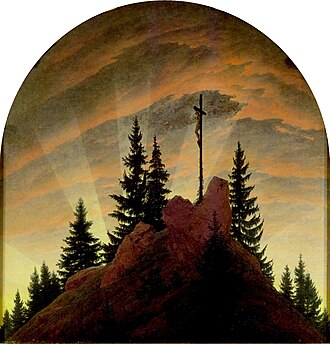 Altarpiece Tetschen - Caspar David Friedrich (1807)
Paintings by related artists
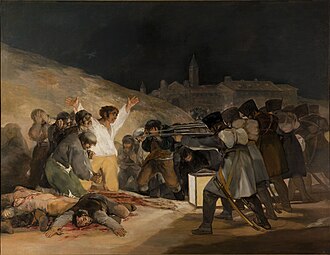 The Third of May 1808 - Francisco Goya (1814)
.jpg) La Maja nue - Francisco Goya (1800)
La Maja nue - Francisco Goya (1800)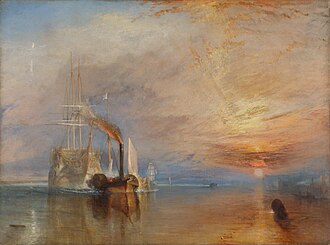 The Fighting Temeraire - J. M. W. Turner (1839)
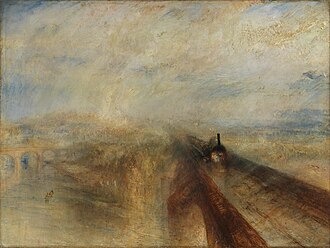 Rain, Steam and Speed - The Great Western Railway - J. M. W. Turner (1844)