Man and Woman contemplating the moon
Caspar David Friedrich · 1824
.jpg)
A man and a woman stand on a dark mountain path at nightfall, her arm resting on his shoulder, both turned away from us toward a thin crescent moon. Friedrich painted this quiet moment more than once, and this Berlin version gives the scene to a couple.
The story behind the painting
Friedrich painted at least three versions of this scene. The best known, with two men, is in Dresden and is usually held to be the original; another with two men is in the Metropolitan Museum of Art. In this variant a woman replaces the man on the left. Friedrich's friend Wilhelm Wegener and the painter Dahl offered identifications of the figures, and Caroline Friedrich, the artist's wife, would be the woman here. The dating is uncertain: Wikipedia gives c. 1824 and a range from 1818 to 1835, and the art historian Kaspar Monrad suggests it may even be the first version of the theme, before early 1818.
What to look for
The couple stand left of centre, seen from behind, the woman's arm on the man's shoulder. Their calm, contemplative pose contrasts with the twisted, half-uprooted oak, set against the upright pine on the left. Wikipedia notes that this irregular, asymmetrical construction was fairly rare for Friedrich, who usually favoured regular geometry. Compared with the Dresden picture, the stump here is broken rather than sawn, the dead branch is gone, the trees on the right rise higher and the walking stick has disappeared, although X-rays show two lines where Friedrich had planned to paint it. The palette is dark in front and pale in the sky.
Meaning and intent
The figures, seen almost entirely from the rear, stand in for us: we are left to look with them and supply a meaning. The series is read as a defining image of German Romanticism, with its tension between the solid earth and the endless sky. Helmut Börsch-Supan read the evergreen and the dead oak as the Christian faith and defeated paganism, the path as the path of life and the waxing moon as Christ. Others stress politics: the old German dress worn by the figures in the series was banned in 1819, and Friedrich himself joked about demagogic intrigues when showing the Dresden picture.
Legacy
This painting of a man and a woman was with the Salomon art dealership in Dresden in 1922. In 1932 it was shown at the Paul Cassirer gallery in Berlin, lent from the collection of Lulu Böhler in Lucerne, and the Alte Nationalgalerie bought it that same year from the Fritz Nathan Gallery. It remains in Berlin today. The setting of the series is among Friedrich's best-known works, and standing before this very picture the playwright Samuel Beckett reportedly said it was the source of Waiting for Godot.
Did you know?
- Friedrich painted at least three versions of the moonlit scene.
- In this variant a woman replaces one of the two men.
- X-rays show where a walking stick was planned and then left out.
- Bought by the Alte Nationalgalerie in Berlin in 1932.
About the artist
Caspar David Friedrich (1774-1840)
woman · man · genre art · landscape painting · Romanticism · tree · sky · Alte Nationalgalerie · couple · night · Moon
More by Caspar David Friedrich
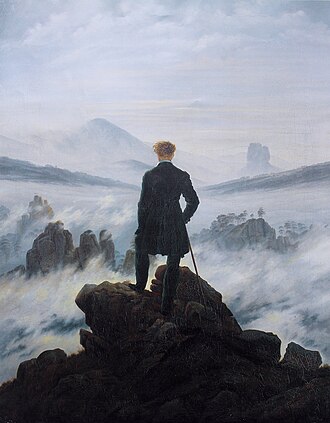 Wanderer above the Sea of Fog - Caspar David Friedrich (c. 1818)
 The Abbey in the Oakwood - Caspar David Friedrich (1800s)
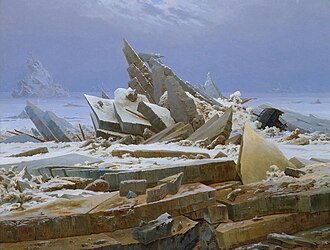 The Sea of Ice - Caspar David Friedrich (1820s)
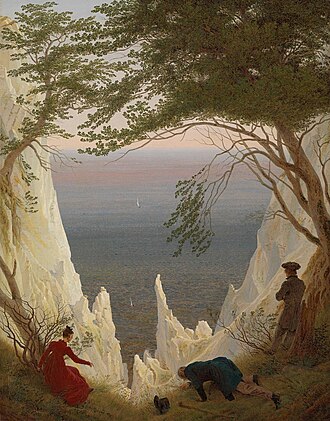 Chalk Cliffs at Ruegen - Caspar David Friedrich (1818)
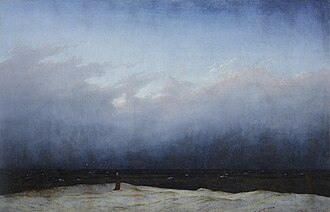 The Monk by the Sea - Caspar David Friedrich (1808)
.jpg) Life stages - Caspar David Friedrich (1834)
Life stages - Caspar David Friedrich (1834)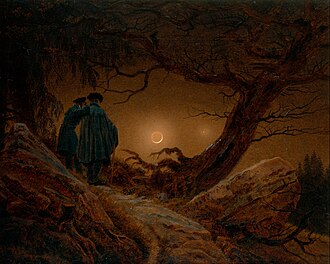 Two men contemplating the Moon - Caspar David Friedrich (1810s)
 Mountain Landscape with Rainbow - Caspar David Friedrich (1809)
Paintings by related artists
 The Third of May 1808 - Francisco Goya (1814)
.jpg) La Maja nue - Francisco Goya (1800)
La Maja nue - Francisco Goya (1800) The Fighting Temeraire - J. M. W. Turner (1839)
 Rain, Steam and Speed - The Great Western Railway - J. M. W. Turner (1844)