J. M. W. Turner
1775-1851
A barber's son from Covent Garden, J. M. W. Turner entered the Royal Academy Schools at 14 and spent his life chasing light, storm, fog and sea. His late, almost abstract canvases puzzled critics in his day and inspired Monet and Pissarro.
Origins
Joseph Mallord William Turner was born on 23 April 1775 in a house on Maiden Lane, in London's busy working-class Covent Garden district. His father, William Turner, kept a barbershop and wig store, and by the time the boy was ten he proudly displayed his son's drawings in the shop window, telling the artist Thomas Stothard that his son was going to be a painter. His mother, Mary Marshall, came from a family of butchers; she suffered from mental illness and died in Bethlem Hospital in 1804. Turner was sent to school in several towns, including Brentford and Margate. Young as he was, he earned a reliable income from topographical and architectural watercolours, working for architects and studying under the draughtsman Thomas Malton.
Life and turning points
Recognised as a child prodigy, Turner was accepted into the Royal Academy Schools in 1789, aged 14, and a year later one of his watercolours was shown at the Academy's exhibition. At 21 he exhibited Fishermen at Sea, a dramatic moonlit seascape that won wide acclaim. Dutch Boats in a Gale took the Academy by storm in 1801, and the next year, at 27, he became a Royal Academician, the second youngest in the institution's history. In 1804 he opened his own gallery, and his father gave up barbering to help him. He never married, though he is generally believed to have fathered two daughters with the widow Sarah Danby. In old age he lived with the widow Sophia Caroline Booth in Chelsea, where he died in 1851, aged 76.
Style and technique
Turner never stopped experimenting. He could emulate the Old Masters, painting in the manner of Rembrandt, Rubens, Claude, Poussin, Canaletto and others, yet make each style his own. From early on he worked from sketches made on long travels through England and Europe, and alongside oceans, rivers and mountains he tried to paint sunlight, storms, clouds and fog themselves. Work as a theatre scene painter left him with a fondness for bright lights and flaring colours. His later landscapes grew more abstract and were poorly received at the time, but are now considered masterpieces. He was also a skilled printmaker who favoured mezzotint, and his Liber Studiorum, about 70 prints made between 1806 and 1819, helped raise the status of landscape painting.
Stories and anecdotes
He loved fishing and boating on the Thames, and for a few years turned a boat at Hammersmith into a floating studio. Some critics were brutal: one paper said of Snow Storm: Steam-Boat off a Harbour's Mouth that he seemed to paint with cream, chocolate, egg yolk or currant jelly. Sir George Beaumont said the sea in Dutch Boats in a Gale looked like pea soup, and a fellow Academician once called him a little reptile. He kept his strong cockney accent and never tried to hide it. Others defended him: in 1816 the essayist William Hazlitt wrote that he loved to go back to the first chaos of the world. In old age visitors said he looked more like an English farmer or a river-boat sailor than a famous painter.
Legacy
Turner is regarded as one of the greatest British painters of the 19th century, and his expressive light and bold colour inspired the early impressionists Monet and Pissarro. He was prolific, making about 550 oil paintings and over 2,000 watercolours. In an unprecedented gesture he left the nation about 100 finished and 200 unfinished oil paintings, over 19,000 sketches, drawings and watercolours, and some 200 sketchbooks. He wished for a new gallery to house them; that finally came in 1987, when Tate Britain opened the Clore Gallery, 136 years after his death. He is buried in St Paul's Cathedral, near Sir Joshua Reynolds, as he asked. His skies still seem to dissolve into pure light before our eyes.
Did you know?
- He built a house in Twickenham that he named Sandycombe Lodge.
- In later life he stayed in Chelsea under the names Mr Booth or Admiral Booth.
- From 1808 to 1824 he spent many summers at Farnley Hall in Yorkshire, where he had his own room.
- The Academy awarded him the Greater Silver Palette for landscape drawing in 1796.
Romanticism · Impressionism · academic art
Related artists
Joshua Reynolds · Claude Monet · Francisco Goya · Caspar David Friedrich · Eugène Delacroix · Thomas Gainsborough
Paintings by J. M. W. Turner
 The Fighting Temeraire - J. M. W. Turner (1839)
 Rain, Steam and Speed - The Great Western Railway - J. M. W. Turner (1844)
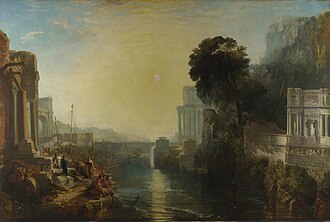 Dido building Carthage - J. M. W. Turner (1815)
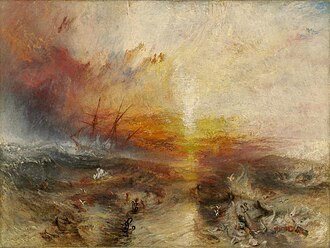 The Slave Ship - J. M. W. Turner (1840)
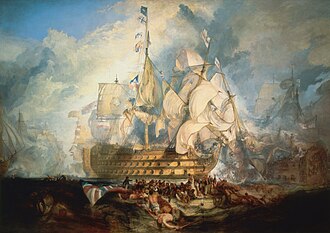 The Battle of Trafalgar - J. M. W. Turner (1820s)
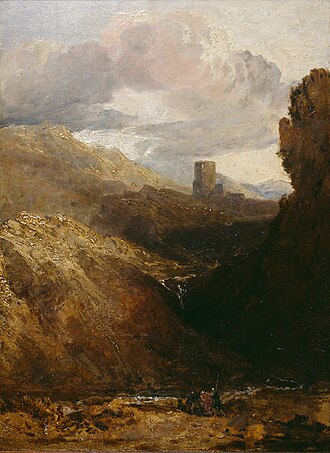 Dolbadarn Castle - J. M. W. Turner (1800)
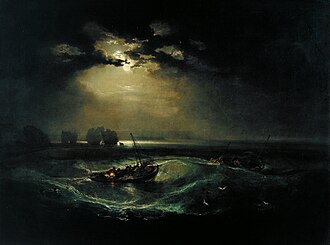 Fishermen at Sea - J. M. W. Turner (1796)
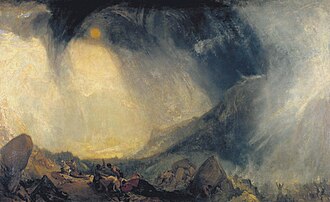 Snow Storm: Hannibal and his Army Crossing the Alps - J. M. W. Turner (1812)
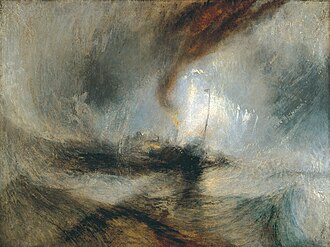 Snow Storm: Steam-Boat off a Harbour's Mouth - J. M. W. Turner (1842)
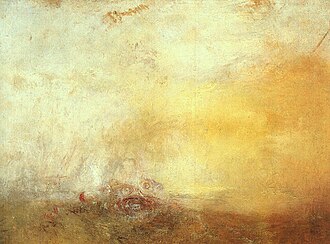 Sunrise with Sea Monsters - J. M. W. Turner (1845)
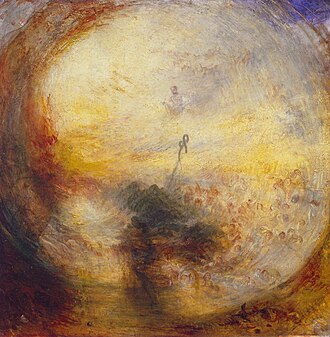 Light and Colour (Goethe's Theory) - The Morning after the Deluge - Moses Writing the Book of Genesis - J. M. W. Turner (1843)
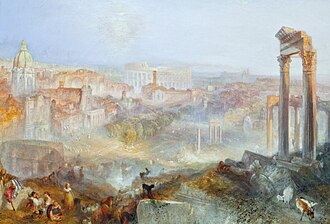 Modern Rome - Campo Vaccino - J. M. W. Turner (1839)
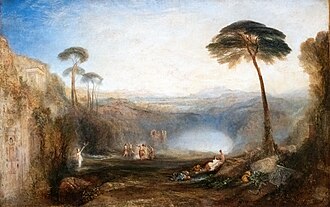 The Golden Bough - J. M. W. Turner (1834)
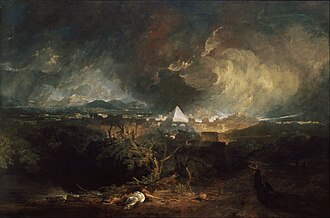 The Fifth Plague of Egypt - J. M. W. Turner (1800)
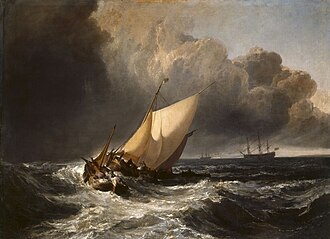 Dutch Boats in a Gale - J. M. W. Turner (1801)
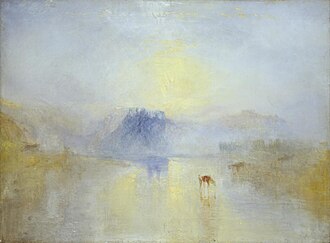 Norham Castle, Sunrise - J. M. W. Turner (1845)
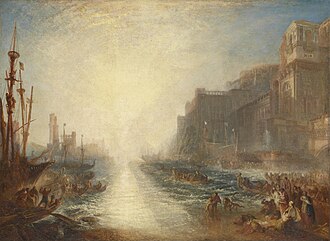 Regulus - J. M. W. Turner (1828)
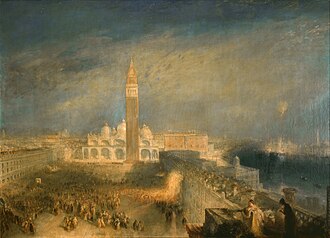 Juliet and her Nurse - J. M. W. Turner (1836)
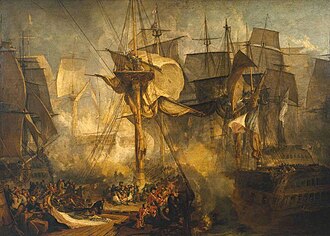 The Battle of Trafalgar, as Seen from the Mizen Starboard Shrouds of the Victory - J. M. W. Turner (1800s)
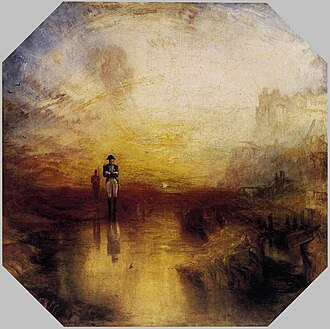 War. The Exile and the Rock Limpet - J. M. W. Turner (1842)
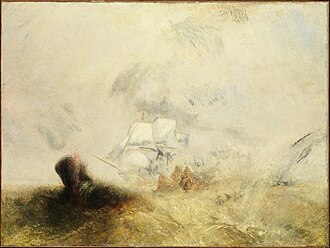 Whalers - J. M. W. Turner (1845)
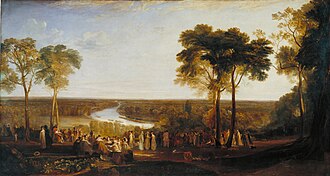 England: Richmond Hill, on the Prince Regent's Birthday - J. M. W. Turner (1819)
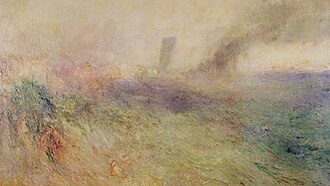 Seascape: Folkestone - J. M. W. Turner (1845)
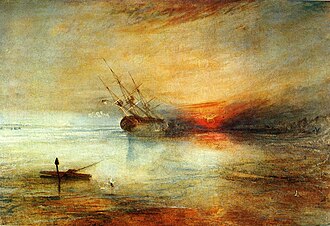 Fort Vimieux - J. M. W. Turner (1831)
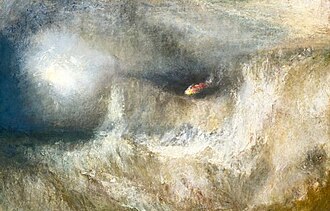 The Beacon Light - J. M. W. Turner (1835)
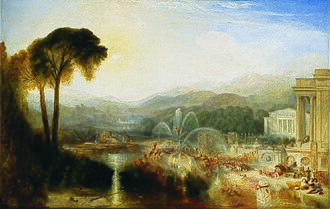 The Fountain of Indolence - J. M. W. Turner (1834)