Claude Monet
1840-1926
Claude Monet gave Impressionism its name with a hazy harbour at sunrise and spent his life painting light as it changes from hour to hour. In his garden at Giverny he made a pond of water lilies that kept him painting for his last twenty years.
Origins
Oscar-Claude Monet was born on 14 November 1840 on the fifth floor of 45 rue Laffitte in Paris, the second son of Claude Adolphe and Louise Justine Monet. In 1845 the family moved to Le Havre in Normandy. His father, a wholesale merchant, wanted him in the family's ship-chandling and grocery business, but his mother, a singer, supported his wish to be an artist. An apathetic student, he was drawing caricatures of acquaintances for money by fifteen. Around 1858 he met the painter Eugene Boudin, who taught him to paint outdoors, en plein air, and whom Monet later said he owed everything to. His mother died in 1857, and his aunt Marie-Jeanne Lecadre became a key support in his early career.
Life and turning points
In Paris he studied at the Academie Suisse, where he met Camille Pissarro, and later in Charles Gleyre's studio, where he met Renoir and Frederic Bazille. Conscripted in 1861, he served in Algeria until typhoid brought him home; he later said North Africa's light and colour held the germ of his future research. In 1867 his partner Camille Doncieux gave birth to their son Jean, and they married in 1870. To avoid the Franco-Prussian War they went to London, where he admired Turner and met the dealer Paul Durand-Ruel. Camille died in 1879. In 1883 he moved to Giverny, where Alice Hoschede, whom he married in 1892, joined him. Alice died in 1911 and Jean in 1914. Monet died on 5 December 1926.
Style and technique
Monet has been called the driving force behind Impressionism, and he was its most consistent practitioner, painting nature as he perceived it, outdoors and directly from the motif. He made light the centre of his paintings, sometimes finishing a canvas in one sitting to catch it. To record how light and seasons change a scene, he painted the same subject many times: haystacks in 1890 and 1891, twenty-six views of Rouen Cathedral in 1892, and the water lilies of his Giverny garden, begun in 1899. In the 1870s he lightened his palette and used smaller, more varied strokes, and in the 1880s he sought harmony between warm and cold hues. Cataracts later changed how he saw colour, and surgery in 1923 followed years of worsening sight.
Stories and anecdotes
The word Impressionism comes from his painting Impression, Sunrise, shown in 1874 at the first independent exhibition he helped organise, and from a hostile review by the critic Louis Leroy. Monet once confessed to his friend Georges Clemenceau that he found himself studying the colours on his beloved wife's dead face by reflex, and he made a study in oils of Camille on her deathbed. Accounts of his conscription differ: in 1900 he said his family would pay for a substitute only if he gave up art, but by the 1920s he told it differently. In Argenteuil he bought a boat to paint on the river. After his cataract operation, now able to see the real colours, he began to destroy canvases from the years before it.
Legacy
Monet founded Impressionism and is seen as a key precursor to modernism. He was frequently exhibited and successful in his lifetime, and his fame soared in the second half of the 20th century, when he became one of the world's most famous painters and an inspiration to many new artists. His series paintings showed that one motif could hold endless variety, depending on the hour, the weather and the season. During the First World War, while his son Michel served, he painted a series of weeping willows as homage to fallen French soldiers. The house and gardens at Giverny, which he shaped himself, remain bound to his name. His water lilies still invite us to stand still and watch the light.
Lo sapevi?
- Although baptised Catholic, he later became an atheist.
- He had never ridden a horse before joining a cavalry regiment in Algeria.
- In 1899 he stayed at the Savoy Hotel in London to paint views of the Thames.
- He travelled to Venice in 1908 and regretted not having come when he was younger.
Impressionism · realism · Japonisme
Artisti collegati
J. M. W. Turner · Gustave Courbet · Édouard Manet · Pierre-Auguste Renoir · Berthe Morisot · Edgar Degas · Alfred Sisley · Gustave Caillebotte
Dipinti di Claude Monet
 Impression, Sunrise - Claude Monet (1872)
 Water Lilies - Claude Monet (1906)
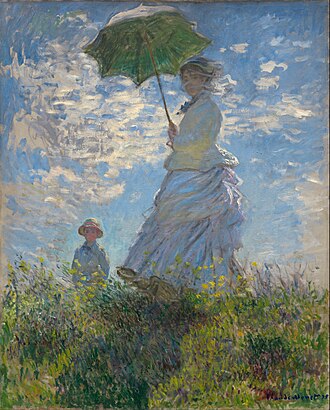 Woman with a Parasol - Claude Monet (1875)
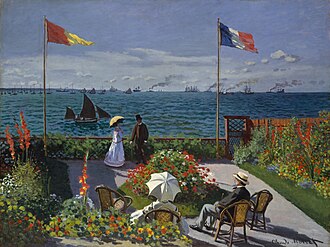 Garden at Sainte-Adresse - Claude Monet (1867)
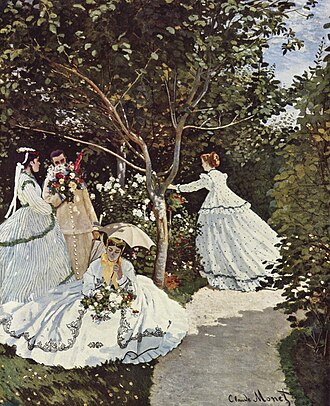 Donne in giardino - Claude Monet (1866)
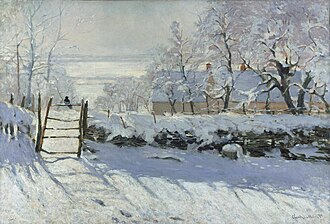 The Magpie - Claude Monet (1868)
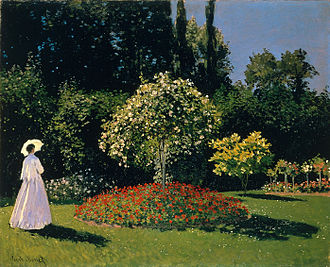 Woman in the Garden - Claude Monet (1867)
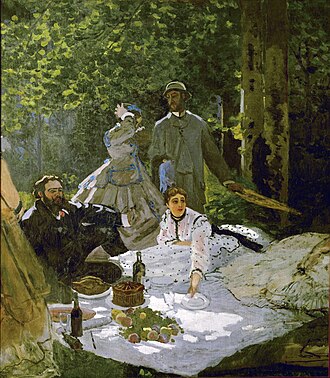 Luncheon on the Grass - Claude Monet (1866)
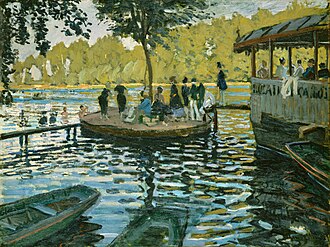 La Grenouillère - Claude Monet (1869)
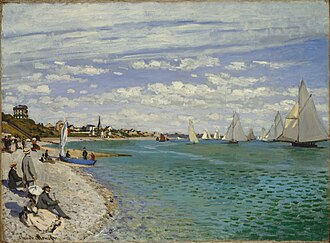 Regatta at Sainte-Adresse - Claude Monet (1867)
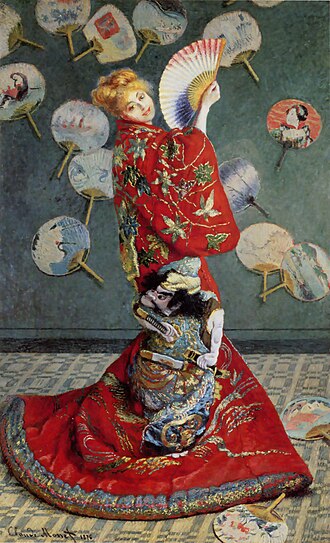 Madame Monet wearing a kimono - Claude Monet (1876)
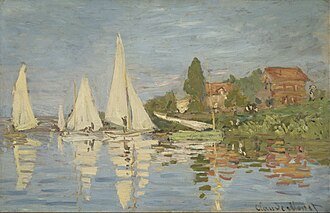 Régates à Argenteuil - Claude Monet (1872)
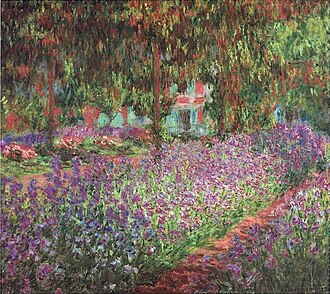 The artist's garden at Giverny - Claude Monet (1900)
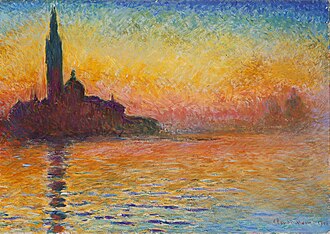 San Giorgio Maggiore at Dusk - Claude Monet (1908)
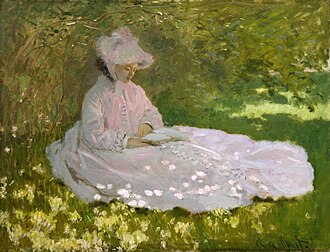 Springtime - Claude Monet (1872)
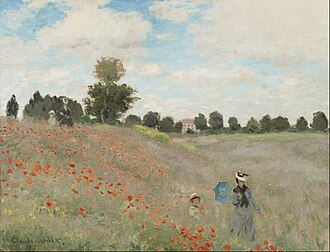 The Poppy Field near Argenteuil - Claude Monet (1873)
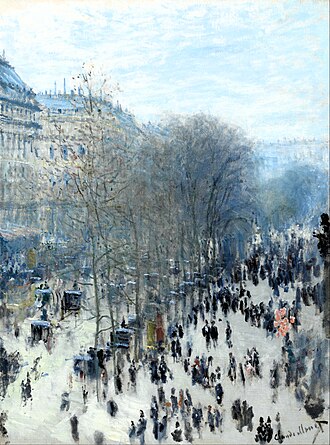 Boulevard des Capucines - Claude Monet (1873)
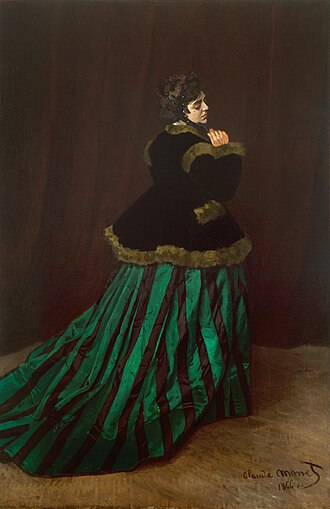 Camille - Claude Monet (1866)
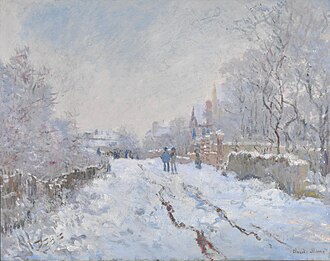 Snow at Argenteuil - Claude Monet (1875)
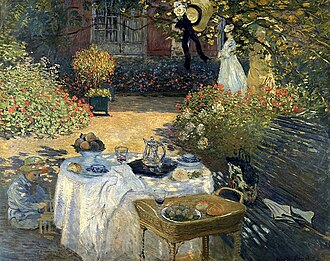 The Luncheon - Claude Monet (1873)
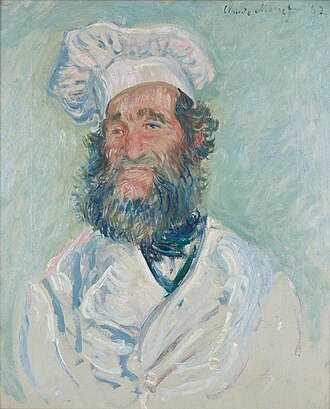 Portrait of Père Paul - Claude Monet (1882)
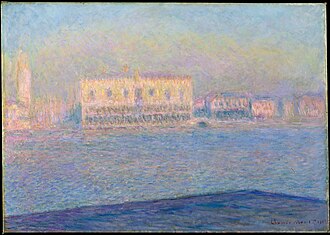 The Doge's Palace Seen from San Giorgio Maggiore - Claude Monet (1908)
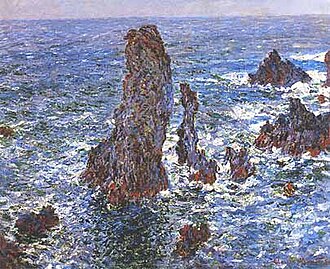 Belle-Île Rocks - Claude Monet (1886)
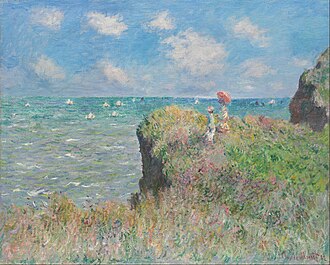 The Cliff Walk at Pourville - Claude Monet (1882)
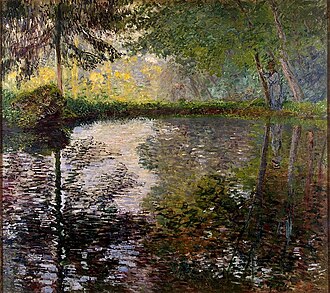 Pond at Montgeron - Claude Monet (1877)
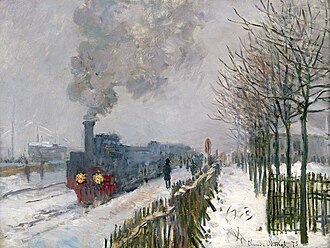 Train in the Snow - Claude Monet (1875)
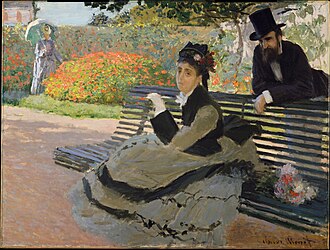 Camille Monet on a Garden Bench - Claude Monet (1873)
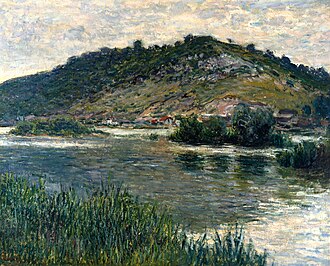 Landscape in Port-Villez - Claude Monet (1883)
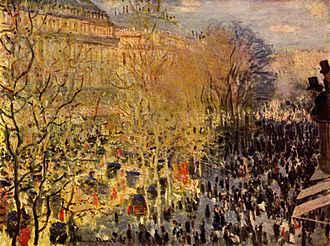 Le boulevard des Capucines - Claude Monet (1873)
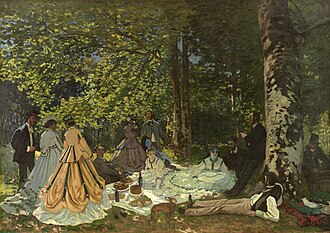 Luncheon on the Grass - Claude Monet (1866)
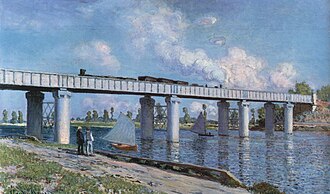 The Railway Bridge in Argenteuil - Claude Monet (1873)
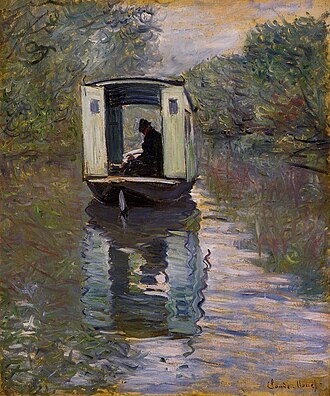 The Studio Boat - Claude Monet (1876)
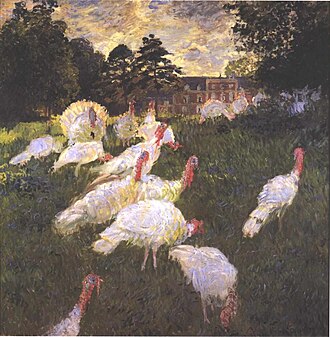 The Turkeys - Claude Monet (1877)
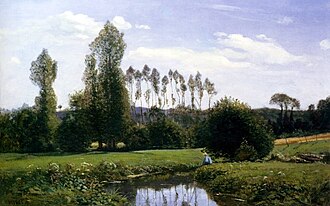 View At Rouelles, Le Havre - Claude Monet (1858)
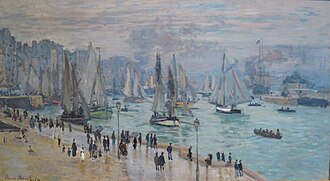 Fishing boats leaving the harbor, Le Havre - Claude Monet (1874)
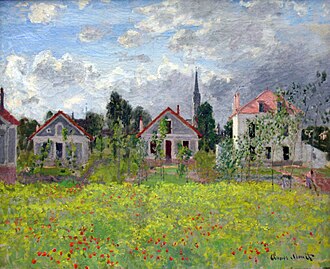 Houses at Argenteuil - Claude Monet (1873)
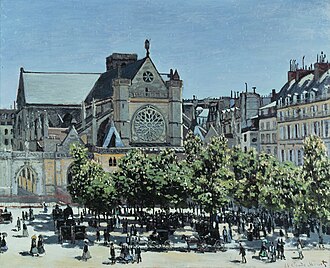 St. Germain l'Auxerrois - Claude Monet (1867)
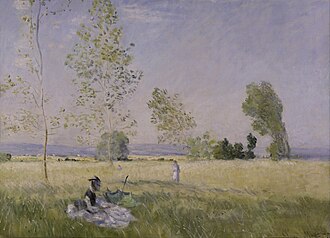 Summer - Claude Monet (1874)
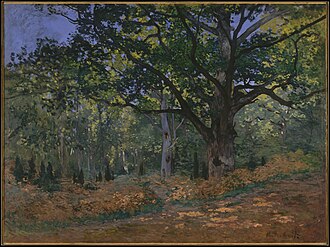 The Bodmer Oak, Fontainebleau Forest - Claude Monet (1865)
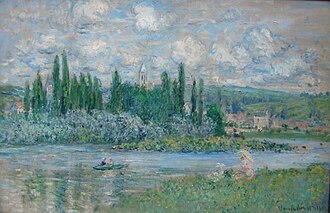 View of Vétheuil - Claude Monet (1880)
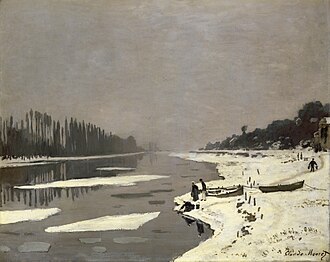 Glaçons à Bougival - Claude Monet (1860s)
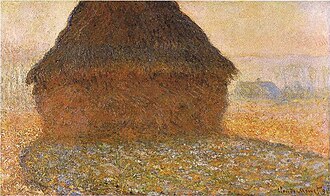 Grainstack in Sunlight - Claude Monet (1890s)
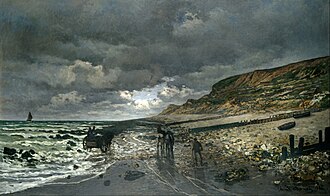 La Pointe de la Hève at Low Tide - Claude Monet (1865)
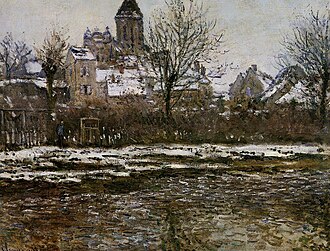 Snow Effect in Vétheuil - Claude Monet (1870s)
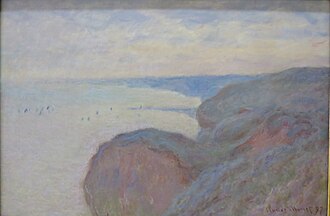 Steep Cliffs near Dieppe - Claude Monet (1897)
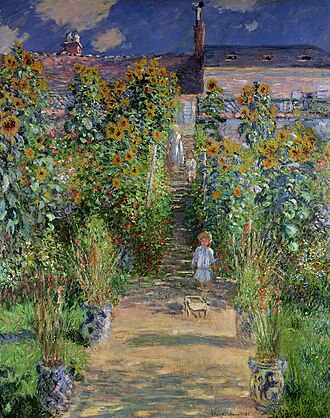 The Artist's Garden at Vétheuil - Claude Monet (1881)
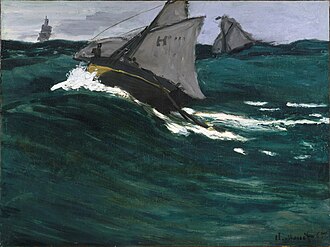 The Green Wave - Claude Monet (1867)
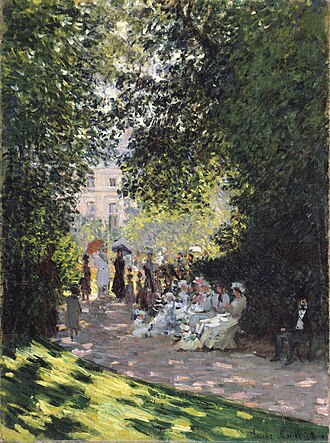 The Parc Monceau - Claude Monet (1878)