Berthe Morisot
1841-1895
Berthe Morisot was the only woman in the first Impressionist exhibition of 1874, and she showed in all but one of the group's shows. With light, feathery brushwork she painted the private world around her: her sister, her daughter, gardens and quiet rooms.
Origins
Berthe Morisot was born on 14 January 1841 in Bourges into a well-off bourgeois family. Her father, Edmé Tiburce Morisot, was the prefect of the department of Cher, and her mother, Marie-Joséphine-Cornélie Thomas, was the great-niece of the Rococo painter Jean-Honoré Fragonard. She had two older sisters, Yves and Edma, and a younger brother, Tiburce. The family moved to Paris in 1852. The sisters first took lessons so that each could make a drawing for their father's birthday. Their teacher Joseph Guichard brought Berthe and Edma to the Louvre, where from 1858 they learned by copying paintings, though they were forbidden to work there without a chaperone and were barred from formal training.
Life and turning points
At the Louvre Morisot befriended artists such as Manet and Monet, and in 1861 she met Camille Corot, under whose influence she began painting outdoors. She first showed at the Paris Salon in 1864 and was accepted six more times, but after a rejection in 1874 she never submitted again. That year she joined the first Impressionist exhibition at the photographer Nadar's studio, the only woman to exhibit, and she missed only the 1879 show, when her daughter Julie was born. In 1874 she married Eugène Manet, brother of her friend Édouard Manet. She died in Paris on 2 March 1895 of pneumonia caught while nursing Julie through a similar illness, leaving her daughter an orphan at sixteen.
Style and technique
Her strokes were so light that critics often used the French verb effleurer, to brush lightly against, to describe them. Around 1880 she began painting on unprimed canvas and her brushwork grew looser; later her short, quick strokes became long, sinuous lines that define form. She often left the edges of a picture unfinished so the canvas showed through, and she worked in oil, watercolour and pastel at the same time, as Degas did. Though her palette was limited, fellow Impressionists called her a virtuoso colourist, and she used white generously to create transparency. Her pictures are almost always small. She painted domestic scenes, children, women and flowers, the private world open to a woman of her class.
Stories and anecdotes
Morisot was never pleased with her work and destroyed nearly everything she made before 1869. Her sister Edma, who stopped painting after marrying in 1869, wrote that she often slipped away in thought to Berthe's studio to breathe the air they had shared. In 1874 a Le Figaro critic mocked the Impressionists as five or six lunatics, one of them a woman, yet by 1880 even he ranked her among the best. In 1890 she wrote that no man had ever treated a woman as an equal, and that she knew she was worth as much as they. The day before she died she wrote to Julie, telling her she loved her and begging her not to cry.
Legacy
In 1894 the critic Gustave Geffroy named Morisot one of the three great ladies of Impressionism, alongside Marie Bracquemond and Mary Cassatt. In 1877 a critic for Le Temps had called her the one real Impressionist in the group. She chose to exhibit under her own maiden name rather than a pseudonym or her married name. Édouard Manet painted her many times, in works such as Repose and Berthe Morisot with a Bouquet of Violets. Her daughter Julie became a painter and art collector. Scenes that may look gentle today, such as The Cradle of 1872, were seen in her time as deeply intimate. In 2019 the Musée d'Orsay honoured her with an exhibition.
Lo sapevi?
- In the winter of 1863 to 1864 she studied sculpture, but none of her sculptures is known to survive.
- Manet gave her an easel as a Christmas present.
- Her sister Yves was painted by Edgar Degas as Madame Théodore Gobillard.
- She is buried in the Cimetière de Passy in Paris.
Artisti collegati
Claude Monet · Édouard Manet · Pierre-Auguste Renoir · Edgar Degas · Alfred Sisley · Gustave Caillebotte · Camille Pissarro · Joaquín Sorolla
Dipinti di Berthe Morisot
 The Cradle - Berthe Morisot (1872)
 Summer's Day - Berthe Morisot (1879)
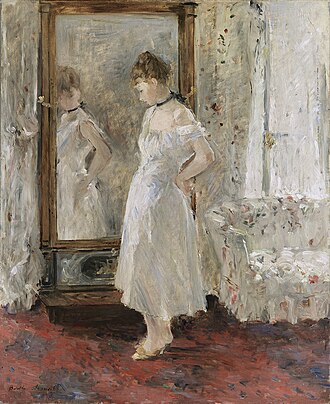 The Psyche mirror - Berthe Morisot (1876)
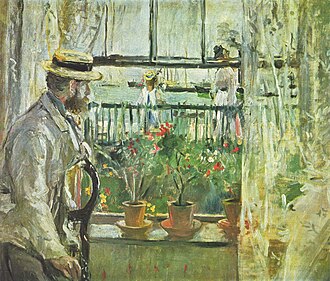 Eugène Manet on Isle of Wight - Berthe Morisot (1875)
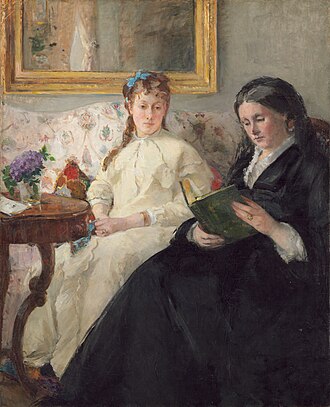 The Mother and Sister of the Artist - Berthe Morisot
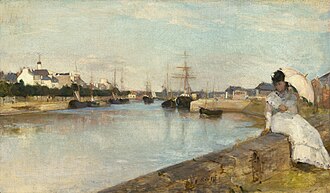 The Port at Lorient - Berthe Morisot (1869)
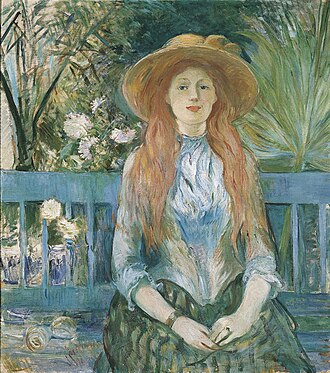 Young girl in a park - Berthe Morisot (1893)
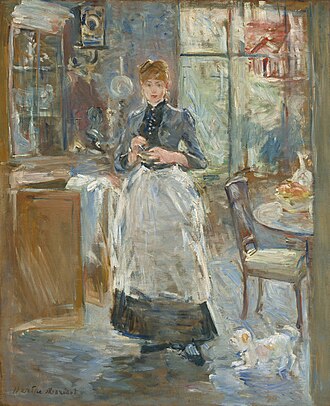 In the Dining Room - Berthe Morisot (1886)
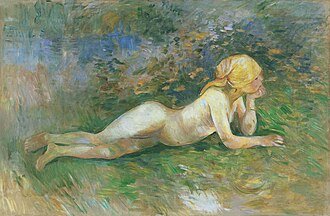 Reclining Nude Shepherdess - Berthe Morisot (1891)
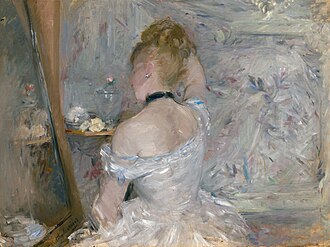 Woman at Her Toilette - Berthe Morisot
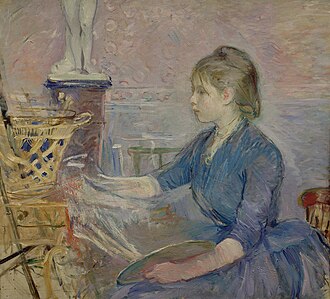 Paule Gobillard peignant - Berthe Morisot (1887)
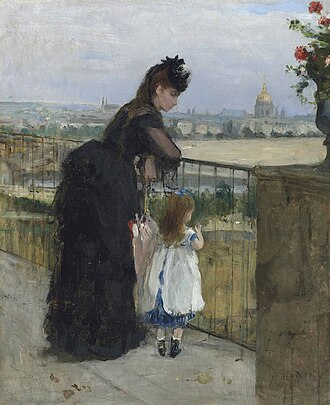 Woman and child on a balcony - Berthe Morisot (1872)
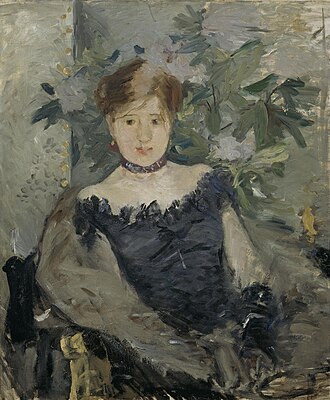 Le Corsage Noir - Berthe Morisot (1878)
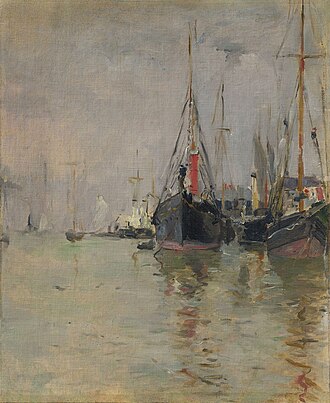 The Thames - Berthe Morisot (1875)