The Turkeys
Claude Monet · 1877
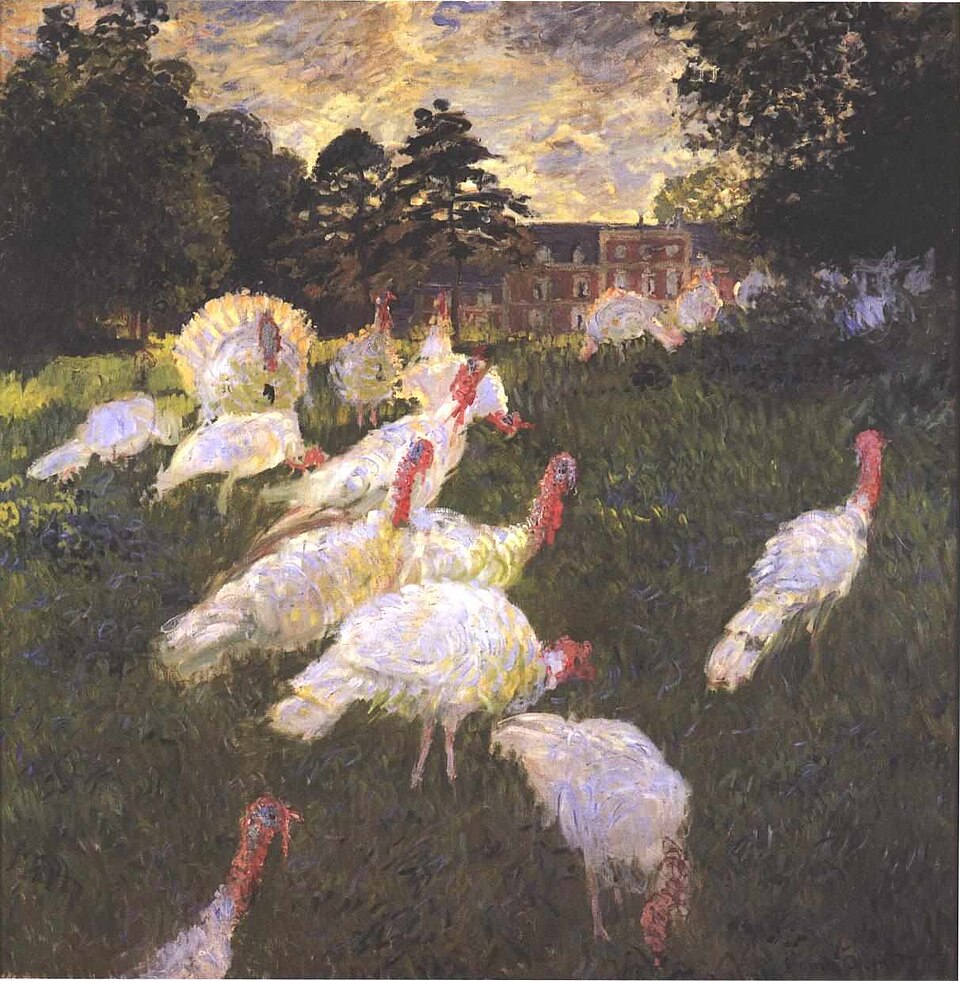
White turkeys wander a wide lawn below a chateau, one with its neck cut off by the edge of the canvas. Monet painted it as a grand decoration for a patron's salon, but the patron went bankrupt before it was ever hung.
The story behind the painting
The Turkeys is one of a monumental set of four large paintings Monet made in 1876 to 1877 during stays at Montgeron and Yerres, at the invitation of Ernest Hoschedé, a friend and great patron of the still little-known painter. They were commissioned specially to decorate the large round salon of the Château de Rottembourg, which belonged to Hoschedé. But Hoschedé went bankrupt and had to sell his property and the paintings the following year, without ever seeing them installed. It was also during this stay that Monet met Alice, who became his second wife; they married on 16 July 1892, after the deaths of Ernest and of Camille Doncieux, Monet's first wife.
What to look for
The scene is painted from the lower part of the park of the Château de Rottembourg. A vast lawn fills the canvas, enlivened by a few turkeys, and one of them has its neck cut off by the framing, a bold crop for a decorative picture. The composition is closed by the woods along the lawn and, at the far end, by the facade of the château. The canvas is almost square and large, about 174.5 by 172.5 cm, which suits its original purpose as part of a room-sized decoration. The birds in the foreground take the place of the people or monuments one might expect in front of a grand house.
Meaning and intent
With these four large decorative paintings, Monet for the first time realised an old idea of conceiving grand decorations. The source draws a line from this project to the Water Lilies, the major work he would finally create years later, not without difficulty, installed in a dedicated oval room at the Musée de l'Orangerie a few months after his death. Seen this way, The Turkeys is an early step toward painting not just a picture but an environment, a work meant to surround the people in a room, even if this first attempt never reached its intended wall.
Legacy
The painting is now kept in the Musée d'Orsay in Paris, and Wikidata also lists the Louvre's department of paintings, which held the national collections before Orsay. It is dated 1877, and it is number 416 in Daniel Wildenstein's catalogue raisonné of Monet's work. Its story is a reminder of how fragile patronage could be for the young Impressionists: a commission meant to crown a château salon was scattered by a bankruptcy within a year. Yet the meeting it brought about, with the Hoschedé family and with Alice, shaped the rest of Monet's life.
Lo sapevi?
- One of four large decorations for Ernest Hoschedé's Château de Rottembourg.
- Painted during Monet's 1876-1877 stay at Montgeron.
- Hoschedé went bankrupt before the paintings were installed.
- Now in the Musée d'Orsay; Wildenstein no. 416.
L'artista
Claude Monet (1840-1926)
landscape painting · Department of Paintings of the Louvre · Musée d'Orsay · Impressionism · tree · sky · garden · animal art · grass · herd
Altre opere di Claude Monet
 Impression, Sunrise - Claude Monet (1872)
 Water Lilies - Claude Monet (1906)
 Woman with a Parasol - Claude Monet (1875)
 Garden at Sainte-Adresse - Claude Monet (1867)
 Donne in giardino - Claude Monet (1866)
 The Magpie - Claude Monet (1868)
 Woman in the Garden - Claude Monet (1867)
 Luncheon on the Grass - Claude Monet (1866)
Dipinti di artisti collegati
 The Fighting Temeraire - J. M. W. Turner (1839)
 Rain, Steam and Speed - The Great Western Railway - J. M. W. Turner (1844)
 L'Origine du monde - Gustave Courbet (1866)
 A Burial at Ornans - Gustave Courbet (2020)
 Luncheon on the Grass - Édouard Manet (1863)
 Olympia - Édouard Manet (1863)
 Dance at Le Moulin de la Galette - Pierre-Auguste Renoir (1876)
 Luncheon of the Boating Party - Pierre-Auguste Renoir (1881)
 The Cradle - Berthe Morisot (1872)
 Summer's Day - Berthe Morisot (1879)
 L'Absinthe - Edgar Degas (1875)
 The Bellelli Family - Edgar Degas (1858)