The Studio Boat
Claude Monet · 1876
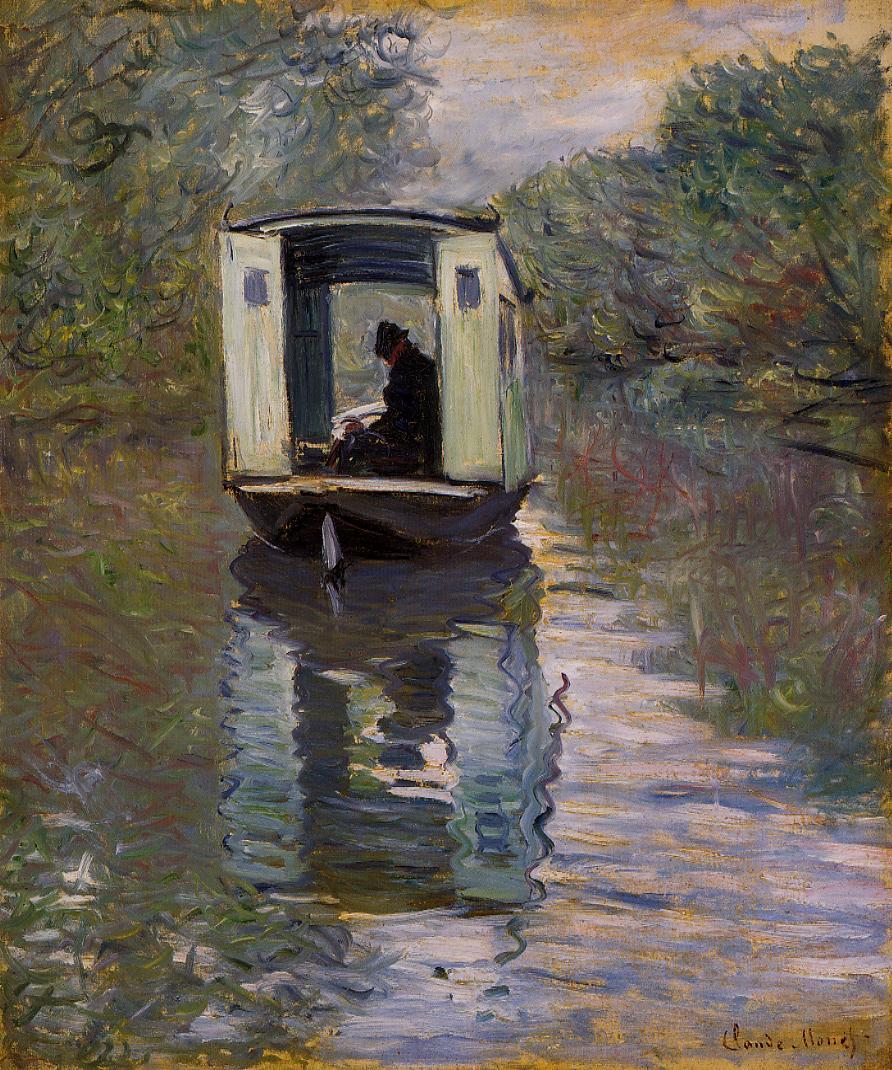
A small wooden cabin floats on the Seine, and inside it the painter is at work. In The Studio Boat Monet painted himself painting, a quiet sign that his art was moving beyond pure observation.
The story behind the painting
Monet bought his boat around 1873, soon after moving to Argenteuil. He described it as a cabin made of planks with just enough room to set up his easel. He most likely modelled it on the studio boat of his friend Charles François Daubigny. The floating studio let him paint views of the Seine he could not otherwise reach, beginning with a series of sailing boats at Petit-Gennevilliers. Monet lived near the Seine all his life and painted his studio boat several times, at Argenteuil and later at Giverny. In 1874 his friend Édouard Manet painted him working on the boat with his wife Camille.
What to look for
This 1876 canvas shows Monet at work in his studio boat on the Seine at Argenteuil, painted in oil en plein air. The scene is an idyllic stretch of river rather than the factories and town of Argenteuil, with the small boat and its cabin set in natural scenery. Compare it in your mind with Manet's painting of 1874, which gives a closer view of the boat and more signs of human activity around it, mixing the natural and the industrial sides of Argenteuil. Monet's version keeps its distance, and the mood leans toward isolation and contemplation. The canvas is upright, about 73 by 60 cm.
Meaning and intent
Monet had economic reasons: in the 1870s he used smaller canvases to sell to a growing middle class, and boating had become an affordable bourgeois pastime. The work is believed to be inspired by Daubigny's etching Gulping it Down (Luncheon on the Boat), made in 1861 and published in 1862. There were artistic reasons too. Showing himself at work means the scene was not painted wholly from observation, which scholars see as the beginning of Monet's move beyond Impressionism, stressing the creative role of the artist. The quiet river also marks a turn away from industrial and urban scenes, though Monet did not stop painting those altogether.
Legacy
Because of its shift away from industry, Monet's work of this period is compared with the earlier Barbizon School, which also favoured picturesque views of nature. The Studio Boat has also been linked to his later and successful Mornings on the Seine series of the 1890s, since both show his move beyond the Impressionist style. The painting is now in the collection of the Barnes Foundation in Philadelphia. It stands as a small, personal record of a working method: the painter who wanted to be on the water itself, and who, for once, let himself appear inside his own picture.
Lo sapevi?
- Painted in 1876 on the Seine at Argenteuil.
- Monet bought the studio boat around 1873.
- Thought to be inspired by an etching by Charles François Daubigny.
- Now at the Barnes Foundation, Philadelphia.
L'artista
Claude Monet (1840-1926)
Altre opere di Claude Monet
 Impression, Sunrise - Claude Monet (1872)
 Water Lilies - Claude Monet (1906)
 Woman with a Parasol - Claude Monet (1875)
 Garden at Sainte-Adresse - Claude Monet (1867)
 Donne in giardino - Claude Monet (1866)
 The Magpie - Claude Monet (1868)
 Woman in the Garden - Claude Monet (1867)
 Luncheon on the Grass - Claude Monet (1866)
Dipinti di artisti collegati
 The Fighting Temeraire - J. M. W. Turner (1839)
 Rain, Steam and Speed - The Great Western Railway - J. M. W. Turner (1844)
 L'Origine du monde - Gustave Courbet (1866)
 A Burial at Ornans - Gustave Courbet (2020)
 Luncheon on the Grass - Édouard Manet (1863)
 Olympia - Édouard Manet (1863)
 Dance at Le Moulin de la Galette - Pierre-Auguste Renoir (1876)
 Luncheon of the Boating Party - Pierre-Auguste Renoir (1881)
 The Cradle - Berthe Morisot (1872)
 Summer's Day - Berthe Morisot (1879)
 L'Absinthe - Edgar Degas (1875)
 The Bellelli Family - Edgar Degas (1858)