The Poppy Field near Argenteuil
Claude Monet · 1873
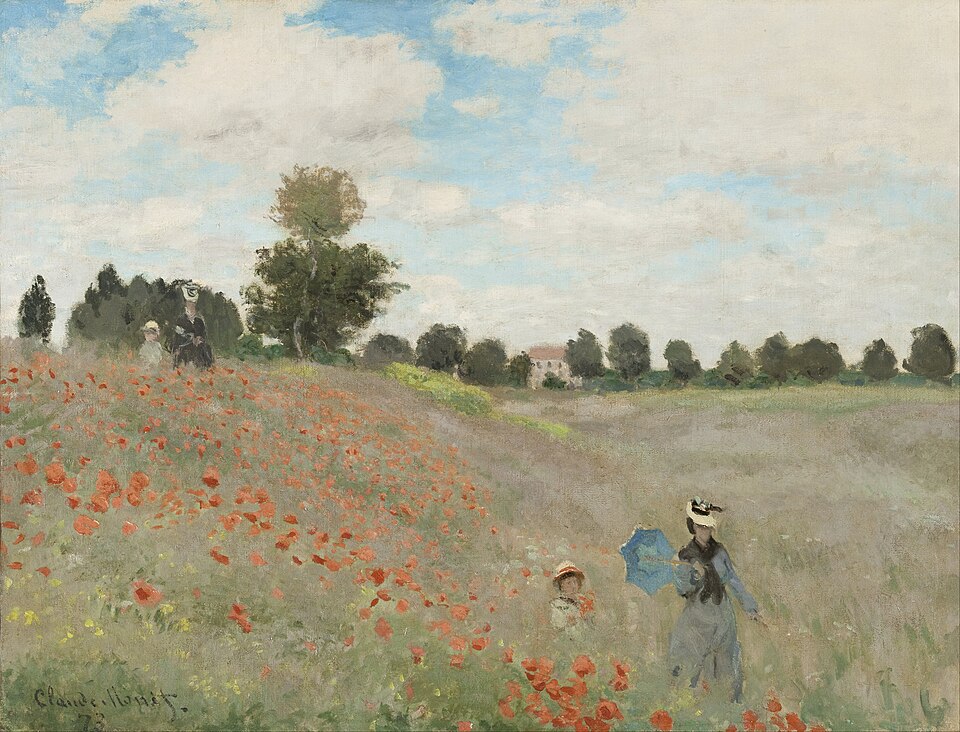
A woman with a parasol and a small child wander down through a hillside of red poppies on a summer day. Monet painted the field near his home in Argenteuil, and the pair in front is probably his wife Camille and their son Jean.
The story behind the painting
In 1873 Claude Monet, then 33, was living in Argenteuil, at that time a rural area, and he completed this painting there. It was probably painted in the countryside near the town. In French it is called Les Coquelicots, Coquelicots, or Coquelicots, la promenade, the poppies or the poppies walk. The next year, 1874, Monet showed it at the First Impressionist Exhibition, alongside the work of his fellow painters. It brings together several marks of Impressionist work: it was painted outdoors, in light shades, with sketched details.
What to look for
A large field fills the canvas, with poppies dominating the left side. In the foreground walk a woman with a parasol and a straw hat and a child. Higher up in the middle ground is a second, similar pair. At the far end of the field a row of trees stands with a house visible among them. The two mother and child pairs mark a diagonal that structures the whole picture. The left half is dominated by red and the right half by blue-green. The canvas is a modest 50 by 65 cm.
Meaning and intent
The woman in front is probably Camille Doncieux, Monet's wife, and the child is probably their son Jean, born in 1867, who would be six here. That makes this field a family walk as much as a landscape. The picture is less about the people than about a moment outdoors: the colours of a summer field, light on a parasol, the feeling of moving through tall grass. Painting it in the open air, with quick sketched details instead of careful finish, was exactly what the Impressionists set out to do.
Legacy
The art dealer Paul Durand-Ruel acquired the painting. It then belonged to the painter Ernest Duez, to the singer and collector Jean-Baptiste Faure, and to the painter and collector Étienne Moreau-Nélaton, who gave it to the French state in 1906. It was held successively by the Louvre, the Musée des Arts Décoratifs and the Jeu de Paume, and since 1986 it has been shown at the Musée d'Orsay in Paris, where visitors can still step into that red field.
Lo sapevi?
- Painted in Argenteuil in 1873.
- Shown at the First Impressionist Exhibition in 1874.
- Given to the French state by Étienne Moreau-Nélaton in 1906.
- At the Musée d'Orsay since 1986.
L'artista
Claude Monet (1840-1926)
woman · landscape painting · Musée d'Orsay · Impressionism · dress · child · rural area · parasol · straw hat · Papaver rhoeas · meadow
Altre opere di Claude Monet
 Impression, Sunrise - Claude Monet (1872)
 Water Lilies - Claude Monet (1906)
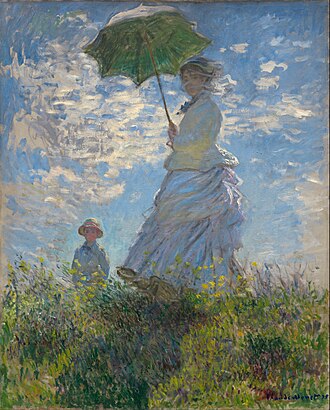 Woman with a Parasol - Claude Monet (1875)
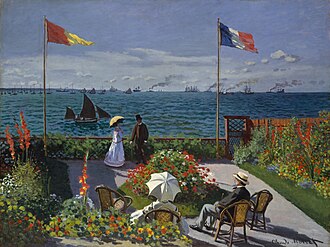 Garden at Sainte-Adresse - Claude Monet (1867)
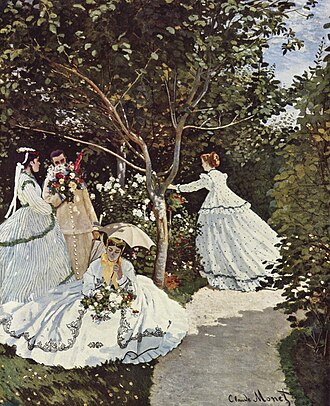 Donne in giardino - Claude Monet (1866)
 The Magpie - Claude Monet (1868)
 Woman in the Garden - Claude Monet (1867)
 Luncheon on the Grass - Claude Monet (1866)
Dipinti di artisti collegati
 The Fighting Temeraire - J. M. W. Turner (1839)
 Rain, Steam and Speed - The Great Western Railway - J. M. W. Turner (1844)
 L'Origine du monde - Gustave Courbet (1866)
 A Burial at Ornans - Gustave Courbet (2020)
 Luncheon on the Grass - Édouard Manet (1863)
 Olympia - Édouard Manet (1863)
 Dance at Le Moulin de la Galette - Pierre-Auguste Renoir (1876)
 Luncheon of the Boating Party - Pierre-Auguste Renoir (1881)
 The Cradle - Berthe Morisot (1872)
 Summer's Day - Berthe Morisot (1879)
 L'Absinthe - Edgar Degas (1875)
 The Bellelli Family - Edgar Degas (1858)