Houses at Argenteuil
Claude Monet · 1873
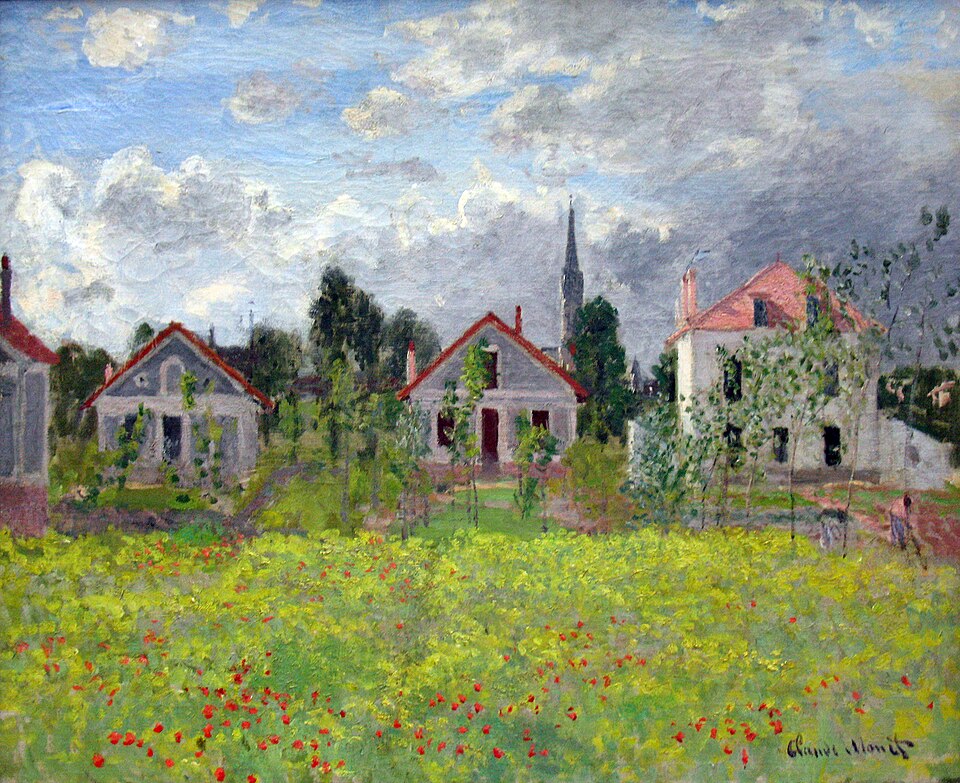
A meadow full of yellow flowers and red poppies, a row of plain new houses, and a sky blown about by the wind. Critics called the subject almost banal, and said Monet made it noble by the way he painted it.
The story behind the painting
Monet had fled to London with his family in 1870 during the Franco-Prussian War, then spent months in the Netherlands before returning to Paris in November 1871. At the end of that year he settled in Argenteuil, a suburb of Paris, renting a house near the station. Life there was cheaper than in the capital, and the banks of the Seine gave him plenty of subjects. Yet the town itself rarely became the theme of his pictures. In 1873 he painted these houses, which had been built only shortly before on the western edge of Argenteuil, on a canvas 54 by 73 cm.
What to look for
The picture is built in three bands. In the bottom third a light green meadow is painted in small dabs, lit by yellow flowers and a few red poppies, with the signature Claude Monet tucked in at lower right. In the middle, the houses are drawn with clear lines: two small, almost identical houses with grey-blue fronts and scarlet tiled roofs, and on the right a larger white house one storey taller. Between them, in the distance, rises the church tower of Saint-Denys. Look closely at the right edge: two people, sketched in a few strokes, are bent over their garden work.
Meaning and intent
The young saplings in front hint that the houses were new, while old trees near the church point to the historic centre. The new buildings reflect the fast growth of the suburb after it was linked to the railway in 1851. The modest houses may have been built for Parisians who wanted to spend their free time in the country, the same longing that had brought Monet there. Above them, the sky is painted with bold, rough strokes, shading from bright blue on the left to grey on the right, its windswept clouds giving drama to an otherwise calm landscape.
Legacy
The art dealer Paul Durand-Ruel bought the painting from Monet before 1880 and kept it for about twenty years. He lent it to an exhibition in Dresden in 1897, where the Berlin museum director Hugo von Tschudi saw it, and on 19 December 1898 Tschudi acquired it for the Nationalgalerie in Berlin, paid for by the donor Henriette Mankiewicz. Tschudi wrote that Monet turned a seemingly dull motif into art through lively handling, fine colour and the magic of the air. In 2000 the historian Paul Hayes Tucker compared it with Dutch Baroque views by Ruisdael and Vermeer.
Lo sapevi?
- Painted in 1873, oil on canvas, 54 x 73 cm.
- Shows new houses on the western edge of Argenteuil.
- Acquired for the Berlin Nationalgalerie on 19 December 1898.
- Now in the Alte Nationalgalerie, Berlin.
L'artista
Claude Monet (1840-1926)
landscape painting · Alte Nationalgalerie · Argenteuil
Altre opere di Claude Monet
 Impression, Sunrise - Claude Monet (1872)
 Water Lilies - Claude Monet (1906)
 Woman with a Parasol - Claude Monet (1875)
 Garden at Sainte-Adresse - Claude Monet (1867)
 Donne in giardino - Claude Monet (1866)
 The Magpie - Claude Monet (1868)
 Woman in the Garden - Claude Monet (1867)
 Luncheon on the Grass - Claude Monet (1866)
Dipinti di artisti collegati
 The Fighting Temeraire - J. M. W. Turner (1839)
 Rain, Steam and Speed - The Great Western Railway - J. M. W. Turner (1844)
 L'Origine du monde - Gustave Courbet (1866)
 A Burial at Ornans - Gustave Courbet (2020)
 Luncheon on the Grass - Édouard Manet (1863)
 Olympia - Édouard Manet (1863)
 Dance at Le Moulin de la Galette - Pierre-Auguste Renoir (1876)
 Luncheon of the Boating Party - Pierre-Auguste Renoir (1881)
 The Cradle - Berthe Morisot (1872)
 Summer's Day - Berthe Morisot (1879)
 L'Absinthe - Edgar Degas (1875)
 The Bellelli Family - Edgar Degas (1858)