La Pointe de la Hève at Low Tide
Claude Monet · 1865
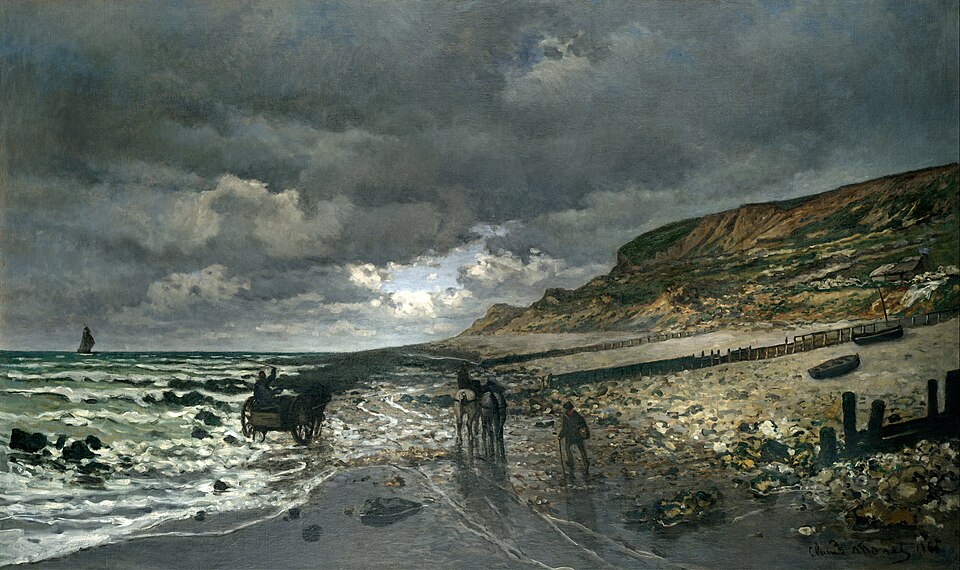
Horses and a figure on a Normandy shore at low tide, a long slanting line, browns and greys: this was the painting Monet sent to his first Salon in 1865. Critics noticed him at once.
The story behind the painting
In 1864 Monet spent a long time at Honfleur and met the Dutch painter Jongkind, who became a friend and whose sense of composition strongly influenced him, as Monet later said. He was 23, weary of the teaching of Gleyre, and more drawn to capturing light on the motif than to studio subjects. He was far from living from his art, and his family, who supported him, were losing patience. To win back his father's favour he spent some days in Le Havre and sketched nearby sites, including the Pointe de la Hève. A meeting between Bazille and Monet's father reassured the father about their plan to share a Paris studio and prepare work for the Salon of 1865.
What to look for
In their studio from December 1864, Monet took up a study now known as Horses at the Pointe de la Hève and turned it into this large canvas, 90.2 by 150.5 cm, sized for what the Salon jury expected. He kept the first composition but rearranged the horses and the figure, added beached boats on the right and a ship on the horizon, and removed a cart. Look for a strong diagonal crossing the picture and a pronounced perspective, close to Jongkind's style, and a sky that recalls Boudin, who had guided Monet's very first steps. Having studied the colours on site, he paid particular care to the browns and greys.
Meaning and intent
Monet deliberately kept a summary, sketch-like handling, which gives the work a kind of spontaneity, even though he worked the composition and finish with great care so that the jury would accept it. The result shows a boldness that goes beyond the styles of his mentors. This is a young painter caught between two worlds: on one side the Salon's expectations of size and finish, on the other his own wish to record how light falls on a real place. Here, at the tip of the Hève, both meet.
Legacy
It was Monet's first time at the Salon, and the 1865 exhibition brought him warm reviews. Zacharie Astruc saw the influence of Courbet but also great originality, noting a will toward both simplification and richness. Paul Mantz saw a very promising artist, gifted at catching the viewer's eye with harmonious colourings. The painting later belonged to private collectors and was acquired in 1968 by the Kimbell Art Museum in Fort Worth, Texas. It was shown in the exhibition Impressionism: the origins 1859 to 1869, in Paris and New York in 1994 and 1995.
Lo sapevi?
- Painted in 1865 from a study made the year before.
- Monet's first painting accepted at the Salon, in 1865.
- Shaped by the influence of Jongkind and Boudin.
- In the Kimbell Art Museum, Fort Worth, since 1968.
L'artista
Claude Monet (1840-1926)
marine art · Kimbell Art Museum
Altre opere di Claude Monet
 Impression, Sunrise - Claude Monet (1872)
 Water Lilies - Claude Monet (1906)
 Woman with a Parasol - Claude Monet (1875)
 Garden at Sainte-Adresse - Claude Monet (1867)
 Donne in giardino - Claude Monet (1866)
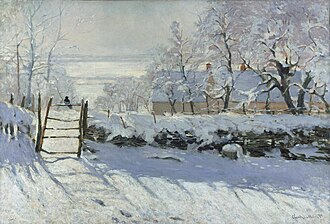 The Magpie - Claude Monet (1868)
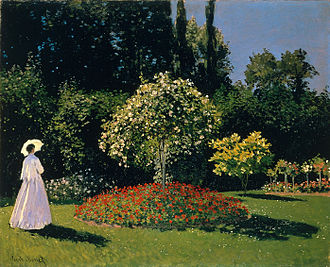 Woman in the Garden - Claude Monet (1867)
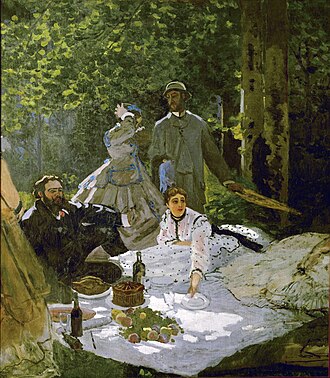 Luncheon on the Grass - Claude Monet (1866)
Dipinti di artisti collegati
 The Fighting Temeraire - J. M. W. Turner (1839)
 Rain, Steam and Speed - The Great Western Railway - J. M. W. Turner (1844)
 L'Origine du monde - Gustave Courbet (1866)
 A Burial at Ornans - Gustave Courbet (2020)
 Luncheon on the Grass - Édouard Manet (1863)
 Olympia - Édouard Manet (1863)
 Dance at Le Moulin de la Galette - Pierre-Auguste Renoir (1876)
 Luncheon of the Boating Party - Pierre-Auguste Renoir (1881)
 The Cradle - Berthe Morisot (1872)
 Summer's Day - Berthe Morisot (1879)
 L'Absinthe - Edgar Degas (1875)
 The Bellelli Family - Edgar Degas (1858)