La Grenouillère
Claude Monet · 1869
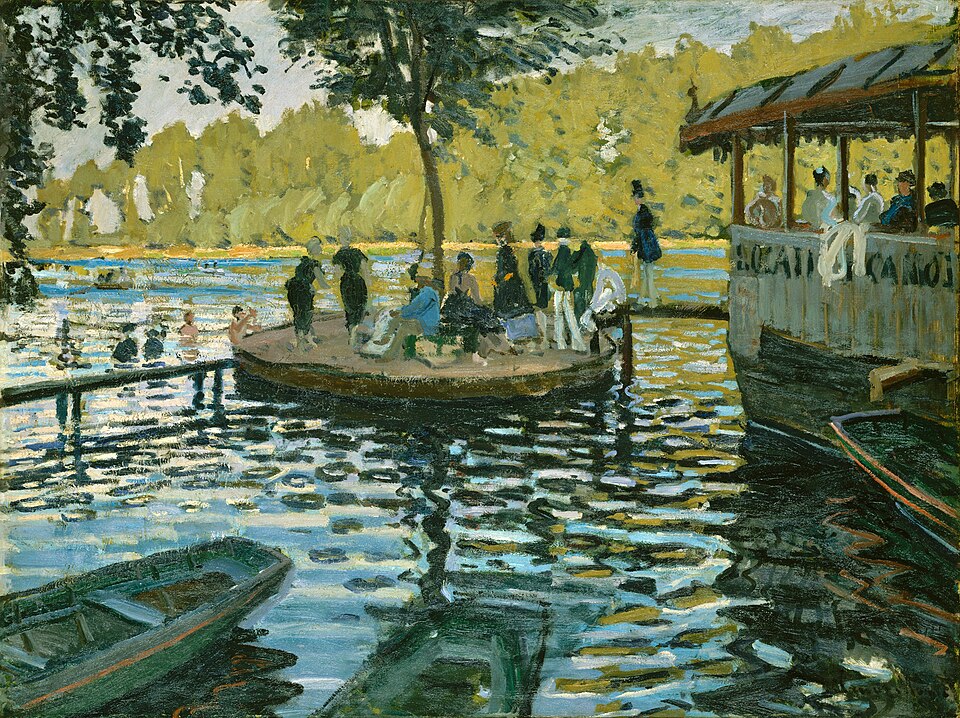
In 1869 two poor young painters set up their easels side by side on the Seine. What Monet called a few bad sketches became one of the founding images of Impressionism.
The story behind the painting
La Grenouillère was a popular middle-class resort on the Seine near Bougival, at Croissy-sur-Seine, with baths, boat hire and a floating café. It was easy to reach by train from Paris, and had just been visited by Emperor Napoleon III with the Empress Eugénie and their son. Monet and Renoir, both desperately poor and close friends at the time, saw in it an ideal subject for the images of leisure they hoped to sell. On 25 September 1869 Monet wrote to Frédéric Bazille that he dreamed of a painting of the baths of La Grenouillère, for which he had made only some bad sketches. This canvas and one in the National Gallery in London are probably those sketches.
What to look for
The scene centres on a small round island, nicknamed Flowerpot Island or the Camembert, with a tree rising from it and figures gathered around. A gangplank leads across to the floating restaurant. Look at the water: Monet builds it from rippling, repeated strokes, and the same rhythm runs through the foliage, the moored boats and the people. These broad, constructive brushstrokes are clearly those of a sketch, quite unlike the delicate, calibrated surfaces Monet usually sought for exhibition pictures then. Yet they remain strongly descriptive: each mark is plainly paint, and still you can read light glancing on the river. The canvas measures 74.6 by 99.7 cm.
Meaning and intent
For Monet, this was a study toward a dream: a larger finished tableau. A bigger painting, now lost and once in the Arnhold collection in Berlin, may have been that work. What survives here is the process itself, a painter weaving a fabric of brushstrokes from repeated elements. Working beside him, Renoir painted an almost identical composition, today in the Nationalmuseum in Stockholm; the two friends were undoubtedly working side by side. The resort also had a darker reputation. In his 1881 story La femme de Paul, Guy de Maupassant set the scene here and portrayed the crowd as a shady mixture of Parisian society. Monet's picture shows only the shimmer of summer leisure.
Legacy
La Grenouillère is a key work of Impressionism, the movement to which Wikidata assigns it, and the pairing with Renoir's version makes it a rare record of two artists looking at the same view at the same moment. Its companion sketch, Bathers at La Grenouillère, hangs in the National Gallery, London. This version was bequeathed by Louisine Havemeyer in 1929 to the Metropolitan Museum of Art in New York, where it remains. Standing before it, you can still sense the excitement of a painter discovering that a quick, rough sketch might hold more life than a polished studio picture.
Lo sapevi?
- Painted in 1869; 74.6 × 99.7 cm (Wikipedia, Wikidata).
- Monet described his sketches in a letter to Bazille on 25 September 1869 (Wikipedia).
- Renoir painted a nearly identical view, now in Stockholm (Wikipedia).
- Bequeathed by Louisine Havemeyer to the Met in 1929 (Wikipedia).
L'artista
Claude Monet (1840-1926)
woman · genre art · Impressionism · tree · Metropolitan Museum of Art · boat · bathing
Altre opere di Claude Monet
 Impression, Sunrise - Claude Monet (1872)
 Water Lilies - Claude Monet (1906)
 Woman with a Parasol - Claude Monet (1875)
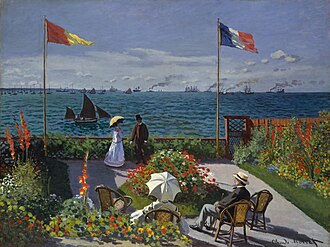 Garden at Sainte-Adresse - Claude Monet (1867)
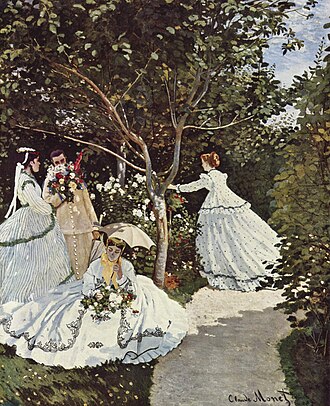 Donne in giardino - Claude Monet (1866)
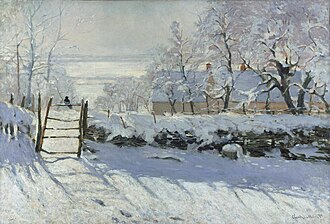 The Magpie - Claude Monet (1868)
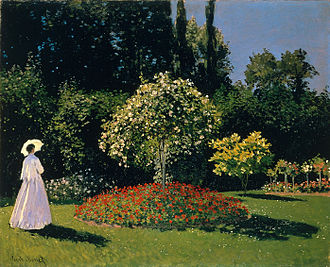 Woman in the Garden - Claude Monet (1867)
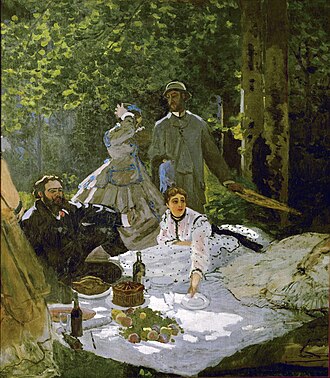 Luncheon on the Grass - Claude Monet (1866)
Dipinti di artisti collegati
 Luncheon on the Grass - Édouard Manet (1863)
 Olympia - Édouard Manet (1863)
 Dance at Le Moulin de la Galette - Pierre-Auguste Renoir (1876)
 Luncheon of the Boating Party - Pierre-Auguste Renoir (1881)
 The Starry Night - Vincent van Gogh (1889)
.jpg) Café Terrace at Night - Vincent van Gogh (1888)
Café Terrace at Night - Vincent van Gogh (1888)